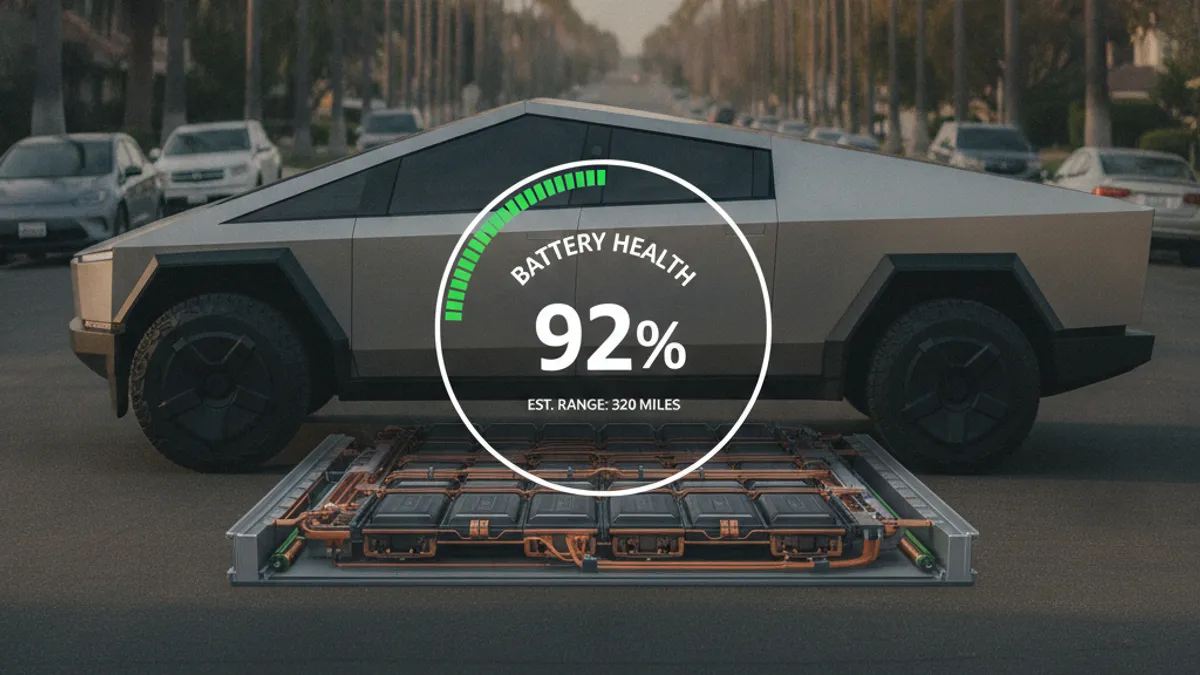
Tesla packs in Phoenix heat still last for years of Valley driving. They just age a bit faster than packs in mild air. Packs in climates above 27C more than 35% of days wear faster. Geotab put that extra loss at about 0.4% per year versus mild climates. Phoenix belongs in that hot group on those 100F days. NWS Phoenix normals show about 111 days a year at or above 100F. About 21 of those days hit 110F or more. That finding is about the high-voltage pack under the floor. If the car won’t wake at all, start with the 12-volt.
Daily range loss is not pack death
Valley drivers mix two clocks on this question. One clock is today’s miles in July heat. The other is capacity after years of desert summers. AAA’s 2026 study found about a 10% efficiency drop at 95F versus 75F. Range in that test fell about 8.5%. Recurrent used 345,622 trips from 300 Phoenix-area EVs. It reported 20 to 30% range loss above about 95F. Loss was about 31% at 100F in that set. NREL says cabin cooling is one of the biggest energy draws. Don’t treat those figures as Tesla’s own numbers. We couldn’t confirm a Tesla range-loss figure from tesla.com. Chemical wear in the pack doesn’t rewind with cooler nights.
Nights in the Valley stay hot too
July highs average near 107F, and August sits near 105F. Overnight summer lows hang in the mid-80s. A pack in a Mesa driveway still sits hot at midnight. The record high is 122F, set June 26, 1990. Official monsoon season runs June 15 to September 30. Cabin Overheat Protection and Sentry Mode still draw power while parked. That parked draw hits the 12-volt battery first. A week at Sky Harbor is the extreme parked case. Level 2 charging is confirmed in the Terminal 3 garage. It’s also in the Terminal 4 garage and at the 24th St. station. Cars that sit unplugged for a week often won’t wake. The traction pack can still be full when you return.
Two batteries, two clocks
The floor pack stores the energy that moves the car. The small 12-volt runs locks, the screen, and the wake contactor. Kill the 12-volt and the car is stuck, even with range showing. That’s a different failure from long-term pack wear. Start with Which Teslas still use a 12-volt battery. Battery Council International, via Battery University, studied starter-battery life in heat. Those units lasted about 47 months in hot climates versus 59 in cool ones. A battery good for five years elsewhere can fail in two or three here. AAA calls heat the number-one cause of battery failure.
What actually ages the high-voltage pack
Phoenix heat is the local multiplier, and charging habits still move the number. Tesla’s daily-charge guidance, for most chemistries, is to stay off 100% except for trips. Sitting near empty for weeks is the other hard case. A Supercharger on a road trip is normal use. Making DC fast charging your only plug, day after day, adds extra heat cycles. Home Level 2 is common where the housing is new. Gilbert has about 4.1% of homes built before 1980. Maricopa, the city in Pinal County, is even newer at about 1.9%. Sun City, a census-designated place, is 88.9% pre-1980. More of those cars live on street parking and public plugs. APS markets R-EV as EV Overnight Charging, 11pm to 5am weekdays. SRP’s Electric Vehicle Price Plan is closed to new enrollment. That closure followed a February 2025 board decision. Existing SRP customers may stay through the November 2029 billing cycle. APS and SRP split many Valley streets, so confirm your block. How Tesla home charging bills work on APS and SRP walks through those plans. How Phoenix heat changes EV battery care covers the daily habits.
Grades steal range, not pack years
Phoenix sits about 1,135 ft at Sky Harbor. Northbound I-17 rises through Anthem at about 1,860 ft. New River sits about 2,140 ft, and Black Canyon City about 2,000 ft. ADOT posts a 6% maximum grade on the northern I-17. The Beeline toward Payson posts 7% into Slate Creek Canyon. Forum drivers on the I-17 climb reported about 40% more energy uphill. That extra energy is the hill, not Geotab’s yearly wear rate. A low trip estimate isn’t proof the pack is failing. Read How long a Tesla charge lasts through a Phoenix heat day.
What the miles in settings actually mean
Tesla doesn’t show a phone-style battery-health percent. Open the car’s range settings and read the current maximum. Compare it to the original rated range for that model year. A modest gap after a couple of summers is ordinary aging. A sudden plunge is a service visit, not July weather. If you’re buying used, ask for that max-range screen first. Tesla battery warranty coverage follows the car, not the latest title. Confirm the current terms with Tesla or a service center. Read What Tesla’s battery warranty covers, and what heat doesn’t. If a pack needs replacement after years of desert use, that’s shop work. What replacing a Tesla traction battery means after desert heat explains that path.
Empty on a Valley shoulder is a charge call
Arizona DPS Roadside Motorist Assistance will change a tire. It’ll jump a 12-volt, or bring gasoline or diesel. Published materials don’t mention charging an empty EV. ADOT’s Incident Response Unit covers Phoenix-area freeways from 5am to 8pm weekdays. That unit also doesn’t advertise an on-site EV charge. An empty traction pack needs a mobile Level 2 source. Charge Pro PHX is a referral line for stranded drivers. We match stranded drivers with independent local operators. The operator quotes you before work starts and bills you directly. The truck brings a 240V Level 2 source to the car. Typical charging adds 10 to 20 miles in 15 to 30 minutes of charging. That’s plug time, and never an arrival promise. If you’re on the traveled lanes, ARS 28-871 says move off when you can. For on-site Tesla help, start with Tesla roadside rescue.
Frequently asked questions
Do Tesla batteries last less in Phoenix heat?
Yes, a little extra wear on the traction pack. Geotab’s extra 0.4% a year in hot climates is the measured gap. Phoenix’s 111 days at or above 100F puts you in that group.
Does daily Supercharging ruin a Tesla pack?
Occasional DC fast charging is normal Tesla ownership. Using it as your only method, day after day, adds extra heat cycling.
Is a used high-mileage Tesla a bad bet here?
Mileage alone is a weak signal in this heat. Compare current max range to the original rating. Confirm remaining battery warranty with Tesla before you buy.
If your Tesla won’t wake on a Valley road, call (602) 932-0920. You’ll be matched with a local independent operator.