A Tesla that hits 0% on I-10 in Phoenix at 1 a.m. is a hours problem first. You want to know if Tesla roadside assistance is even taking Arizona calls overnight, not how many minutes a truck might need once someone is assigned. Tesla’s published roadside materials, as we could verify them, do not list Arizona hours, so a 24/7 claim for this state could not be confirmed.
What the 24/7 search actually asks
When someone types is tesla roadside assistance 24 7, they are not asking for an average wait. They want to know if the factory line is open at 2 a.m. on a Phoenix freeway, a Mesa US-60 shoulder, or a Scottsdale Loop 101 ramp.
Hours and wait time are different problems. Hours means someone is taking the request overnight. Wait time means, after that request is live, how long until a contractor shows. We already published the wait-time version at how long Tesla roadside takes in the Valley. This page stays on hours.
Phoenix, Mesa, and Scottsdale are not one night shift. Phoenix is a city of 1,642,323 people across about 518.3 square miles, with I-10, I-17, and Loop 202 South Mountain carrying the late traffic. Mesa is 511,764 people on the East Valley grid, where US-60 is the main east-west spine. Scottsdale is 243,821 people, denser along Loop 101 and thinner toward the northeast desert edge. A request from a downtown Phoenix garage is not the same as a request from a dark US-60 shoulder in Mesa, even if Tesla’s app looks identical.
The search is also not asking whether Charge Pro PHX runs overnight. This brand is a referral service. It matches you with an independent local operator. It does not staff a Tesla factory line, and it does not publish business hours. Do not read this page as a promise that anyone we match will arrive at a set time.
What people often bundle into “is it 24/7” is three separate facts. First: can you open a request at night in the Tesla app. Second: will Tesla pay for that request. Third: will the person who shows charge the pack on site, or only tow.
Only the first is a hours question. The second is coverage. Tesla says assistance for a depleted battery is available, but it is not a financially covered service, regardless of warranty status. The third is dispatch type. We cover that below.
If the car is already in a travel lane, skip the policy fight. Call 911. Arizona law expects you off the traveled part of a highway when it is practical to get there.
What Tesla publishes about roadside hours
Tesla tells owners to request roadside assistance in the Tesla app. You select Roadside, choose the issue, and confirm the details. That path is the published request method. It is not a published hours calendar for Arizona.
We looked for Arizona-specific roadside hours on Tesla’s roadside materials and logged what we could verify. No Arizona overnight staffing figure turned up. No Valley dispatcher window turned up. If Tesla advertises 24/7 somewhere else, that claim is not in our verified ledger, so we will not repeat it as fact. Confirm hours and eligibility in the Tesla app for your VIN, and on Tesla’s current roadside assistance page, before you assume a night crew is sitting in Phoenix, Mesa, or Scottsdale.
The app still matters after people think warranty has ended. Opening Roadside is a dispatch request. It is not a price quote, and it is not proof that Tesla will pay. For a depleted pack, Tesla typically arranges transport to the nearest Supercharger or service center. That transport can be available and still be a bill. Check the coverage screen in the app. Do not guess from a forum post or a model year.
If the app will not load, the next published path is still Tesla’s own support, not a number we invent. We mapped Tesla roadside by app or phone in Phoenix so you can see which channel Tesla actually documents. Do not call Charge Pro PHX and expect us to be Tesla. We are not Tesla roadside.
Public help on Valley freeways is also not a substitute hours chart. The Arizona Department of Transportation Incident Response Unit covers Phoenix-area freeways from 5 a.m. to 8 p.m. on weekdays. That is a 14-member unit. Its published work is crashes, debris, tires, and stranded motorists. It does not mention EV charging. Arizona DPS Roadside Motorist Assistance is statewide and names gasoline and diesel, jump-starts, water, and tows. It says nothing about EV charging, and its hours and corridors are not published. Neither agency fills a Tesla overnight gap.
The U.S. Department of Energy’s electric vehicle pages explain charging levels. They do not staff a desert shoulder at night. Your working tools are the Tesla app, Tesla’s roadside page, 911 if you are in a lane, and a local operator if Tesla’s path is a tow you do not want.
Why Arizona heat and freeway miles change the wait
This section is not a wait-time table. We will not invent minutes, averages, or overnight staffing. Heat and miles change the kind of night you are having. That is why a 24/7 search in Arizona is not the same search in a mild coastal city.
Phoenix averages about 111 days a year at or above 100F, and about 21 days at or above 110F. July highs average near 107F. August highs average near 105F. Overnight summer lows still sit in the mid-80s. Cabin cooling is one of the bigger draws on an EV pack. Recurrent, using 345,622 trips from 300 Phoenix-area EVs, reports 20 to 30 percent range loss above about 95F, and loss near 31 percent at 100F. AAA’s 2026 study found about a 10 percent efficiency drop and an 8.5 percent range loss at 95F versus 75F.
That is how a Tesla that looked fine at a Scottsdale dinner dies on Loop 101 on the way home. It is also how a Mesa commute on US-60 in July uses more pack than the nav suggested. Northbound I-17 out of Phoenix adds grade on top of heat. ADOT posts a 6 percent maximum grade on the northern I-17. Drivers report the climb uses more energy than the nav estimates. Treat that as a driver report, not a lab number.
A night stop on I-10 through Phoenix, US-60 through Mesa, or Loop 101 through Scottsdale is also a safety stop. Arizona has no toll roads, so you are not sitting in a priced express lane. Loop 202 South Mountain was built as a public-private partnership and is free. You are on a public freeway either way. ARS 28-775, the Move Over law, requires other drivers to move over a lane if they can, or slow down, when they see flashing or warning lights. Fines run $275, then $500, then $1,000 for repeats within five years. Your hazards help. They do not make you visible enough.
Heat also changes charging once help arrives. Field measurement of DC fast chargers in extreme heat found offered power declining by up to 35 to 40 kW once rectifier temperature approached 55C, efficiency dropping about 5 to 8 percent, and charging duration rising from 86 minutes in winter to 169 minutes under extreme summer conditions. The vehicle’s battery management system also requests lower current when thermal headroom is limited. None of that is a Tesla hours chart. It is why an overnight out-of-charge on a Phoenix freeway is a worse night than the same percent in January.
Do not sit in a travel lane waiting for a factory status screen. If it is practical, get the car off the traveled part of the highway. ARS 28-871 requires that outside a business or residence district when you can still move. A vehicle disabled so badly it cannot be moved is exempt, but you still leave room for traffic and stay visible 200 feet in each direction.
Tow-only calls versus an on-site charge
The 24/7 question often hides a second question. If someone does come, will they put energy in the pack.
Tesla’s roadside policy treats a depleted battery as assistance that may be available, and as a service that is not financially covered, warranty or not. Tesla typically arranges transport to the nearest Supercharger or service center. That is a tow-shaped answer. It is not an on-site charge. We wrote the factory version of that split at when Tesla roadside will not charge on site.
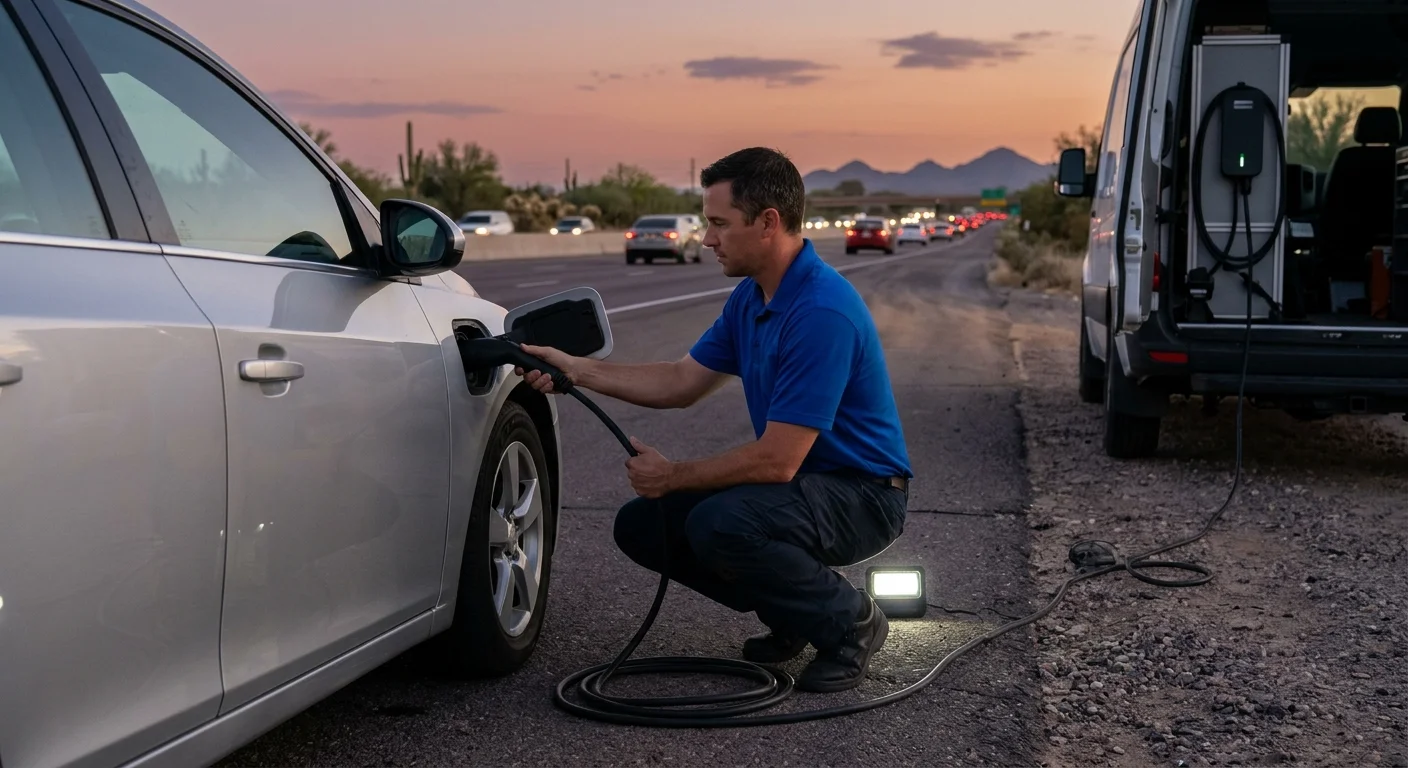
A tow to a Supercharger can be the right call. It can also be the wrong call on a Phoenix I-10 shoulder at night, when you need enough range to get home in Mesa or off the Scottsdale 101 to a working stall. Independent mobile charging is a different product. A typical rescue charge, as we can state it, is 10 to 20 miles of range in 15 to 30 minutes of Level 2 charging. That number is charging time at the car. It is not an arrival window, and it is not a Tesla factory promise.
Tesla roadside rescue is the match path when you want a local operator instead of waiting on a tow-only contractor. Mobile EV charging is the same idea when the pack is empty and the car is otherwise fine. Charge Pro PHX does not own the truck. The operator you are matched with quotes and bills you. The brand sets no price and promises no ETA.
Tow versus charge also depends on what actually failed. A 0% main pack on US-60 in Mesa is an energy problem. A Tesla that will not wake, with a dark screen, can be a low-voltage problem. Those are different requests in the Tesla app. Mixing them is how people get a tow they did not need, or a charge that will not open the contactors. Identify the symptom before you tap Roadside.
If Tesla’s contractor is a flatbed only, you can still ask for a local mobile charge as a backup match. That is not a complaint about Tesla. It is a second path when the first path is transport. You pay the operator. Confirm compatibility, price, and timing with that operator before anyone plugs in.
Do not treat ADOT or DPS as the on-site charger. Their published materials do not name EV charging. A tire change on Loop 202 South Mountain is in their world. A pack at 0% is not.
What to do while you wait, without guessing minutes
Stay out of the minutes game. No page here, including this one, can honestly tell you that Tesla will arrive in a set window at 1 a.m. on I-10, US-60, or Loop 101.
Do this instead.
Get the car out of the travel lane if you can still roll. Call 911 if you cannot, or if the car is already blocking traffic. Turn on hazards. Stay with the car if that is the safer choice, especially in heat, and keep cabin climate as low as you can stand so you do not drain a nearly empty pack. Phoenix overnight lows in summer still sit in the mid-80s, so the cabin will not cool itself.
Open the Tesla app and file the Roadside request if you have not. Screenshot the confirmation. Read whether Tesla is covering this call or sending a tow you will pay for. If the app is the problem, use the app-or-phone path we already documented rather than guessing a support number from memory.
If Tesla’s update says tow-only, decide whether you want that tow or a local on-site charge. A matched operator is a backup, not a second Tesla factory truck.
Do not walk along the freeway in the dark looking for a Supercharger. Arizona’s Move Over law exists because people get hit on these shoulders. You are not safer because the car is electric.
If you are on a Phoenix-area freeway between 5 a.m. and 8 p.m. on a weekday, ADOT’s Incident Response Unit may already be in that corridor. That is still not EV charging. It can help with a tire, debris, or a push off the lane. After 8 p.m., and on weekends, that unit is not the published coverage window.
Keep water on you in monsoon season too. Official monsoon dates run June 15 to September 30. Haboobs can drop visibility to near zero. A dark Tesla on a Mesa US-60 shoulder in a dust wall is a 911 problem first.
When you do talk to anyone, give the exact freeway, direction, mile, and nearest interchange. Phoenix is not a location. I-10 west at 7th Street is. US-60 east at Mesa Drive is. Loop 101 south near Indian Bend in Scottsdale is.
When to call us
Call when Tesla’s path is closed, unclear, or a tow-only contractor, and you still need energy in the pack on a Phoenix, Mesa, or Scottsdale shoulder. Charge Pro PHX matches you with an independent local EV rescue operator. You contract and pay that operator directly. Call us at (602) 932-0920 and we’ll connect you with a local EV rescue operator.