The Tesla is on the I-10 shoulder in Phoenix, hazards on, and the cabin is already climbing. You tapped Roadside in the Tesla app, confirmed the issue, and now you want a clock. Tesla does not publish a public minute figure for how long Tesla roadside assistance takes in Arizona. The live number, when there is one, sits in that request.
What Tesla’s app actually estimates
Tesla roadside assistance is requested in the Tesla app. You select Roadside, choose the issue, and confirm the details. That is the path Tesla documents. The request carries your GPS, VIN, and the car’s own diagnostic picture.
What Tesla does not publish, in any figure we could confirm, is a standard wait in minutes. There is no Arizona average. There is no Phoenix average, no Mesa average, and no Scottsdale average. If an estimate appears after you submit, treat it as a live contractor ETA. It is not a promise, and it is not a Valley-wide rule.
That estimate can move. A 5 p.m. stall on I-10 by Sky Harbor is not the same job as a quiet Sunday on Loop 101 in north Scottsdale. Tesla’s roadside network here uses contractors. Those trucks sit where the last job left them. They also sit in the same heat and the same freeway queues you are already in.
If the app will not open, the fallback is the phone path listed in the app and the owner’s manual. That split is covered in our guide to Tesla roadside by app or phone in Phoenix. Use the app when you can. It is the path Tesla built to get location right the first time.
Do not convert a friend’s wait in another state into your plan. Do not convert an old forum time into your plan. Tesla’s published roadside materials, as we can cite them, describe how to ask for help. They do not post a numeric response window for Arizona. Confirm the current ETA in the request itself, then watch it. If it jumps, that is the contractor network telling you traffic, distance, or job type changed.
Coverage length is a separate clock, and it is easy to mix with wait time. Searchers ask how long Tesla covers roadside assistance. That is warranty and policy, not arrival. A year count for Arizona could not be confirmed in the claims we can publish. Open the Tesla app, the car’s warranty view, and Tesla’s roadside assistance page, and read the current terms for your VIN. Second-hand cars inherit whatever cover is left. When that cover ends, the factory roadside path ends with it.
Whether Tesla roadside is 24/7 in Arizona
People type “is Tesla roadside assistance 24/7” and “is Tesla roadside assistance 24 7” for a reason. Night stalls on US-60 through Mesa feel different from a weekday lunch stall downtown. So do monsoon closures, and so does a 2 a.m. empty pack on Loop 202 near Scottsdale.
Tesla’s logged U.S. roadside materials describe the app request path. They do not, in any row we can publish, print an Arizona hours table. So is Tesla roadside assistance 24/7 here. That specific hours claim could not be confirmed. Do not take a slogan from another country, another club, or a screenshot in a group chat. Open Tesla’s roadside assistance page and the Roadside flow in the app, and read what Tesla shows for your car today.
Factory roadside is also not the only truck on a Valley freeway. Arizona DPS Roadside Motorist Assistance is statewide. It changes tires, provides gasoline or diesel, jump-starts dead batteries, adds water, and calls tows. Its published materials name gasoline and diesel. They say nothing about EV charging or an out-of-charge Tesla. Hours and specific corridors are not published, so do not plan a DPS wait either.
ADOT’s Incident Response Unit is a different program. It covers Phoenix-area freeways, 5 a.m. to 8 p.m. weekdays, with a 14-member unit. It clears crashes and debris, changes tires, and helps stranded motorists. It has no EV-specific mention. After 8 p.m. on a weekday, and on a weekend, that unit is outside its published window. Your Tesla request is then waiting on Tesla’s contractor path, plus whatever private tow that path books.
If you searched Tesla roadside assistance near me, the app is still the locator. Tesla does not publish a Phoenix storefront you walk into for a roadside truck. The “near me” is GPS on the request, then a contractor Tesla assigns. A local mobile operator is a separate match, used when that assignment is a tow-only job or when the app ETA is no longer a wait you can sit through in this heat.
Why heat and freeway miles change the wait
Phoenix averages about 111 days a year at or above 100F, and about 21 at or above 110F. July highs average near 107F. August sits near 105F. Overnight summer lows still hang in the mid-80s. That is the cabin you are sitting in, and it is the same air the contractor is driving through.
Heat also makes the stall more likely in the first place. Recurrent reports EVs can lose 20 to 30% of range above about 95F, with loss near 31% at 100F, from 345,622 trips by 300 Phoenix-area EVs. AAA’s 2026 study found about a 10% efficiency drop and an 8.5% range loss at 95F versus 75F. NREL reports climate-control loads can cut EV range in a meaningful way, with cabin cooling among the biggest draws. The U.S. Department of Energy’s electric vehicle pages are a plain primer on how that energy gets used.
More empty-pack calls on the same afternoon means a thicker queue for the same contractor pool. Phoenix holds about 1.64 million people. Mesa holds about 512,000. Scottsdale holds about 244,000. I-10 through Phoenix, US-60 through Mesa, and Loop 101 and Loop 202 around Scottsdale do not clear because your Tesla is sitting on the shoulder.
Freeway miles are not a straight line on a map. A truck assigned from east Mesa to a stall west of downtown on I-10 is eating the same US-60 and I-10 congestion you already lost range in. A Scottsdale Loop 101 job during event traffic around the north city is a different clock than a midday Mesa frontage-road stall. Arizona has no toll roads and no toll express lanes, so there is no paid lane that truck can buy. SB 1340, effective January 1, 2024, bars the state from adding them without a new legislative vote. Loop 202 South Mountain is free. The wait is traffic, heat, and distance, not a toll gate.
If Tesla’s path is a tow to the nearest Supercharger, heat still follows you. Field measurement of DC fast chargers in extreme heat found offered power declining by up to 35 to 40 kW once rectifier temperature approached 55C, with charging duration rising from 86 minutes in winter to 169 minutes under extreme summer conditions. That is charger performance, not a Tesla roadside ETA. It is why “they are towing me to a charger” can still leave you sitting once you arrive.
Monsoon season is officially June 15 to September 30. It brings haboobs that drop visibility to near zero, and flash floods. A contractor that was 20 minutes out on a clear I-10 can vanish behind a dust wall. Watch the app. Do not treat the first number as fixed.
Tow-only calls versus an on-site charge
Wait time is not one job. A flat tire, a 12-volt (or other low-voltage) no-start, and a fully depleted pack are different assignments. Tesla’s roadside policy says assistance for a depleted battery is available but is not a financially covered service, regardless of warranty status. Tesla typically arranges transport to the nearest Supercharger or service center. That is a tow clock: dispatch, a flatbed, freeway access, and the drive.
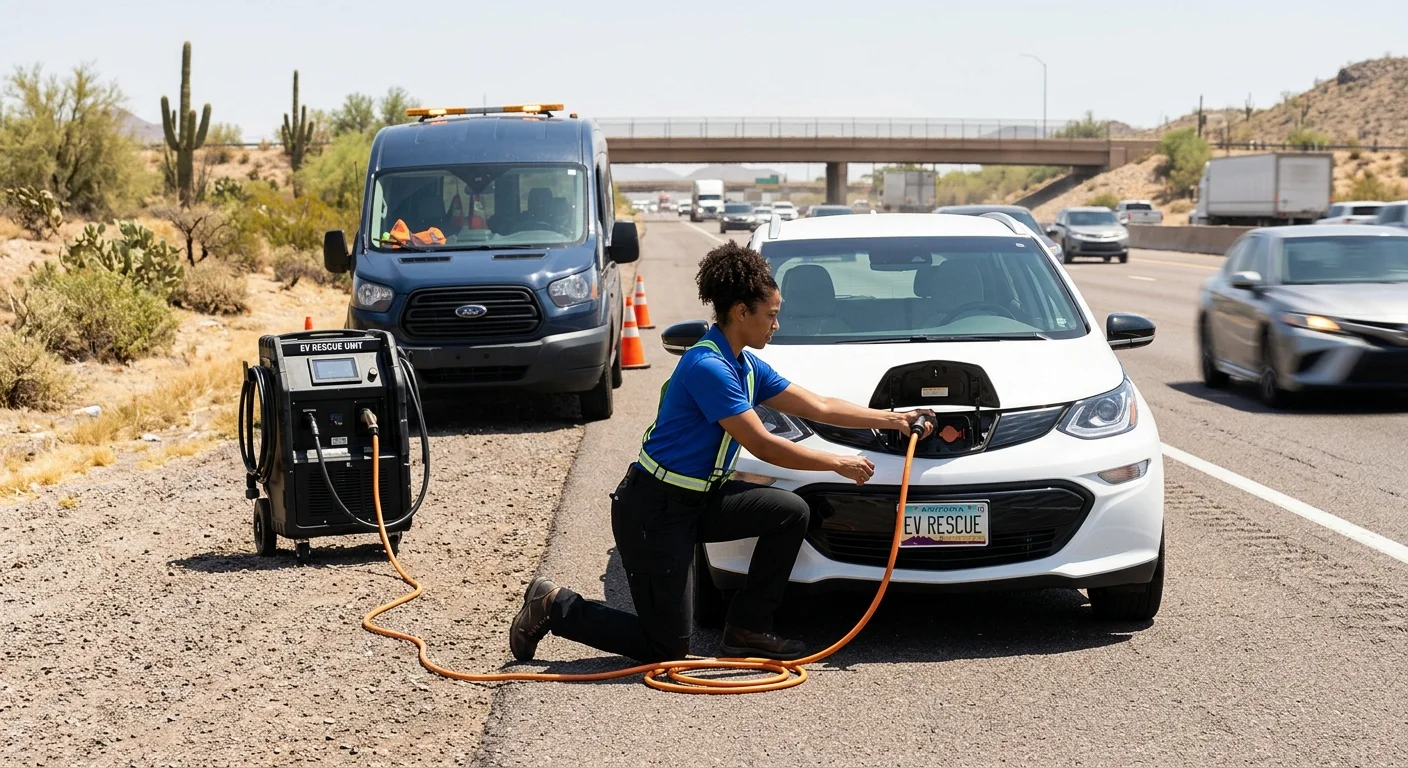
An on-site charge is a different clock. It is the time for an independent mobile operator to reach you, then the time the car actually takes energy. A typical rescue charge, once the operator is already there, is 10 to 20 miles of range in 15 to 30 minutes of Level 2 charging. That 15 to 30 minutes is plug time. It is not arrival. Charge Pro PHX does not publish an arrival window, and it does not send a brand-owned truck.
When Tesla’s assignment is tow-only, a local match can be the backup. That is the point of Tesla roadside rescue and of mobile EV charging in this metro. The operator quotes and bills you. The brand sets no price and promises no ETA. Read Tesla on-site charge or a factory tow before you assume the app request includes a plug. The contractor path itself is walked through in Tesla roadside contractor tows in Phoenix.
A tow can be the right call. If you are in a travel lane on I-10, or the car will not sit safely on a Mesa US-60 shoulder, getting the vehicle off the pavement matters more than saving a Supercharger fee. ARS 28-871 says you may not stop or park on the traveled part of a highway outside a business or residence district if it is practical to get off it. A vehicle disabled so badly it cannot be moved is exempt. When you are stopped, you must leave room for other traffic to pass and be visible 200 feet in each direction.
ARS 28-872 lets police order a disabled or obstructing vehicle removed. Owners pay reasonable tow and storage costs before release. Arizona sets no statewide tow-rate cap. Cities and counties may set maximums locally. Confirm the current rate with the company on the ticket before you pay. Do not guess a Valley tow bill from memory.
Factory roadside is strongest on warrantable car faults. Out-of-charge is the gap that surprises people, because help can still show up as a billable transport. Reliability, in the sense of a published success rate, could not be confirmed. What we can say is local: heat, freeway miles, and whether the job is a tow or a charge change the wait more than a national slogan does.
What to do while you wait, without guessing minutes
Do not pick a minute and then get angry at the app. Tesla did not publish that minute for Arizona. The useful question is how to stay safe until whoever is coming actually arrives.
Get the car as far off the traveled lane as you can, if it will still move a few feet. Hazards on. If you have warning lights, use them. ARS 28-775, the Move Over law, requires other drivers who approach a stopped vehicle with flashing or warning lights to move over a lane if they safely can, otherwise slow down. Fines run $275, then $500, then $1,000 for repeats within five years. That law protects you. It does not make the shoulder cool.
Stay out of the travel lane. If the cabin is livable, stay in the car with the seat belt on, especially on I-10 through Phoenix, US-60 through Mesa, or Loop 101 in Scottsdale. If the cabin is not livable and you have a safe, shaded spot off the pavement, take it. Phoenix heat is the wait’s other clock. July and August highs in the 100s, with overnight lows still in the mid-80s, cook a parked cabin fast. Cabin cooling, if the pack still has energy, is also the load NREL flags as a range drain. If the pack is already empty, do not sit there expecting the A/C to save you.
Keep the phone charged enough to watch the Tesla app. If you have a power bank, use it on the phone, not as a fantasy car charger. If the app ETA disappears or the contractor calls to say they are tow-only, that is the fork. You can stay on Tesla’s transport path to the nearest Supercharger or service center. You can also ask for a local mobile operator as a second match. Neither path has a published minute figure from this brand.
If the stall is a crash, ARS 28-674 says that in a minor crash you must move the vehicle off the traveled roadway when it is safe to do so. You are not at fault merely for moving it. ADOT may require and assist removal when no serious injury is apparent. If anyone is hurt, that is 911, not roadside.
Do not stand behind the car on a Valley freeway. Do not walk the shoulder at night in dark clothes. Do not treat DPS Roadside Motorist Assistance as an EV charge. It is not documented that way. Do not treat ADOT’s weekday 5 a.m. to 8 p.m. window as Tesla’s window. They are different programs.
How long should you wait for roadside assistance, as a rule of minutes. No verified figure exists for Tesla in this metro. Wait in a way that keeps you off the travel lane, visible, and hydrated. Recheck the app. If the scene is unsafe, call 911. If Tesla’s assignment is a tow you do not want, or the car only needs enough range to roll to a charger, ask for an independent mobile operator instead of guessing another hour.
When to call us
Call when Tesla’s request is a tow-only assignment, when the pack is empty and you need range rather than a flatbed, or when the app ETA is no longer a wait you can sit through on a Phoenix, Mesa, or Scottsdale freeway. Charge Pro PHX connects you with an independent local operator. It does not perform the work. Call us at (602) 932-0920 and we’ll connect you with a local EV rescue operator.