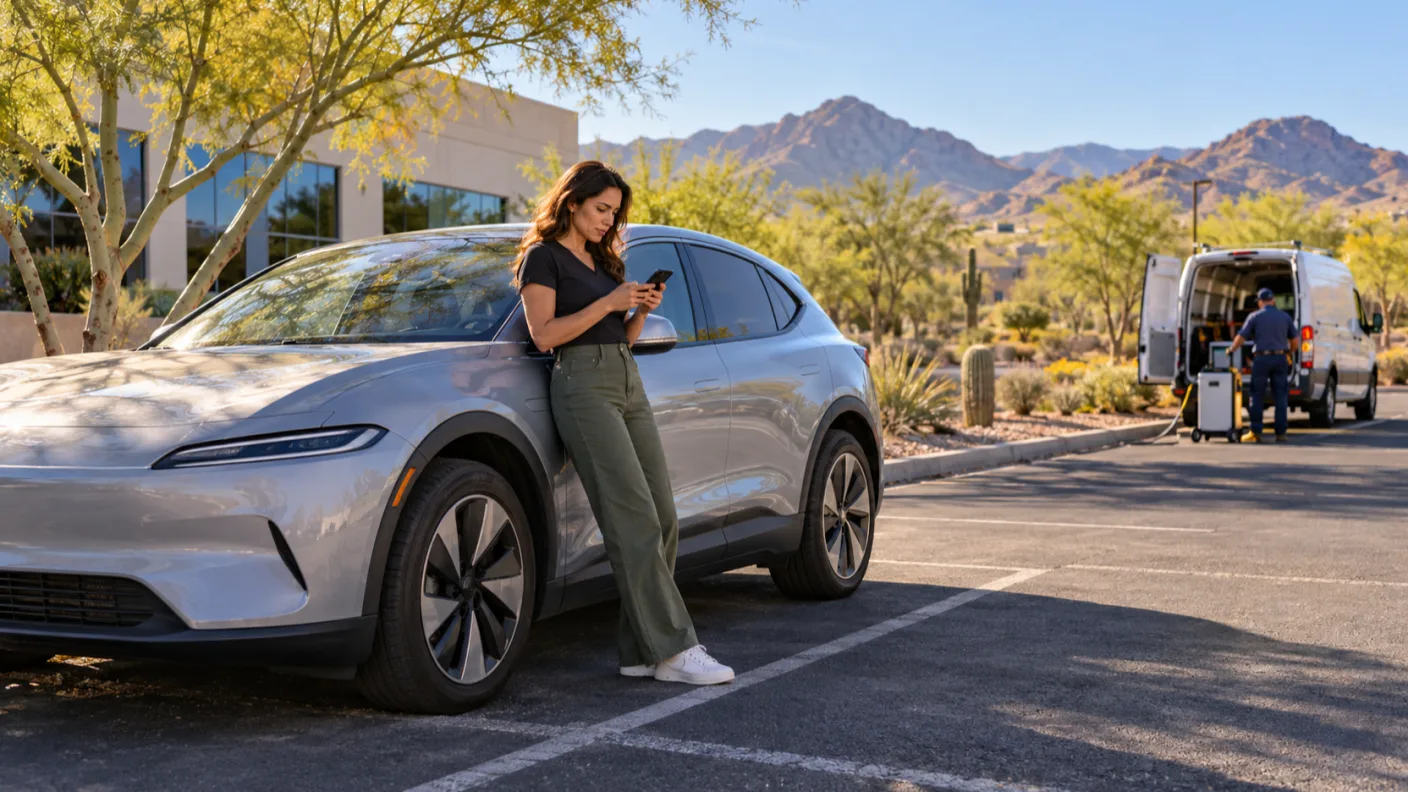
American Family’s EV guidance gives dead-EV drivers a more specific answer than many insurer pages: optional Emergency Roadside Service may provide a mobile charge or a tow to the nearest qualified EV facility. Its detailed guidance says the mobile charge is intended to add enough range to reach the nearest charging station. Coverage still depends on the driver’s policy and the current dispatch, so confirm eligibility before relying on that option in Phoenix.
Charge Pro PHX is not American Family and does not administer its coverage. We are a referral service for independent local EV rescue operators. An operator, not Charge Pro PHX, quotes, performs, and bills for any independent work.
What American Family says about a dead EV
American Family’s official electric vehicle insurance page says optional Emergency Roadside Service may provide either a mobile charge or a tow to the nearest qualified EV facility. Its detailed EV roadside guide adds the practical goal: the mobile charge is meant to provide enough range to reach the nearest charging station. When charging at the car is not an option, a tow may be arranged.
The words “optional” and “may” matter. The page does not turn every American Family auto policy into a mobile-charging promise. The policy and the live dispatch decision control the outcome.
That public mobile-charge language is the main difference between this page and our Liberty Mutual EV roadside guide. Liberty Mutual’s public service list does not name mobile EV charging. American Family’s EV page does.
Make the roadside request specific
Tell American Family whether the problem is an empty traction battery or a dark low-voltage system.
An empty traction battery is the mobile-charge use case described on American Family’s EV page. The car may still show information, but it does not have enough driving range to reach a station. Ask whether a mobile charge is available for the exact location and covered by the active policy.
Dark screens do not prove which battery system is responsible. Report exactly what works, what does not, and whether the car displays a state of charge. Do not ask for “a battery charge” without describing those observations.
Give the dispatcher:
- The year, make, and model
- The exact road, cross street, garage level, or parking area
- Whether the displays wake
- The range shown before the car stopped, if known
- Whether the charge port is accessible
- Whether the car is safely outside a travel lane
If you need help separating the two failures, read can roadside jump-start an EV and when a dead EV needs a charge, jump, or tow.
Confirm these terms before a truck is sent
American Family’s public page supports asking for mobile charging, but it does not replace the policy conversation. Ask these questions:
- Is Emergency Roadside Service active for this vehicle and driver?
- Is a mobile EV charge covered for this incident?
- Can the current provider reach and safely work at this location?
- Is the plan a mobile charge or a tow?
- If it is a tow, which qualified EV facility will receive the car?
- Who pays the dispatched provider?
- If no dispatched charger is available, does the policy allow an independent operator and what documentation is required?
Do not substitute a general web page for the answer on the current call. Eligibility and the approved response depend on the active policy and circumstances.
American Family’s published purpose for a mobile charge is modest and useful: enough range to reach the nearest station. It is roadside recovery, not a full recharge. Before the provider leaves, identify the intended station and make sure the remaining route is realistic for the range shown by the vehicle.
Plan the handoff from mobile charge to charging station
A small roadside charge only works if the next station is accessible and compatible. Confirm the connector, station access, and live status using the charging network or property source before driving away.
Phoenix maintains a public EV charging map and says city-owned public ports can be found at parks, libraries, the convention center, Sky Harbor, and parking garages. The city’s page does not establish that every listed port is free, available, or compatible at a particular moment. Verify the specific stall rather than relying on the map pin alone.
Sky Harbor confirms Level 2 charging in the Terminal 3 garage, Terminal 4 garage, and at the 24th Street station. Those can be relevant to an airport incident, but a mobile charge should not be planned around a stall until access and availability are checked.
If the nearest practical station cannot be confirmed, tell the American Family dispatcher before accepting a range-only plan. Its own EV guidance also identifies towing to the nearest qualified EV facility as the alternative when mobile charging is not an option.
For the broader station-versus-roadside decision, see roadside EV charging near Phoenix and EV rapid charger or roadside help.
If American Family cannot dispatch mobile charging
Provider availability can be different from policy eligibility. American Family may confirm that the policy includes roadside help but still determine that a mobile charge is not the available response for the location. Its published alternative is a tow to the nearest qualified EV facility.
Ask what makes the destination qualified for the vehicle and the failure. An EV at zero range needs compatible charging. A car with a low-voltage or other fault may need service rather than a charging stall. The destination should match the problem.
A driver can also seek a direct quote from an independent EV rescue operator. Confirm with American Family first if you expect reimbursement. Its public page does not establish a universal reimbursement process for independent work.
Charge Pro PHX can make the independent referral. We do not decide whether American Family will pay, and we do not represent the operator as an American Family vendor. The independent operator confirms the vehicle and location, states what they can offer, quotes the work, and bills the driver.
A typical Level 2 rescue charge adds 10 to 20 miles of range in 15 to 30 minutes of charging time. That is time connected to the equipment, not travel time or an arrival promise. The exact result depends on the vehicle and conditions. See mobile EV charging in the Phoenix area for the referral route.
Handle a freeway stall safely
Coverage questions come after immediate roadway safety. Arizona law says a vehicle should be moved off the traveled part of a highway when practical. A vehicle disabled so badly that it cannot move is exempt, but it must leave room for other traffic and be visible from 200 feet in both directions.
Arizona DPS Roadside Motorist Assistance can jump dead batteries and call tows, but its published materials do not mention EV charging. ADOT’s Incident Response Unit helps stranded motorists on Phoenix-area freeways, and its published services are not an American Family benefit or a mobile EV charging promise.
If the EV is exposed to moving traffic, tell the dispatcher and contact emergency services when there is immediate danger. Do not remain in a live lane to negotiate whether the policy sends a charger or a tow.
Call for an independent referral
If American Family cannot send a mobile charger, or if you want a separate quote after confirming your policy terms, call (602) 932-0920. Charge Pro PHX will connect you with an independent local operator. The operator confirms the scope, quotes the work, performs anything you authorize, and bills you directly.