When your electric car died in Phoenix-area heat, check the 12-volt first. A dead 12-volt can lock a car whose traction pack is still full. An empty pack needs a charge on the spot. A tow is for damage, unknown faults, or a car nobody can reach.
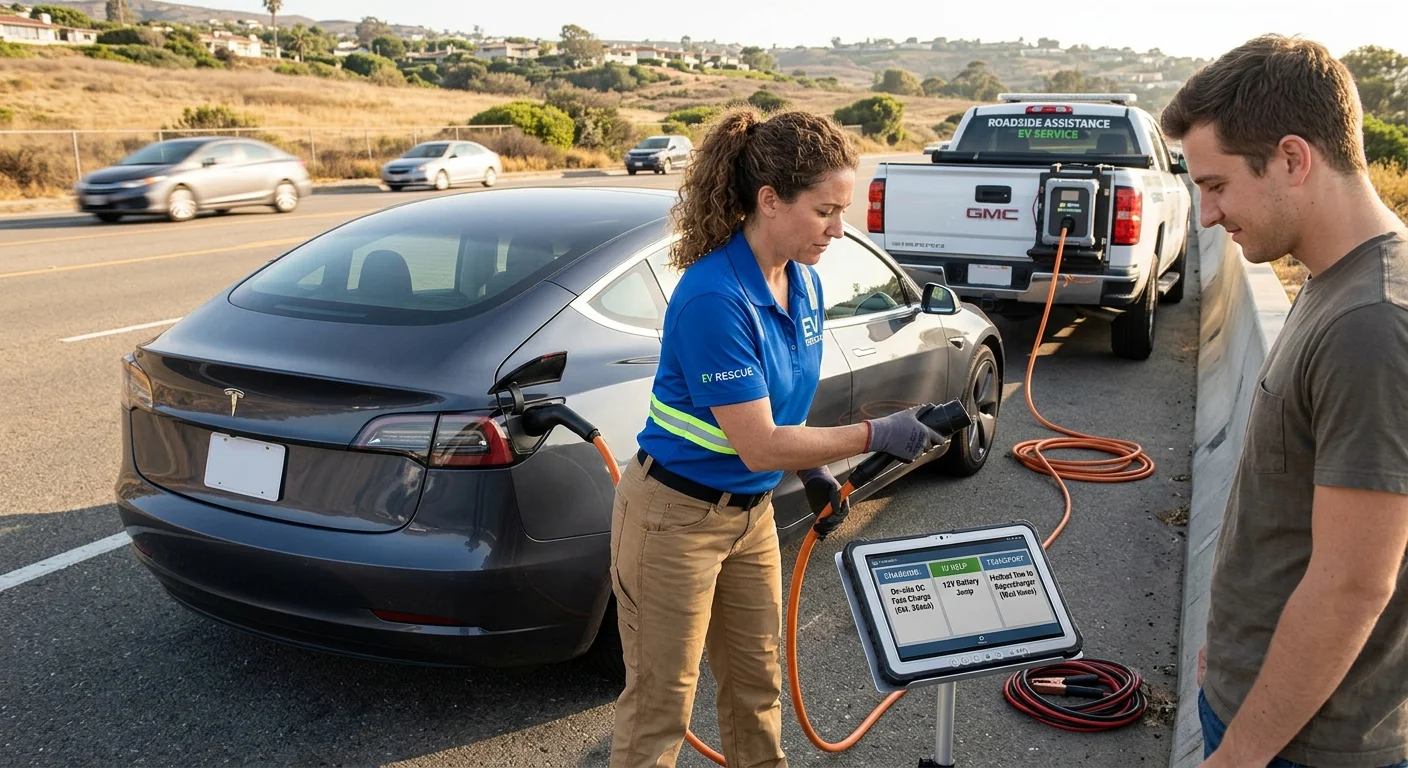
In this heat, a dead EV is often the 12-volt
Phoenix averages about 111 days a year at or above 100F. About 21 of those days hit 110F or more. July highs sit near 107F, and August sits near 105F. The little 12-volt fails in that heat sooner than the traction pack.
Starter batteries last about 47 months in hot climates, per the Battery Council International. AAA names heat as the top cause of battery failure. It recommends AGM batteries for hot areas.
In an EV, that small battery runs the door handles, the screens, and the contactor. The contactor is what ties in the high-voltage pack. A DC-DC converter recharges the 12-volt only while the car is on or charging. Parked cars sit on their own. Tesla Sentry Mode and Cabin Overheat Protection keep drawing power in the lot.
That’s why a week at Phoenix Sky Harbor is a classic stall. Level 2 charging is confirmed in the Terminal 3 and Terminal 4 garages. You come back from a trip. The app won’t wake. The handles stay dead. The pack may still hold plenty of range. Recurrent looked at 345,622 trips from 300 Phoenix-area EVs. Cars lost 20 to 30 percent of range above about 95F. Heat plus a weak 12-volt is what strands people here.
If the car is a Tesla, read when Tesla 12-volt batteries fail in desert heat. Dark screens with a charged pack point at the small battery first.
Read the dash before you pick a path
Died is a driver’s word, not a diagnosis. One person sees an empty driving-battery warning. Another finds black glass and silent locks.
Copy the dash message word for word. Note whether the cluster, lights, locks, phone app, or charge-port door still respond. If a remaining charge percentage is on screen, report that number. Say whether the car quit while moving or refused to wake after sitting.
An empty-pack warning supports a talk about out-of-charge recovery. Blank controls may lead an operator toward a 12-volt jump in desert heat. That still isn’t a green light to pop a cover or clip on cables.
Use the current owner’s manual for your exact car. Search roadside, low-voltage, towing, and charging. If you don’t have the manual, say so before anyone starts. The U.S. Department of Energy’s electric-vehicle overview is background only. The manual and the operator on scene make the service call.
Get the car out of live traffic
Safety beats diagnosis. If people are in danger, call emergency services and follow them.
Arizona law is specific here. ARS 28-871 limits stopping on a highway outside a business or residence district. You may not sit on the traveled part if you can get off it. A vehicle disabled so badly it can’t move is exempt. When you’re stopped, leave room for traffic to pass. ARS 28-775 is the Move Over law. Drivers who see warning lights must move over a lane if they can. If they can’t, they have to slow down.
Name the road the way a dispatcher hears it. Northbound I-17 toward Anthem isn’t southbound I-10. Loop 101 is Agua Fria on the west and Price on the southeast. US-60 is Grand Avenue northwest and the Superstition Freeway east. The Beeline posts a 7 percent grade toward Payson. ADOT posts a 6 percent maximum grade on northern I-17.
Give the travel direction and the nearest exit or cross street. Westbound Loop 101 Agua Fria near Glendale, Arizona is useful. Say whether you sit in a lane or on a shoulder. A lot or a garage changes the job too. Mention gates, height bars, and security desks.
Arizona DPS Roadside Motorist Assistance can change a tire and jump a 12-volt. It can bring gasoline or diesel and call a tow. Its published materials don’t mention EV charging. ADOT’s Incident Response Unit works Phoenix-area freeways on weekdays. State help isn’t a mobile Level 2 source. If police or ADOT already own the scene, their directions come first.
When a jump is the right call
Discuss a jump after the symptoms line up with a low-voltage failure. Dark screens and dead handles are the usual cluster. So is a pack that still showed range before shutdown. Don’t order a jump only because the glass is black.
Don’t invent battery access. Don’t follow a video shot on a different model. Use the manual for your year for the approved path. Some Teslas can take a jump at the tow-hook terminals. The operator brings the procedure, not a guess.
A jump that wakes the car isn’t always a lasting fix. Independent operators can jump a 12-volt or replace it on site. That still isn’t a high-voltage pack repair.
When you need a charge, not a tow
Discuss charging when the traction battery looks empty. Share the displayed percentage and the warning text. Give make, model, year, and whether the charge port opens. Independent operators bring a 240V Level 2 source to the car. They use a native NACS plug on Teslas. Non-Tesla EVs get a CCS or J1772 adapter. They typically add 10 to 20 miles of range. That takes 15 to 30 minutes of charging. That’s charging time. It isn’t an arrival promise.
Mobile charging still has limits. The car may sit where a truck can’t stop. It may refuse a charge or show a fault that isn’t energy. See when you need a charge, not a tow for those limits.
Tesla’s own roadside path doesn’t charge you on site. Factory help tows to the nearest Supercharger or service center. If you want the car charged where it sits, say that up front.
Heat plus cabin cooling plus grade makes empty-pack stalls more likely. The I-17 climb toward Anthem and New River is a 6 percent ADOT grade. Name where you are. Let the operator decide if a mobile EV charge can reach you.
Event lots add the same heat soak. Chase Field and Mortgage Matchup Center leave cars parked for hours. So do State Farm Stadium in Glendale, Arizona, and Phoenix Raceway in Avondale. A full pack at arrival can be a weak 12-volt at exit.
When a tow is the safer branch
Discuss transport when on-site work doesn’t fit. The cause may still be unknown. The car may not accept a charge. The manufacturer may require a flatbed for the displayed fault. Collision damage, smoke, or a live-lane stop also belong in that first conversation.
ARS 28-872 lets police order a disabled or obstructing vehicle removed. Owners pay reasonable tow and storage costs before release. Private-property tows in Arizona need the property owner’s written authorization or a police request. The state sets no statewide tow-rate cap. Confirm the current price with the operator before you authorize anything.
The transport method has to follow the current manual for that vehicle. Don’t tell a tower how to handle wheels or park pins. Share the maker’s current instructions instead. Our note on towing a dead EV in the Phoenix area covers the rest.
Arizona has no toll roads and no toll express lanes. Scam texts about unpaid Arizona tolls are scams.
What to tell the person who quotes the job
Start with make, model, model year, and the displayed charge level. Explain what happened right before the car quit. List what still works: displays, locks, lights, the app, and the charge-port door.
Give a precise Phoenix-area location. Include the road, direction, nearest exit, parking level, or space number. Phoenix, Mesa, Tempe, and Scottsdale aren’t interchangeable. Maricopa the city is in Pinal County, not Maricopa County. If you’re on Salt River Pima-Maricopa or Gila River land, say so.
For later charging plans, see the Phoenix-area EV charging hub. The independent operator handles today’s triage.
How Charge Pro PHX connects you with an operator
Charge Pro PHX is a referral line. We match stranded EV drivers with independent local mobile rescue operators. We don’t diagnose the car, own trucks, or set prices. We don’t promise an arrival time. We hold no trade license. The operator quotes you before starting and bills you directly.
When you call, share the vehicle and location details you already gathered. The operator explains whether a jump, a charge, or a tow fits before work starts.
Ask the operator to confirm the service scope, current price, and credentials before you authorize. If the selected service can’t fix it, ask what the manufacturer requires next.
Call when the electric car died, won’t wake, or shows a message you can’t classify. Call (602) 932-0920 and we’ll connect you with a local EV rescue operator.