Jump starting an electric car in desert heat means waking the 12-volt. That’s the small battery, not the traction pack. It dies first on Phoenix 100-degree days, even with a full pack. It runs the locks, screens, and the contactor that connects the pack. Use a lithium jump pack on the marked posts, not another car.
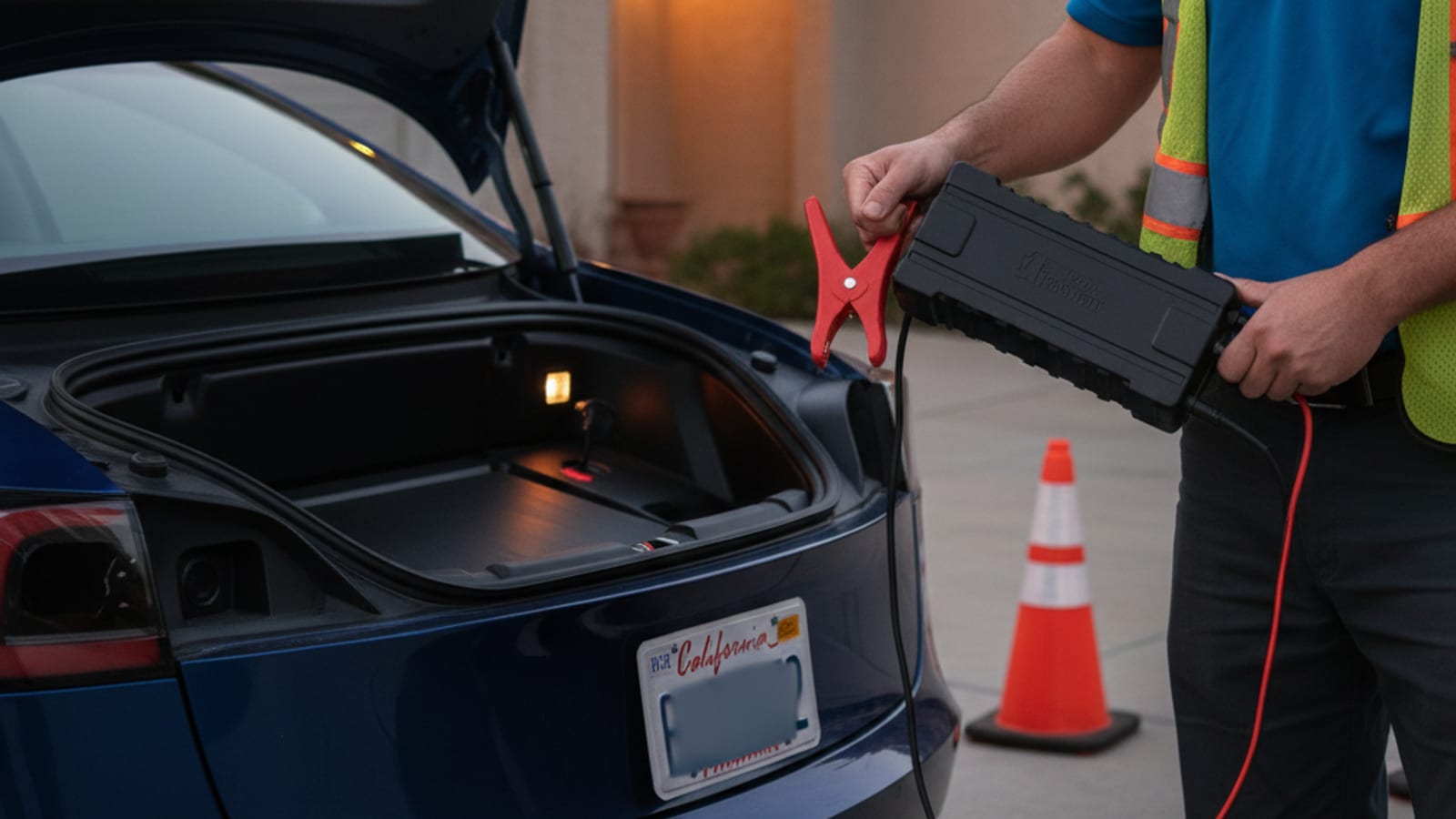
Phoenix heat is the usual reason that 12-volt cooks. NOAA normals show about 111 days a year at or above 100F. About 21 of those days reach 110F or more. July highs average near 107F, and August stays near 105F. Overnight summer lows often sit in the mid-80s, so the battery never really cools.
Battery Council International work, via Battery University, found the life gap in hot climates. Starter batteries last about 47 months in heat versus about 59 months in cool weather. A five-year battery elsewhere can fail in two or three years here. AAA calls heat the top cause of battery failure. It also recommends AGM batteries for hot areas.
In an EV, that failure strands the whole car. The traction pack can still show a healthy charge. The 12-volt wakes door handles, screens, and the high-voltage contactor. A DC-DC converter recharges it only while the car is on or charging. Sentry Mode and Cabin Overheat Protection keep drawing power while a Tesla sits parked.
A week in a hot Sky Harbor garage is a common way this shows up. Terminal 3, Terminal 4, and the 24th Street station have Level 2 stalls. A drained 12-volt still won’t let the car wake. A long park near Chase Field or Mortgage Matchup Center can do it too. That’s why Tesla 12-volt batteries fail in desert heat so often across the Valley. Newer Gilbert homes often charge at the house. Those failures then show up after a parked workday or an airport trip.
How to tell it’s a jump, not a charge
A dead traction pack usually still lets the car talk. You’ll see a low-range warning, a turtle icon, or a charge-now message. A dead 12-volt is quieter than a low traction pack. Handles don’t pop, the app goes dark, and screens stay black. The charge port may not open at all. If the big pack is empty too, you need a wake-up and a charge. A jump alone won’t add range to an empty pack.
Don’t jump from another vehicle
A running gas car can push well above a resting 12 volts. Voltage can spike when you clamp the cables on. Gas 12-volt systems tolerate that kind of spike. An EV 12-volt circuit feeds a DC-DC converter, body modules, and battery management. A spike or reversed leads can damage those parts.
Tesla tells owners not to jump from another vehicle. Rivian, Ford, and Hyundai service manuals say the same thing. Use a dedicated lithium jump pack with reverse-polarity protection. Don’t use your Tesla to jump a gas car either. The reasons a Tesla shouldn’t jump another car are the same sensitive electronics, just reversed.
What a lithium jump pack actually does
A lithium jump pack is a small battery with leads attached. It delivers a controlled 12 volts, enough to wake the low-voltage system. You need reverse-polarity protection and a charge already in the box. Keep one in the frunk or cargo area. Check its indicator before a long I-17 or US-60 run.
If you don’t own one, don’t borrow cables off a stranger’s truck. Call for a Tesla 12-volt jump or a general EV roadside rescue. Charge Pro PHX matches stranded drivers with independent local operators. We don’t own the trucks and we don’t do the work. The operator quotes you before starting, then bills you directly.
The safe order of operations
Use the same sequence on almost every EV. Confirm the jump pack has charge before you clip anything. Find the marked 12-volt posts for your model, not a random bolt. Clip the red lead to the positive post first. Clip the black lead to the marked ground. Don’t clamp an unmarked battery negative if the maker calls out a chassis point. Wait about half a minute so voltage can settle. Then try a handle, the app, or the driver’s door.
When the car wakes, leave the pack connected a couple of minutes. That gives the DC-DC converter time to take over. Disconnect the black lead first, then the red.
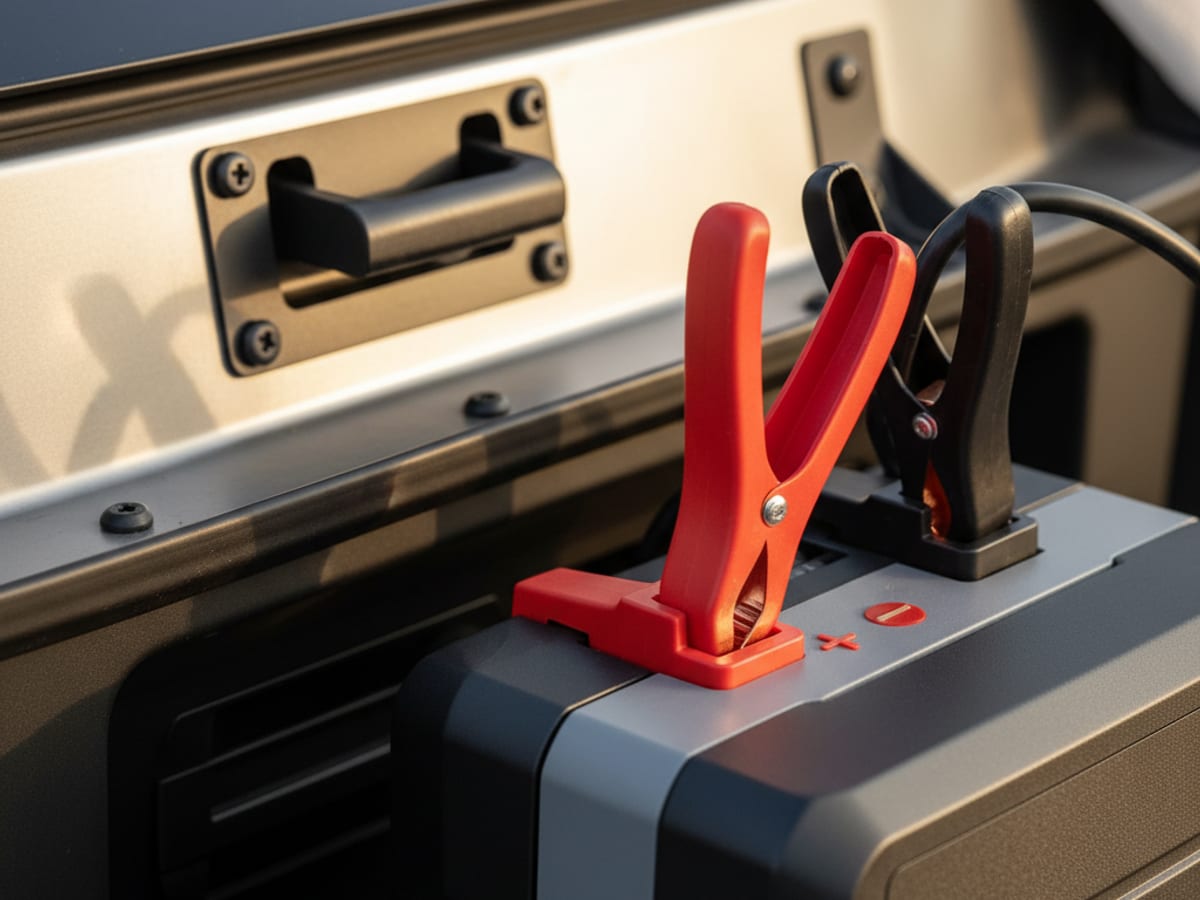
Polarity is the whole game on an EV jump. Red goes to positive, and black goes to the designated ground. A decent pack will refuse to fire if you swap them.
Where the posts hide on cars Valley drivers actually own
Bumper pigtails and tow-eye covers
Many Model 3 and Model Y cars hide jump leads behind the tow-eye cover. Connect the pack there, then wait for the frunk to release. See how to jump a Tesla from the tow hook for the bumper steps. Older Model S and Model X cars use similar tow-eye access up front.
Frunk terminals once you can open the lid
Newer Model S and Model X cars from 2021 on use interior manual door releases. Pull the frunk release under the carpet, then jump the 12-volt posts inside. Rivian R1T and R1S trucks hide a manual frunk release behind the grille. If the fob is dead, that grille release is the way in. You’ll need a Phillips screwdriver for the cover plate. Jump the passenger-side 12-volt on the positive post and the marked ground stud.
A Ford F-150 Lightning’s power frunk won’t open on a dead 12-volt. The mechanical release is a pull loop under the front bumper. The battery is on the driver’s side, with standard posts. Polestar 2 keeps the 12-volt in the frunk. If the Polestar lid stays shut, look for a manual cable behind the driver-side headlight.
Rear battery, front jump posts
Hyundai Ioniq 5, Kia EV6, and Kia EV9 hide the 12-volt under the rear floor. They still give you front jump terminals: a red positive post and a marked ground. The Chevrolet Bolt is similar, with the 12-volt under the rear load floor. Jump from the front compartment, a red positive under a cap plus a ground stud. Ford Mustang Mach-E also keeps the 12-volt in the rear. Jump posts live in the frunk on a Mach-E. If the app can’t open it, there’s a manual cable behind a driver’s-side kickplate.
Non-Tesla cars still need the right adapter later if the traction pack is low. Ask for a non-Tesla EV rescue when the plug isn’t NACS.
After the car wakes
Drive the car or plug it in after it wakes. Either one lets the DC-DC converter recharge the 12-volt from the traction pack. A jump is a wake-up, not a rebuild. If the car dies again soon, the 12-volt likely needs replacement. Heat here shortens that 12-volt’s working life. Watch for a 12-volt service warning or slow waking from sleep. More of those early tells are in signs your EV 12-volt needs replacement. Don’t keep jumping a battery that won’t hold through the next 107-degree afternoon.
If you’re already on a Valley shoulder
Get yourself and passengers to a safe spot first. ARS 28-871 covers stopping on a highway outside a business or residence district. Don’t stay on the traveled lanes if you can get the car off them. A vehicle disabled so badly it can’t move is exempt. When you’re stopped, leave room for other traffic to pass. You also need to be visible 200 feet in each direction.
ARS 28-775 is the Move Over law. Other drivers should change lanes or slow down. It matters on I-10, Loop 101, and the Superstition Freeway stretch of US-60.
Arizona DPS Roadside Motorist Assistance will jump-start a dead battery. It can also add fuel, change a tire, and call a tow. Its published materials name gasoline and diesel, not EV charging. ADOT’s Incident Response Unit works Phoenix-area freeways on weekdays. It helps stranded motorists and doesn’t advertise EV charging.
When to call for a local operator
Call Charge Pro PHX at (602) 932-0920 if you don’t have a pack. Use that line if the car won’t hold a jump. Use it if you also need range on the spot. We’re a referral line for the Phoenix area. Independent operators jump or replace a dead 12-volt on site. They can bring a 240-volt Level 2 source to Tesla and other major EVs. That source uses a native NACS plug, or a CCS or J1772 adapter. Typical on-car charging adds about 10 to 20 miles of range. That takes 15 to 30 minutes of charge time once the 12-volt is awake. That’s charging time, not a promise of when someone arrives. The operator quotes you before starting, then bills you directly.