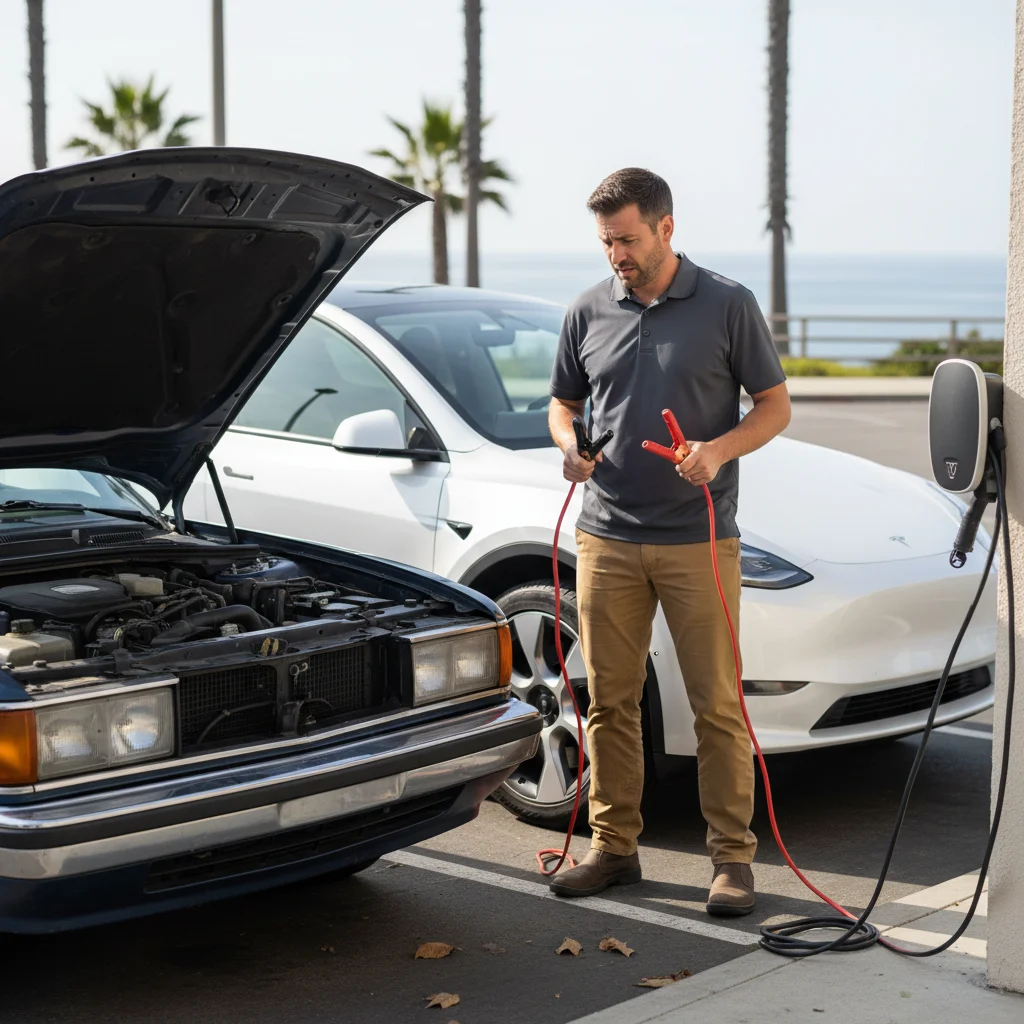
A neighbor’s hood is up in a Chandler grocery lot. Hazards are on. July heat sits near 107F. Your Tesla still shows range. Jumper cables are in the frunk. That old habit says clip on and help. Don’t. A Tesla shouldn’t jump start another car. The small 12-volt wakes screens and door handles. It isn’t a starter battery. Phoenix-area heat already works it hard. Help with a portable pack, a ride, or a call. Don’t tie your low-voltage system to someone else’s dead battery.
Heat is already eating that 12-volt
Phoenix sees about 111 days a year at or above 100F. That’s NOAA’s 1991-2020 normals through NWS Phoenix. July highs average near 107F. August sits near 105F. The query is can a Tesla jump start another car, and the terminals look familiar. The answer stays no.
The Battery Council International work, via Battery University, found a harsh gap. Starter batteries last about 47 months in hot climates. They last about 59 months in cool ones. AAA names heat as the number-one cause of battery failure.
Your Tesla’s 12-volt is smaller than a truck’s cranking battery. It’s also more specialized. Older Model S and Model X cars use a lead-acid 12-volt. Many Model 3 and Y builds do too. Newer Model 3 and Y cars moved to a lithium 12-volt. Either type exists for electronics. Neither exists to spin a gas engine. We cover the split in Which Teslas still use a 12-volt battery.
Sentry Mode keeps drawing power while you park. Cabin Overheat Protection does the same. That matters at Chase Field. The DC-DC converter only tops the 12-volt while the car is on or charging. A week in a Sky Harbor garage can flatten that small battery. The traction pack may still hold energy. Your Tesla may need a jump. It’s not built to give one.
What that 12-volt actually does
In a gas car, the 12-volt dumps a huge current into a starter motor. Hundreds of amps, for a few seconds, spin a heavy engine. The battery is sized for that punch.
A Tesla doesn’t crank an engine. The 12-volt wakes computers and the screen. It runs locks and lights. It closes the contactors that connect the high-voltage pack to the drive unit. If that small battery dies, the car can look fully dead. That can happen with a full traction pack. Doors may not open. The screen stays black. You sit in a sealed cabin in 100F air.
Asking that same battery to feed a neighbor’s starter is backwards. You’re pulling a surge it wasn’t sized to send. The DC-DC converter wasn’t sized for that either. The 12-volt can overheat or fail. The converter can take a reverse surge. Voltage sag can hit the computers that run the car. You can strand two vehicles instead of one.
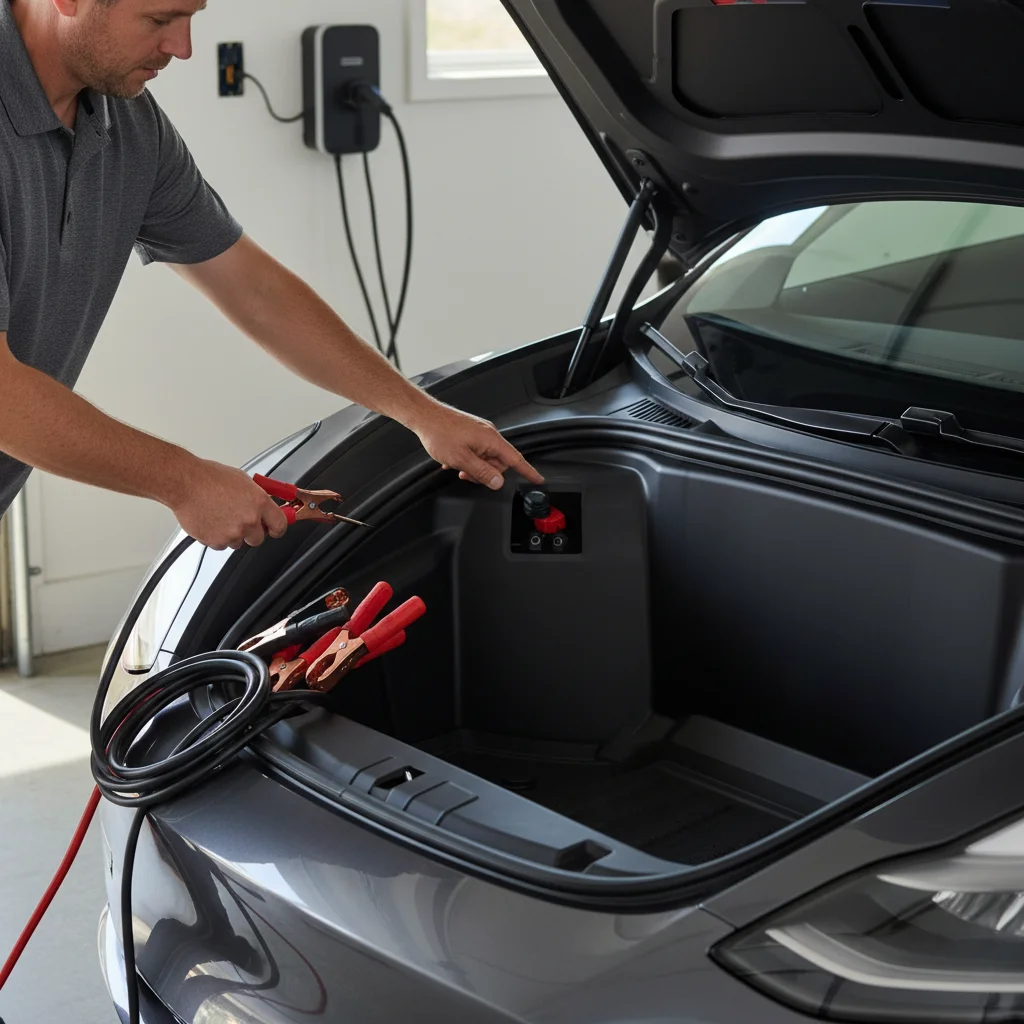
Tesla’s owner’s manuals are blunt on the policy. They walk you through receiving a jump. That’s for when your own 12-volt is dead. They tell you not to use the car to jump another vehicle. The frunk posts exist so an external source can wake your low-voltage system. They aren’t a donor tap. A clip that seems to work in a lot isn’t proof. Damage doesn’t always show before you drive home.
Why 100F makes a bad idea worse
A 12-volt already running hot has less margin. Cabin cooling adds load. Sentry Mode adds load. Parked electronics add load. Recurrent’s dataset included 345,622 trips by 300 Phoenix-area EVs. It found traction-pack range can drop about 20 to 30 percent above about 95F. Loss sits near 31 percent at 100F. That figure is about the big battery, not the little one. It still tells you the car is working harder in this climate.
Stack a starter-level draw on top of that heat. The small battery is the weak point. East Valley lots in Mesa, Gilbert, and Chandler bake after work. West Valley pavement in Glendale, Arizona, Goodyear, and Surprise does the same. North of the city, Anthem and Cave Creek add I-17 grade. None of that changes Tesla’s rule. It only raises the odds that your own 12-volt is next.
Read Why jumping a gas car from your Tesla is a bad idea for the neighbor-jump problem. The same logic holds if the other car is an EV. The truth about using an EV to jump a gas car covers that across brands.
What Arizona roadside help will and won’t do
Arizona does run free motorist help. Arizona DPS Roadside Motorist Assistance will change a tire. It will bring gasoline or diesel. It will jump a dead battery, add water, and call a tow. Its published materials name gasoline and diesel. They don’t mention EV charging. They don’t mention an out-of-charge Tesla. ADOT’s Incident Response Unit works Phoenix-area freeways. Hours are 5am to 8pm on weekdays. It clears crashes and debris. It changes tires and helps stranded motorists. It also doesn’t advertise bringing an EV a charge.
A gas neighbor on Loop 101 Agua Fria may get a conventional jump from the state. The same can happen on the Superstition Freeway. Your Tesla is still the wrong donor. If the stuck car is an EV, a standalone jump pack can wake a dead 12-volt. Using your Tesla as that pack is the part to skip.
ARS 28-871 says to get a disabled vehicle off the traveled highway when you can. Stay visible 200 feet in each direction. ARS 28-775 is the Move Over law. Other drivers should change lanes or slow for a stopped car with lights on. If you’re helping, keep people out of live lanes. Don’t stand between bumpers on I-10 or Loop 202.
Help without turning your Tesla into a jumper
Carry a portable lithium jump pack sized for automotive use. Clip that to the other car, not your Tesla. Keep it in the frunk. Kindness shouldn’t drain your 12-volt.
If you don’t have a pack, help them call. Their insurer, club roadside, or a local shop can send a proper jump. Wait with them in a safe lot if you can. Offer a ride to shade, a grocery, or a terminal. Banner University Medical Center Phoenix is an easy landmark. So is Mayo Clinic Hospital in northeast Phoenix. A ride costs your 12-volt nothing.
If the other driver is in an EV, the problem may be an empty traction pack. It may not be the 12-volt. Tesla roadside tows to a Supercharger or service center. It doesn’t charge on site. Independent mobile operators can bring a 240V Level 2 source to the car. They use a native NACS plug. They use a CCS or J1772 adapter for other brands. Typical on-site charging adds about 10 to 20 miles of range. That’s in 15 to 30 minutes of charging. That’s charging time, not an arrival time. Charge Pro PHX is a referral line. We match stranded drivers with independent local operators. Those operators quote before they start. They bill you directly. We don’t own trucks. We don’t do the work. The pros we connect you with are licensed and insured.
When your Tesla is the one that won’t wake
The question flips when it’s your car. It happens in a Tempe apartment lot. It happens after a Diamondbacks night at Chase Field. Heat plus parked electronics is a common 12-volt killer here. Watch for a low-voltage warning. Watch for a 12-volt battery service message. Watch for doors that won’t release. When Tesla 12-volt batteries fail in desert heat walks through the pattern.
Receiving a jump is the approved direction. Use a proper pack. Follow your model’s manual. Mind the tow-hook method if that’s what Tesla specifies for your car. How to jump a Tesla from the bumper tow hook is the local walkthrough. If you’d rather not clip cables in 100F sun, call for help. The operators we connect you with can jump a dead 12-volt on site. They can replace it on site too. That’s the Tesla 12-volt battery jump path.
Don’t confuse a dead 12-volt with an empty pack. An empty pack needs energy into the charge port. A dead 12-volt needs a clean 12-volt source first. That’s so the contactors can close. How to jump start an electric car safely in desert heat separates those two calls.
Home charging on APS or SRP keeps the car plugged in at night. That helps the DC-DC keep the 12-volt topped. It still doesn’t make your Tesla a safe donor the next morning in a Mesa lot.
Valley lots and freeway shoulders
You’ll hear the ask after night games at Chase Field and Mortgage Matchup Center. Parking garages hold heat long after first pitch. You’ll hear it at Sky Harbor. Someone returns to a car that sat in Terminal 3, Terminal 4, or East Economy. Level 2 charging is confirmed in the Terminal 3 and Terminal 4 garages and at the 24th St. station. A car that sat unplugged can still refuse to wake. The 12-volt can cook even when stalls exist in the same garage. Confirm stall status on site.
You’ll hear the same ask on the shoulder of I-17 toward Anthem. You’ll hear it on US-60 through Mesa. Phoenix Raceway in Avondale packs lots on race weekends. State Farm Stadium in Glendale, Arizona, does the same on Cardinals Sundays. Neighbors still offer cables.
Sun City and Youngtown have older housing and more unshaded driveways. Gilbert, Surprise, and Maricopa have newer homes, so home charging is common. Maricopa the city is in Pinal County, not Maricopa County. The jump request still happens on the road.
Tribal land sits inside the metro, including Salt River Pima-Maricopa land by Scottsdale, Tempe, Mesa, and Fountain Hills. Follow posted rules if you stop there. Your Tesla still shouldn’t jump the other car. Arizona doesn’t observe daylight saving time. Treat a portable jump pack as a year-round frunk item.
If two Teslas are involved
Jumping one Tesla from another looks tempting. Both have 12-volt posts. It’s still using a Tesla as a donor. Tesla’s published instruction isn’t limited to gas cars. Keep the portable pack as the middle device. If both cars are out of traction charge, jumper cables won’t move pack energy. Operators can charge on site when the pack is empty. They can jump the 12-volt when the car won’t wake. They can’t rewrite Tesla’s electrical design. Neither can a helpful neighbor in a Phoenix lot.
Frequently asked questions
Can a Tesla jump start another car?
No. Don’t use a Tesla as the donor. Its 12-volt system isn’t built to start another vehicle. Valley heat already stresses that battery.
Can a Tesla jump start a gas car?
No. A gas starter wants a high-amp punch your Tesla shouldn’t supply. Use a portable jump pack. Help them reach roadside help from a safe spot.
What should I use instead of my Tesla?
Use a self-contained jump pack made for cars. You can also wait in a safe spot. Help them call for a proper 12-volt jump or a mobile charge.
If your own Tesla won’t wake, you’re the one who needs the jump. Call (602) 932-0920. We’ll connect you with an independent local operator. That operator quotes you before starting. They bill you directly.