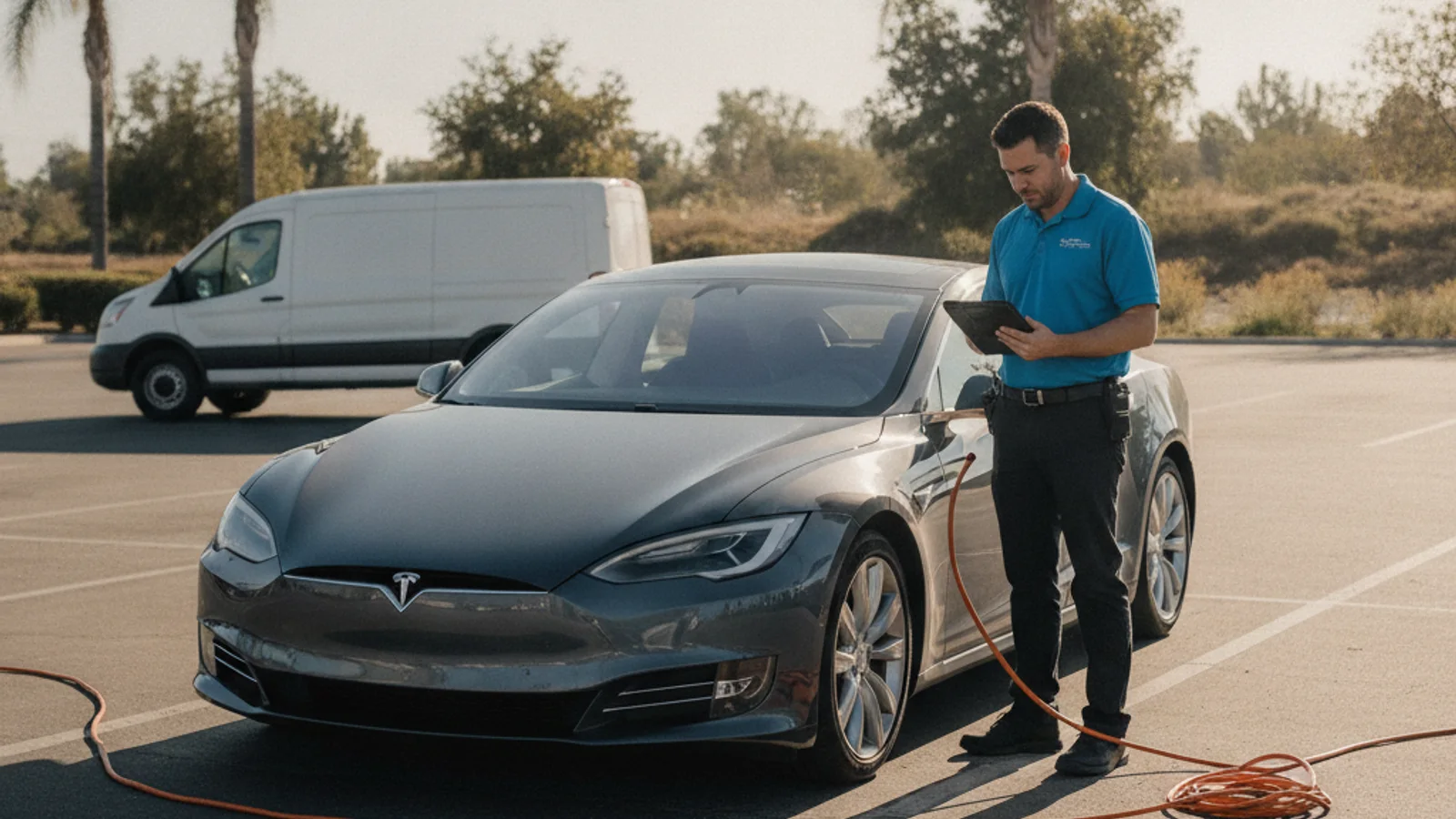
Do Teslas have a 12v battery? Yes. Every Tesla still carries a small 12-volt-class battery besides the traction pack. That little battery wakes the car. Phoenix heat is what usually kills it first.
The car has two power systems, not one
The floor pack is the one on the window sticker. It feeds the motors and sets the range. A second, much smaller battery runs everything that isn’t the motors. Screens, handles, cameras, and computers sit on that side. So do the relays that connect the pack.
Tesla markets the car as electric. It rarely dwells on that second battery. If the small one drops too low, the car can go fully dark. The pack can still hold a healthy charge. Nothing in the cabin responds. The app may not reach the vehicle. Plenty of range and a car that won’t wake. That’s why this search exists.
Other production EVs keep a low-voltage battery too. It’s a structural choice, not a Tesla quirk. The U.S. Department of Energy’s overview of how electric vehicles work covers this two-system layout. It doesn’t name any one brand’s parts.
The small battery is what lets the pack connect
The traction pack runs at several hundred volts. That’s the voltage the motors want. You don’t want that voltage on door locks or cabin lights. Most of those parts are ordinary low-voltage automotive hardware.
Tesla keeps the high-voltage pack isolated behind contactors. Contactors are large relays. They need low-voltage power to close. Until they close, the pack can’t feed the rest of the car. The 12-volt is the wake-up source. It powers the computers first. Then the contactors close. Only then does the pack start doing work.
A gasoline car solves a similar stack with a starter and an alternator. Tesla solves it with contactors and a DC-DC converter. While the car is on or plugged in, the converter steps pack voltage down. That keeps the small battery charged. Once the car is parked and asleep, the 12-volt runs the background systems by itself.
Sentry Mode and Cabin Overheat Protection keep drawing power in a parked car. In a Valley summer that draw never really stops. Overnight lows in the mid-80s don’t give the battery a cool rest. The converter isn’t topping it off unless the car is awake or charging.
Desert heat is why Valley 12-volts die early
Phoenix sees about 111 days a year at or above 100F. About 21 of those days reach 110F or more. July highs average near 107F. August sits near 105F. The record high is 122F, set June 26, 1990. The car lives in a dry oven, not a mild climate.
Battery Council International failure-mode work, cited through Battery University, found starter batteries last about 47 months in hot climates versus 59 in cool ones. A battery that lasts five years in a mild city can fail in two or three here. AAA calls heat the number-one cause of battery failure. It recommends AGM batteries for hot areas.
In an EV, that early death isn’t a no-start with a working radio. A dead 12-volt strands the car completely, even with a full traction pack. Handles, screens, and contactors all need it. Our write-up on when Tesla 12-volt batteries fail in desert heat walks through that stall on Valley roads.
Parking is often the trigger. Leave a Tesla a week at Phoenix Sky Harbor. The 12-volt is often the part that comes back dead. Level 2 charging is confirmed in the Terminal 3 garage. Stalls sit on Level 1 west, Level 3, and Level 7. The Terminal 4 garage has stalls on Level 4 east in zone B. The 24th St. station has charging too. The car can sit in heat between those sessions. Cabin Overheat Protection cools the cabin. It also pulls from the low-voltage side while the car is off.
East Valley suburbs with newer housing often have home charging. Gilbert and Maricopa are in that group. The 12-volt stays healthier when the car is plugged in most nights. APS’s R-EV plan covers overnight charging from 11pm to 5am weekdays. It serves much of Phoenix, Surprise, Goodyear, and Queen Creek. SRP’s Electric Vehicle Price Plan is closed to new enrollment. Existing customers can stay through the November 2029 billing cycle. Those plans help the pack. They also keep the DC-DC converter working while the car sleeps on the charger. A car that sits unplugged in a Sun City driveway doesn’t get that top-off. Neither does one in a Tempe apartment lot.
Lead-acid and lithium aren’t the same part
Tesla has changed the low-voltage battery more than once. Some Model S, 3, X, and Y cars use a traditional lead-acid 12-volt. Later Model 3 and Model Y cars use a lithium 12-volt. The two age differently. They aren’t serviced the same way.
Access changes too. On some cars the battery sits where a driver can picture it. On others, a technician has to pull trim or work from underneath. That’s not a parking-lot shortcut.
A model-year chemistry table goes stale the moment Tesla swaps a part mid-production. Wrong chemistry means the wrong replacement and the wrong procedure. The owner’s manual for that exact car is the first source. Tesla’s current service documentation is the second, and it overrides this page.
If you drive a newer 3 or Y, read what to do when the lithium 12-volt is dead. For physical layout on a 3, see where the Model 3 hides the 12-volt and the main pack. Name the model, year, and trim when you request help. Don’t guess.
A dark cabin isn’t an empty pack
Telling the two failures apart matters before anyone opens a panel.
A dead 12-volt usually means the car won’t wake at all. The touchscreen stays black. Door handles don’t present. The mobile app can’t reach the vehicle. Drivers describe it as the car going to sleep and never coming back.
A depleted pack looks different. The car still wakes. The screen still turns on. You get a range warning, not silence. Dark and silent versus awake but low is the fastest split.
That split holds in a Scottsdale garage and on a Loop 101 Agua Fria shoulder. Arizona DPS Roadside Motorist Assistance will change a tire. It can bring gasoline or diesel. It can jump-start a conventional battery. Its published materials say nothing about charging an EV. They don’t mention waking a Tesla with a dead 12-volt. ADOT’s Incident Response Unit works Phoenix-area freeways from 5am to 8pm weekdays. It clears crashes and debris and helps stranded motorists. Independent operators do that work instead. They can jump a Tesla 12-volt on site when the car is dark.
If you’re still sorting symptoms, how to tell a Tesla 12-volt is dead walks through the checks from the curb.
If you’re already on the shoulder
ARS 28-871 says you shouldn’t stop on the traveled lanes if you can get off them. That applies outside a business or residence district. A vehicle disabled so badly it can’t move is exempt. Leave room for other traffic. Stay visible 200 feet in each direction.
ARS 28-775 is the Move Over law. Other drivers should change lanes if they can. Otherwise they should slow down for a stopped vehicle with warning lights. That’s why an operator working a Tesla on I-10 or US-60 needs passing traffic to give space.
Arizona has no toll roads and no toll express lanes. Loop 202 South Mountain is free. You’re not waiting in a toll plaza. You’re on an ordinary Valley freeway in heat. State motorist help won’t bring the car a charge. A matched operator can.
Confirm the car before anyone works on it
Have the model, year, and trim ready. That’s what sets chemistry, location, and access. Your owner’s manual is the primary reference. Tesla’s published service notes supersede any blog, including this one.
Don’t follow a driveway video filmed on a different year. A step that’s routine on one Tesla can be wrong on another. If you’re not sure which low-voltage battery you have, say so. The matched operator confirms the system before touching it.
Charge Pro PHX is a referral line. It matches stranded Tesla drivers in the Phoenix area with independent local operators. It doesn’t own trucks, employ technicians, or set prices. The operator quotes you before starting and bills you directly. For a car that won’t wake, start with a 12-volt jump. That’s Tesla roadside rescue, not a tow by default.
When to pick up the phone
Call when the Tesla has gone dark and unresponsive. Call even if the last range figure looked healthy. That mismatch usually points to the 12-volt, not the pack. Call (602) 932-0920 and we’ll connect you with a local EV rescue operator.