A Model S can need low-voltage help while its main battery still has charge. In Phoenix, the immediate decision is whether the car needs a jump, a Tesla 12V battery replacement, or transport for further service.
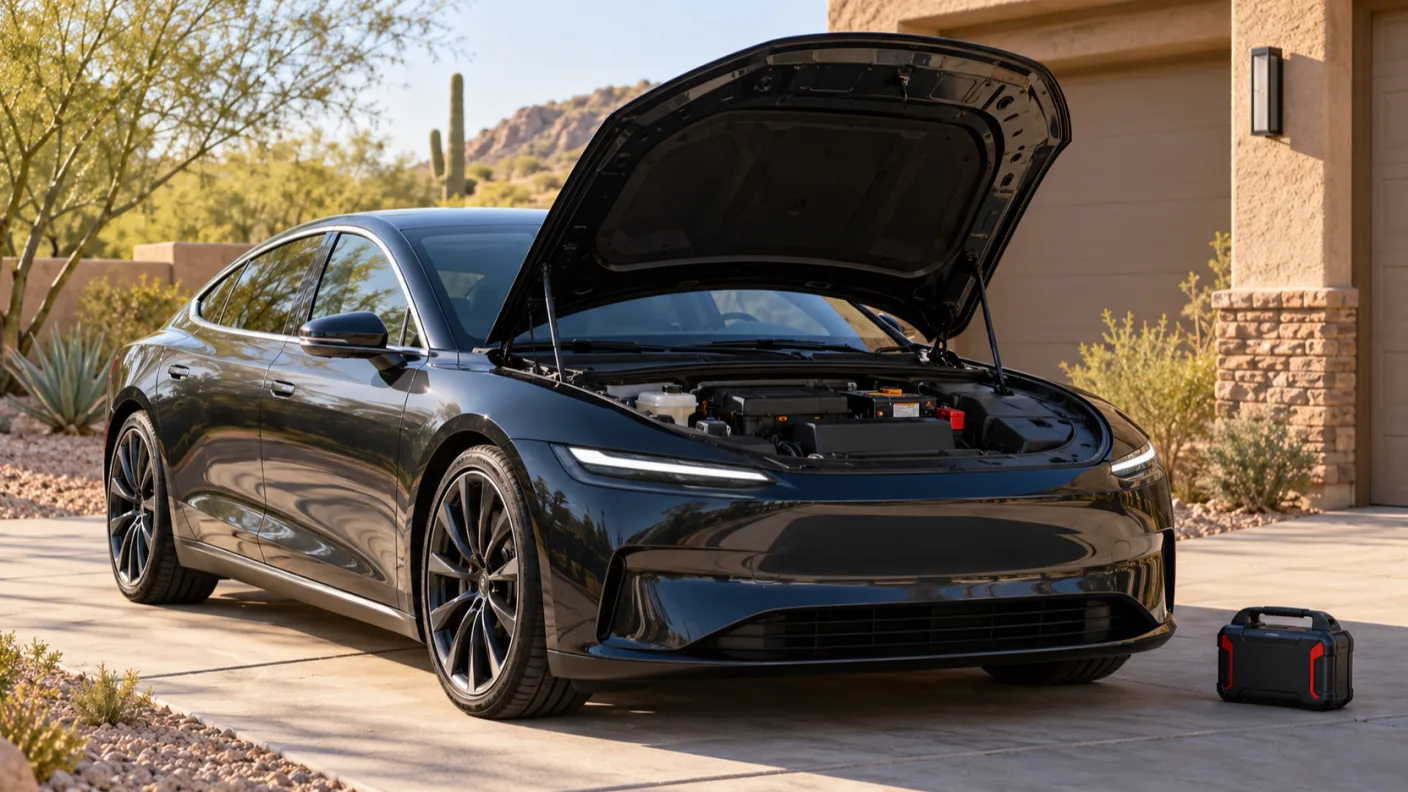
Where the Model S hides the 12-volt
Tesla places the current Model S positive jump post beneath the maintenance panel. The exact position differs slightly between vehicles made before and after approximately January 2023. Tesla’s illustrated procedure also identifies a separate grounding point for the negative lead.
That distinction matters when someone reaches the car at a Phoenix curb or parking lot. A photo from another Model S may show a different layout. Instructions for a Model 3 or Model Y shouldn’t be transferred to a Model S either.
Start with the car’s exact configuration. If the touchscreen works, review the available vehicle information and current alerts. The Tesla app and vehicle details can also help Tesla Service identify the correct procedure. When the screen doesn’t work, provide the vehicle identification details rather than guessing from its appearance.
Don’t order a replacement based only on the words “Model S 12V battery.” The approved battery type, connection layout, and replacement steps weren’t confirmed as universal across Model S production. Tesla’s current manual should control the decision for that specific car.
The same caution applies to battery chemistry. Model S vehicles shouldn’t be grouped into a simple “older means lead-acid, newer means lithium” rule without Tesla confirming the installed configuration. Check with Tesla Service before buying a battery or approving a substitute.
Drivers comparing other Tesla bodies can review our Model 3 replacement guide and Model Y replacement guide. Their access procedures don’t replace the Model S instructions.
Heat signs that the small battery is failing
Phoenix heat makes battery condition worth addressing early. NOAA climate normals show about 111 days each year at or above 100°F. July highs average near 107°F, while August highs average near 105°F.
Battery Council International data, reported through Battery University, found starter batteries lasted about 47 months in hot climates. The comparable figure was 59 months in cooler climates. That finding isn’t a Model S replacement schedule, but it explains why age deserves attention in the desert.
AAA also identifies heat as the leading cause of battery failure. That doesn’t mean every electrical problem in a hot Model S comes from its low-voltage battery. A warning, dark screen, access problem, or failure to wake still needs proper identification.
Read the complete message if the touchscreen or app shows one. Save a screenshot when possible. Record whether the car responds to the key, app, touchscreen, locks, or charge-port controls. Those observations help Tesla or an independent operator understand the situation. They don’t prove that replacement is necessary.
Location adds useful context. A Model S parked near Chase Field faces a different recovery setting than one inside a Sky Harbor garage or on a Scottsdale driveway. Tell the operator whether the car is in traffic, behind a gate, inside a height-restricted garage, or tightly parked.
If the Model S has no usable low-voltage power, our guide to a Model S that won’t start explains how to separate the immediate roadside problem from the later replacement decision.
Service center replacement versus an on-site jump
A jump and a battery replacement are separate services. Choose between them based on the car’s condition, its exact configuration, and the next step recommended for that vehicle.
Tesla’s current Model S manual says an independent provider may replace the low-voltage battery, depending on configuration and location. That wording doesn’t make every Model S an appropriate curbside replacement. The provider still needs to identify the installed system and confirm the applicable procedure.
An on-site jump focuses on restoring low-voltage support through the Model S jump points. It may help with access or allow the vehicle to wake. It doesn’t establish that the battery is healthy, identify why power was lost, or confirm that the car should be driven.
Tesla says a Model S must not be used to jump-start another vehicle. That warning applies even when another stranded car is nearby. The Model S is the vehicle receiving assistance, not the power source for someone else.
A Tesla Service replacement may make more sense when the car has active warnings, an uncertain configuration, or another electrical concern. An independent replacement may be practical when the provider can verify the battery and Tesla procedure for that exact vehicle.
Tesla doesn’t publish one universal Model S replacement price in the approved information available for this page. Current battery pricing, labor, mobile-service availability, disposal, and warranty terms couldn’t be confirmed. Ask Tesla Service for a written estimate through the app. Ask an independent provider what its quote includes before approving work.
For the immediate low-voltage problem, see our Tesla 12V battery jump service. Charge Pro PHX refers drivers to independent local operators. It doesn’t perform the jump or replacement.
What a matched operator can do from the curb
A matched operator can first review the situation you report. Give the operator the Model S model year, approximate build period if known, parking location, warning text, and current access status. Mention whether the frunk is already open and whether the maintenance panel has been disturbed.
The operator can then determine whether the requested work fits that location and vehicle configuration. Tesla’s manual places the positive jump point under the maintenance panel and shows the proper negative grounding point. The operator should use the current illustrated Model S procedure, not a generic Tesla diagram.
If the request is a jump, say that clearly. If you want replacement considered, ask whether the operator can identify and obtain the exact compatible battery. Also ask what post-service checks are included. Don’t assume a successful wake-up automatically changes the request into a replacement.
Leave the battery bay intact while help is being arranged. Don’t disconnect components or move cables merely to identify the battery. Photos can help, but only when they’re taken without dismantling the car or touching exposed connections.
Roadside conditions also shape the response. Arizona law says a vehicle outside a business or residential district shouldn’t remain on the traveled highway when it’s practical to move off. A severely disabled vehicle is exempt, but it must leave room for traffic and remain visible from both directions.
If the Model S is obstructing a Phoenix-area freeway, prioritize personal safety and official roadside direction. A curb, driveway, garage, or parking space presents a different working area. Describe it accurately when requesting Tesla roadside rescue.
What Tesla publishes, and what you still confirm
Tesla publishes a current Model S jump-start procedure. It identifies the positive post beneath the maintenance panel and the illustrated grounding point for the negative lead. It also notes the location difference around the January 2023 production period.
Tesla further states that an independent provider may replace the low-voltage battery, depending on configuration and location. Those are the firm boundaries available from the current Model S owner’s manual.
Several details still require confirmation for the individual car:
- The installed low-voltage battery type and chemistry
- The correct replacement part for that configuration
- The complete isolation and reconnection procedure
- Any required tools, settings, or completion checks
- Whether Tesla mobile service is available at that location
- Current parts, labor, disposal, and transport charges
- Warranty coverage for the battery and completed work
Tesla roadside assistance is requested through the Tesla app. Select Roadside, choose the issue, and confirm the requested details. Availability and coverage can depend on the situation, so review the terms shown for that request.
Don’t confuse this small low-voltage battery with the high-voltage traction pack. A listing for “Tesla battery replacement” may concern the main pack instead. Ask the seller or provider to state plainly that the quote covers the Model S low-voltage battery.
Also avoid treating an aftermarket fitment claim as Tesla approval. Compatibility, battery chemistry, electrical connections, and required procedures must match the individual Model S. Tesla Service or the selected independent provider should confirm those points before installation.
That careful verification is especially useful after prolonged Phoenix parking. Heat history may explain why a driver is concerned, but it can’t identify the failed component by itself. The actual alert, vehicle configuration, and diagnostic findings should guide the work.
When to call us
Call when your Model S needs low-voltage help at a Phoenix-area curb, driveway, garage, or parking lot. Charge Pro PHX can connect you with an independent local EV rescue operator who can assess whether an on-site jump or another service path fits the situation.
Call us at (602) 932-0920 and we’ll connect you with a local EV rescue operator.