A Farmers card in a Phoenix glove box does not automatically mean a dead EV gets a charge. You might be sitting in palo verde shade in Mesa, or on a curb near Tempe Town Lake, with a dark cluster and a hot cabin. The next call is about a jump, a tow, or a mobile charge. Farmers sets those terms. Confirm them before anyone rolls a truck.
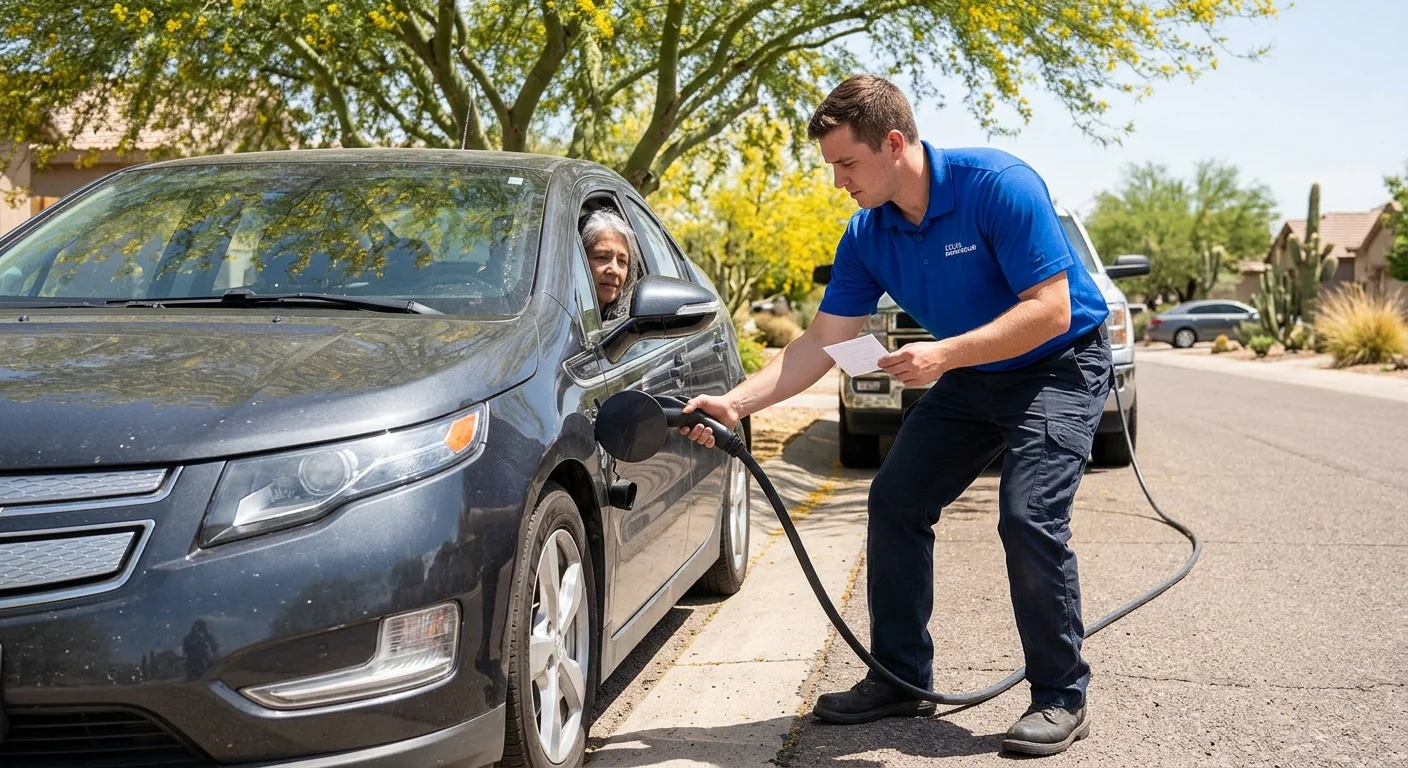
What Farmers roadside typically covers for EVs
Roadside on a Farmers auto policy is a coverage question, not a given. Some policies add towing and roadside. Some do not. Your declarations page is the list of what you actually bought.
A specific Farmers benefit that pays for mobile EV charging could not be confirmed. Farmers writes the current form. Ask them. That gap matters in the Valley because an empty pack and a dead 12-volt battery look the same from the sidewalk. They are not the same job.
For an EV, split the call into three jobs. A jump tries to wake the low-voltage battery. A tow moves the car to a charger, a shop, or home. A mobile charge puts energy into the traction pack where you sit. Many auto roadside add-ons in the U.S. were written around gas cars: a jump, a tire, a lockout, a few gallons of fuel, a tow. Fuel does not map to charging. Confirm each job by name.
Tesla’s roadside policy is a comparison, not a Farmers rule. Tesla says assistance for a depleted battery is available, and it is not a financially covered service. Tesla typically arranges transport to the nearest Supercharger or service center. Whether Farmers treats an empty pack as a tow in Arizona has to come from Farmers on the current call.
Valley drivers ask the same question of other carriers. See State Farm roadside for a dead Phoenix EV and Progressive roadside for a dead Phoenix EV. Your Farmers endorsement still controls your claim.
Local roads change the work even when the policy does not. A stall on Loop 202 at South Mountain is a freeway problem under ARS 28-871: get off the traveled lanes when you can, leave room for traffic, and stay visible 200 feet each way. A stall in a Sky Harbor garage is a parking problem. A stall on SR-347 toward Maricopa sits on a corridor ADOT still lists as a charging gap in planning. Arizona has no toll roads. The bill that matters is the operator’s quote, then whatever Farmers agrees to pay.
Jump, tow, and charging: what to ask on the call
Call Farmers first if you are already in a safe spot. Then ask three questions. Do not let them collapse into one.
First, is this a no-start with a dark dash, or did the range hit zero. A heat-killed 12-volt battery can lock the car with miles still in the pack. An empty pack needs energy. A jump does not add range.
Second, what will they send. Ask whether their contractor will attempt an EV 12-volt jump, a flatbed tow, or neither until a tow is approved. Ask whether mobile charging is a covered service on your endorsement. If the answer is not a clear yes, treat the charge as a bill you pay to a local operator. Seek reimbursement only after Farmers says they will pay.
Third, who is covered on this vehicle today. People ask whether a partner or friend driving the car is included. A household-member or permissive-use rule for Farmers roadside could not be confirmed here. Ask the representative. Get a reference number.
Have these details ready:
- Year, make, model, and whether it is a Tesla or another EV
- Exact location: milepost, exit, garage level, or cross street
- Whether the car can roll or sit in tow mode
- Whether the charge port and low-voltage posts are reachable
- Whether you already called Arizona DPS or ADOT
On a Phoenix-area freeway, ADOT’s Incident Response Unit works those roads from 5 a.m. to 8 p.m. on weekdays. It is a 14-member unit, sponsored by State Farm since 2020, not by Farmers. It clears crashes and debris, changes tires, and helps stranded motorists. Published materials do not mention EV charging. DPS Roadside Motorist Assistance is statewide. It names gasoline and diesel. It says nothing about charging an EV. Those trucks can make you safer. They are not a mobile charger.
ARS 28-775, the Move Over law, applies when you are stopped with warning lights on. Approaching drivers must move over a lane if they can, or slow down. Fines run $275, then $500, then $1,000 for repeats within five years. Stay out of the live lane.
If Farmers will only tow, ask where the truck may take you: nearest public charger, a dealer, or an address you name. Mileage caps, deductibles, and trip limits could not be confirmed here. Do not guess them. Ask, then write the number down.
If you hire a local operator for emergency EV roadside assistance, tell Farmers the contractor’s name before work starts when you can. Some insurers only pay the truck they dispatch. If Farmers has that rule, they have to say so.
Phoenix heat lockouts a policy may not solve
Phoenix averages about 111 days a year at or above 100F, and about 21 days at or above 110F. July highs average near 107F. August sits near 105F. Overnight summer lows still hang in the mid-80s. That is cabin heat, 12-volt heat, and pack heat at once.
Recurrent looked at 345,622 trips by 300 Phoenix-area EVs. They report EVs can lose 20 to 30% of range above about 95F, with loss near 31% at 100F. AAA’s 2026 study found about a 10% efficiency drop and an 8.5% range loss at 95F versus 75F. NREL lists cabin cooling among the biggest range draws.
A 12-volt failure is the lockout a roadside jump is built for. The dash is dark. Handles may not work. The high-voltage pack can still hold range. Battery Council International work, via Battery University, found starter batteries last about 47 months in hot climates versus 59 in cool ones. AAA calls heat the number-one cause of battery failure. Many EVs still need that small low-voltage battery to boot. Tesla’s current Model Y uses a lithium-ion low-voltage pack with its own jump-post procedure. Confirm the type in the manual for your model and year.
A jump may restore 12-volt power. It does not refill the traction pack. If the car sat at a few percent on I-17 north of Anthem, you need energy. Anthem is about 1,860 feet. Sunset Point rest area is about 3,410. ADOT posts a 6% maximum grade on the northern I-17. Drivers on that climb report much higher energy use going up than coming down. That is a driver report, not a lab measurement.
If the car died in a Sky Harbor garage, Level 2 charging is confirmed in the Terminal 3 garage, the Terminal 4 garage, and at the 24th St. station. A local charge can be the better move when an operator can reach the stall. Farmers still has to say whether they will pay for it.
West Valley lots in Surprise, Goodyear, and Buckeye bake all afternoon. East Valley street parking in Gilbert, Chandler, and Mesa does the same. Scottsdale and the northeast add hills. The Pinal belt toward Maricopa and Casa Grande is newer housing and longer gaps between chargers. The endorsement does not change by city. The failure mode does.
How a local mobile charge is quoted by operators
Charge Pro PHX is a referral service. We connect you with independent local operators. We do not own the truck. We do not set the price. We do not promise an arrival time. The operator quotes you, does the work, and bills you.
A typical rescue charge is 10 to 20 miles of range in 15 to 30 minutes of Level 2 charging. That is charging time on the plug, not travel time to you. A Level 2 unit can range from 2.9 to 19.2 kW. Most residential Level 2 chargers run up to 30 amps and deliver 7.2 kW. A mobile truck may not match a wall unit. Ask what they will deliver to your inlet.
Quotes usually turn on four things. Where the car sits: surface lot, garage, or freeway shoulder. Which connector you have: J1772, NACS, or CCS. How many miles you need to reach a charger or home. Whether the 12-volt system must be woken first.
Pay the operator unless Farmers has already agreed, on the current call, to dispatch and pay that operator. Keep an itemized receipt: location, connector, minutes on the plug, and the total. Insurers that reimburse roadside work want that paper.
We keep a separate walkthrough of how Phoenix mobile EV charging is quoted. For the service itself, see mobile EV charging.
If the operator says the pack is empty and a jump will not move the car, that is the charge job. If they say the 12-volt is dead and the pack is fine, that is the jump job. Mixing them on a Farmers claim is how reimbursement fights start.
Confirm Farmers current EV policy before you pay
Open the Farmers app or the paper packet. Find towing and roadside on the declarations page. If that line is missing, you may only have liability and collision. Those pay for crashes and named perils. They do not, by themselves, prove a dead EV gets a charge.
Call the roadside number on your card. Ask the charging question in one sentence: will you pay for a mobile EV charge at my location in the Phoenix area, or only a tow. Stay on the line until you have yes, no, or a cap they state. A Farmers dollar cap, trip limit, or EV charging benefit could not be confirmed for this page. Farmers is the authority. Their current form wins.
Hours for Farmers customer service and roadside dispatch could not be confirmed here. Do not assume a window. If you cannot reach them and you are in a live lane, call 911.
Geico policyholders in the Valley hit the same fork. We covered that in Geico roadside for a dead EV in Phoenix. The insurer writes the endorsement. The local operator does the charge. The U.S. Department of Energy explains how EV charging works. It does not pay your claim.
If Farmers says no to a mobile charge, you can still hire an operator if you need energy at the car instead of a hook. If they say yes, get the claim number before the plug goes in. If they say they will reimburse you later, ask what document they need. Then decide whether you can float that bill.
Do not pay a contractor based on a memory of last year’s card. Policies change. Arizona forms change. Your endorsement is the only yes that counts.
When to call us
Call when the car will not wake, the pack is empty, or Farmers will not send a mobile charge. We connect Phoenix-area drivers with independent local EV rescue operators who can jump a 12-volt system or put a Level 2 charge on the car. Call us at (602) 932-0920 and we’ll connect you with a local EV rescue operator.