A stalled EV in the Phoenix area doesn’t have a posted price. The mobile EV charging service cost comes from the operator, not a menu. Charge Pro PHX only matches you with an independent operator. That operator quotes you before they start, then bills you directly.
You want that number before anyone rolls. The honest answer is local, and it isn’t a Valley-wide rate card. It’s a quote from the person who’ll actually plug in.
What a roadside charge is, and what it isn’t
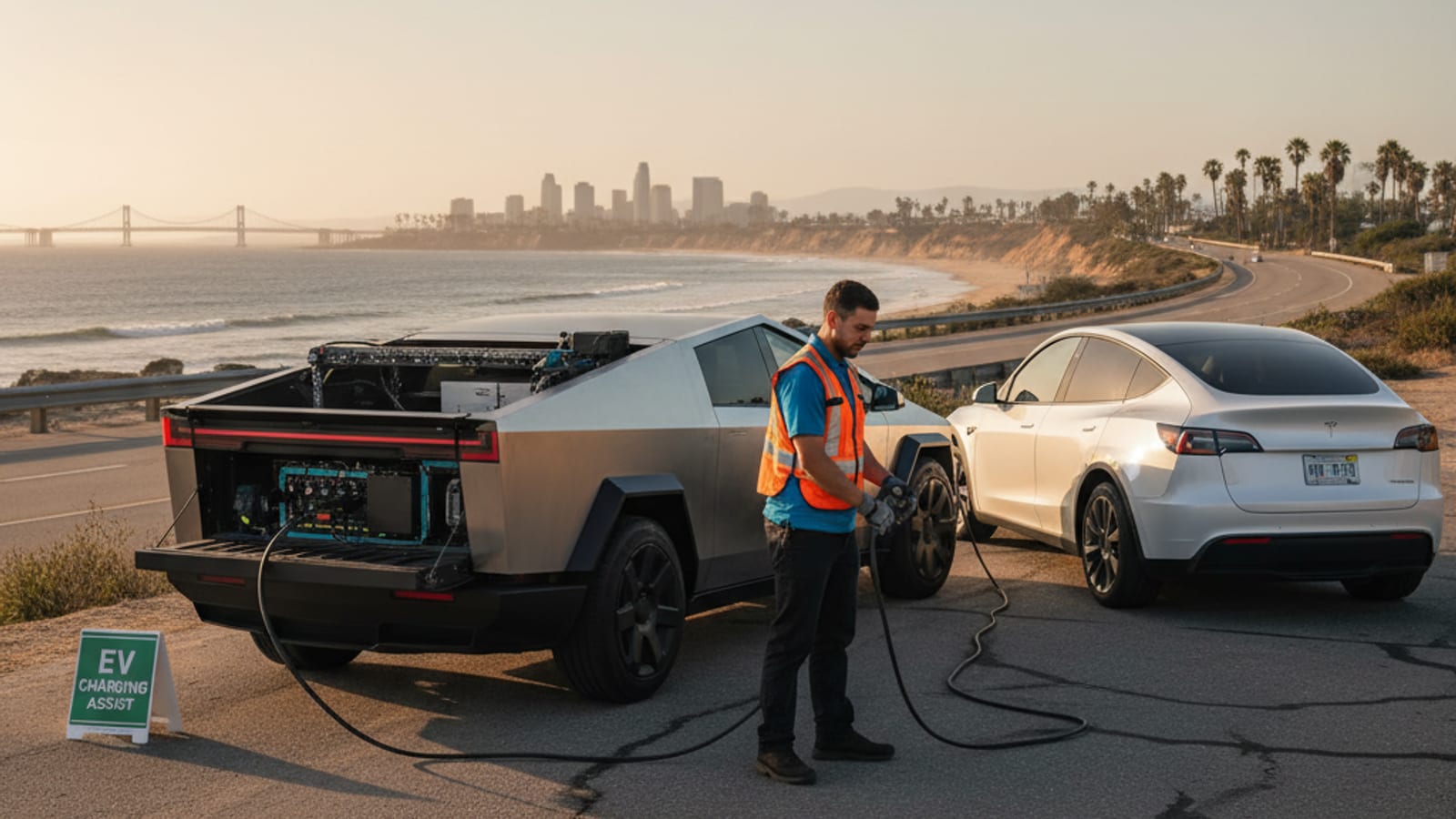
A mobile rescue isn’t a Supercharger on a truck. The operator brings a 240-volt Level 2 source to the car. Teslas take a native NACS plug, and other EVs take CCS or J1772. The point is a short, usable bump, not a full pack.
Most stops add about 10 to 20 miles of range. That’s charging time of about 15 to 30 minutes. That’s plug-in time once the truck is already there. It isn’t a promise of when the truck shows up.
You stay with the car and hear the number first. You decide if the job is worth it.
A packed traction battery doesn’t save you if the 12-volt is dead. The small battery runs the screens, the latches, and the contactor. Operators we connect you with can jump or replace that 12-volt on site. That’s a different job from an empty pack. The quote should name which one you’re buying.
Who names the price
Charge Pro PHX doesn’t own trucks or employ technicians. It doesn’t warehouse parts, and it holds no trade licence. It sets no prices, publishes no hours, and promises no arrival window.
The brand is a matching line for stranded Phoenix area drivers. Independent operators do the work, quote you, and bill you. If you want the current number, you get it from them.
Leave your pin, your make, and what the dash actually says. An empty traction pack is one kind of call. A car that won’t wake is a different job. A Tesla that needs NACS isn’t the same setup as a CCS hatchback. The operator prices the job they can do at your pin.
What usually shapes a Phoenix area quote
No public rate sheet turned up for mobile EV rescue across the Valley. Arizona doesn’t publish a statewide cap on this kind of work. Cities and counties may cap private-property tows. That’s a different statute from a live charge on a shoulder. Confirm the number with the operator before they start.
The quote still follows a few real inputs. Distance, shoulder safety, and miles added all feed the quote. Time of day can change who is available. None of those inputs is a figure we’re inventing here. They’re the questions a working operator will ask.
Where you’re sitting when you call
The Phoenix area isn’t one commute with one price. Central Phoenix, the East Valley, the West Valley, and the Pinal belt drive different roads. A stall in downtown Phoenix isn’t a stall on the Beeline. A quiet Tempe apartment lot isn’t the I-17 grade north of Anthem.
Operators price travel, and they also price access. A garage stall at Sky Harbor is a different setup from Loop 202.
Phoenix Sky Harbor International parks cars in the Terminal 3 and Terminal 4 garages. It also uses the East Economy garages and the East Economy surface lot. Level 2 charging is confirmed in the Terminal 3 garage. It’s also in Terminal 4 and at the 24th Street station. EVPassport installed that charging gear at PHX in 2022.
A car left a week in that heat often comes back drained. The 12-volt dies even if the pack still holds energy. Tell the operator which garage and whether the car will wake. The quote changes with the walk, the ramp, and access.
Phoenix-Mesa Gateway has Hourly, Daily, and Ray Road Economy lots. Whether that airport has on-site EV charging couldn’t be confirmed. The official amenities list doesn’t show it, so ask the operator what they can do in that lot.
East Valley calls often sit on Loop 101 Price or US-60 through Mesa. They also sit on the Santan stretch of Loop 202. West Valley calls sit on Loop 101 Agua Fria or Grand Avenue. They also sit on I-10 toward Goodyear and Buckeye. North Valley calls sit on I-17 toward Anthem, New River, and Black Canyon City. South and Pinal calls sit on I-10 toward Casa Grande. They also sit on SR-347 toward Maricopa, a city in Pinal County. I-8 toward Gila Bend is another long desert run.
None of that is a published mileage chart. Two drivers with the same car can still hear two quotes.
Arizona has no toll roads and no toll express lanes. ADOT confirms that, and SB 1340 bars new ones without a new vote. A text about an unpaid Arizona toll is a scam.
How much energy they plan to put in
Roadside Level 2 is a bump, not a fill. Ask how many miles they intend to add. Ask whether that’s enough to reach the charger you already picked. If you haven’t picked one, say so. The operator isn’t a trip planner. They’re pricing a short charge at your pin.
Don’t treat a blog’s 10 to 20 mile range as a contract. Cabin cooling and pack temperature both change what you actually get. Your car’s acceptance rate changes that number too.
AAA’s 2026 study found about a 10 percent efficiency drop at 95F versus 75F. It also found an 8.5 percent range loss in that same comparison. Recurrent used 345,622 trips from 300 Phoenix-area EVs. It reported 20 to 30 percent range loss above about 95F. Loss sat near 31 percent at 100F.
Phoenix averages about 111 days a year at or above 100F. About 21 days hit 110F or more. July highs average near 107F, and August sits near 105F. Summer nights often stay in the mid-80s. That’s why a planned commute still ends on a shoulder.
If the car won’t power on, you may not need kilowatt-hours at all. You may need a 12-volt jump or a replacement. Get that distinction into the quote before anyone plugs in. Paying for a charge session on a car that can’t close contactors wastes the stop.
Shoulder work, lots, and the Move Over law
A quote for a parking-lot job isn’t the same as a freeway shoulder. The operator has to stage the truck and set cones. They also have to keep both of you out of travel lanes.
ARS 28-871 covers stopping on the traveled part of a highway. Outside a business or residence district, get off it if you can. A vehicle disabled so badly it can’t be moved is exempt. When you’re stopped you must leave room for other traffic to pass. You must be visible 200 feet in each direction.
ARS 28-775 is the Move Over law. Approaching warning lights, move over a lane if you can do it safely. If you can’t, you have to slow down. That’s why an operator working your car needs passing traffic to give space. A live shoulder job asks for more staging, even without a published extra line.
ARS 28-872 lets police order a disabled or obstructing vehicle removed. Owners pay reasonable tow and storage costs before release. Arizona sets no statewide tow-rate cap. Cities may set maximums under ARS 9-499.05. Counties may set them under ARS 11-251.04. Those caps apply to private-property tows, not to a mobile charge. If someone is already talking tow, confirm the yard’s current rate before you pay.
In a minor crash, move the vehicle off the traveled roadway when it’s safe. That’s ARS 28-674, and you aren’t at fault merely for moving it. A low-pack stall isn’t a crash, but the same habit helps. Get out of the lane if the car can still creep.
Monsoon season runs June 15 to September 30. Haboobs can drop visibility to near zero, and flash floods follow. ARS 28-910 covers drivers who go around a barricade into floodwater. You can be billed for the emergency response. Don’t drive into water to make the next charger. Stay put and call from high ground.
Grade, elevation, and why the dash lied
Phoenix and Sky Harbor sit about 1,135 feet. Northbound I-17 doesn’t stay that low. Anthem is about 1,860 feet, and New River is about 2,140. Black Canyon City is about 2,000 feet. ADOT posts a 6 percent maximum grade on that northern I-17 climb.
Forum drivers on that grade have reported roughly 481 Wh/mi going up. That’s about 40 percent more energy uphill, and the nav often underestimates it.
SR-87, the Beeline toward Payson, climbs toward about 4,920 feet. ADOT posts a 7 percent grade into Slate Creek Canyon. US-60 east hits Apache Junction around 1,700 feet. I-10 south to Casa Grande is about 1,380 feet. I-8 west to Gila Bend drops toward about 700 feet.
A quote on those grades is still a charge or a 12-volt job. The grade is why you’re there, not a secret extra line we can invent. Tell the operator which road and which direction. They’ll price the run they actually have to make.
Don’t treat SR-88, the Apache Trail, as a through route. Parts of it were closed by monsoon damage as of 2026. The I-10 Broadway Curve project finished in spring 2025. That stretch isn’t active construction anymore.
Factory roadside, club plans, and a local operator
Tesla’s published roadside pattern is a tow, not an on-site charge. Tesla takes the car to the nearest Supercharger or service center. That tow is billed to the owner. Ford tows to the nearest charger, home, or dealer within 50 miles. Rivian and Hyundai/Kia owners have documented trouble getting a dead EV towed. Those drivers are often told to specifically request a tow.
None of those programs publishes a Valley-wide mobile-charge menu. Ask whether anyone will charge the car where it sits. If the answer is no, a local operator is a different product. See our Tesla roadside cost comparison.
Club plans, AAA, and insurer add-ons all vary. Some reimburse a local charge, and some only send a tow. Some still think battery means a 12-volt jump on a gas car. Read your card before you assume a charge truck is included. Charge Pro PHX can’t promise that a third party will cover the operator’s bill. Ask the operator for an itemized quote you can submit later.
Arizona does run free motorist help, and it isn’t an EV charge. Arizona DPS Roadside Motorist Assistance changes tires and brings gasoline or diesel. It jump-starts batteries, adds water, and calls tows. Its materials name gasoline and diesel. They don’t mention EV charging or an empty traction pack. Confirm current coverage with DPS if you want that truck, not a charge.
ADOT’s Incident Response Unit works Phoenix-area freeways from 5am to 8pm weekdays. It clears crashes and debris, changes tires, and helps stranded motorists. It doesn’t advertise bringing an EV a charge. That’s the job a mobile operator takes.
If the car only needs a tire, call the state programs. If the pack is empty, you need someone with a 240-volt source. Those are different trucks with different tools.
Home rates don’t write the roadside bill
Valley power is split among five utilities, sometimes on the same block. Treat any city-level map as directional, and confirm your own address.
APS serves large parts of Phoenix and all of Surprise, Goodyear, and Buckeye. It also serves Queen Creek, Apache Junction, San Tan Valley, and Litchfield Park. El Mirage, Youngtown, Sun City, Anthem, and Gila Bend sit on APS too. APS shares Chandler, Gilbert, Glendale, and Scottsdale with SRP. Tempe, Peoria, Avondale, and Paradise Valley are shared as well.
APS names the R-EV residential EV rate plan. It’s marketed as EV Overnight Charging, 11pm to 5am weekdays. It also names a Level 2 smart-charger rebate, APS Smart Charge, and Take Charge AZ.
SRP serves much of Mesa and shares the East Valley and central cities with APS. SRP names an Electric Vehicle Price Plan. That plan closed to new enrollment after a February 2025 board decision. Existing customers may stay through the November 2029 billing cycle. SRP also names an Electric Vehicle Export Price Plan for solar customers. There’s a Level 2 rebate through the SRP Marketplace. EV Smart Charge and Business EV Charging, or BizEV, are named too.
Mesa Municipal Electric covers about 5.5 square miles around downtown Mesa with an Electric Vehicle Time-of-Use rate called E1EV. ED3 serves the city of Maricopa and much of northern Pinal. It names EV TOU 2-10 and EV smart-charger on-bill financing. ED2 serves Casa Grande, Coolidge, and Florence. No EV-specific program was found on the ED2 site.
Those plans shape what you pay at home. They don’t set what an operator charges on I-10. A rebate for a wall unit doesn’t discount a shoulder session. Arizona has no state EV rebate or tax credit. It has no annual EV registration surcharge. The federal clean-vehicle credits ended for vehicles acquired after September 30, 2025. None of that writes a mobile quote.
Read home charging versus rescue for that tradeoff.
How this compares with a tow, a wait, or another car
A mobile charge keeps the car where it is. You hear a number, then get enough range to roll. You aren’t sitting in a tow yard waiting for a stall.
A tow moves the whole car. Arizona lets cities and counties cap some private-property tow bills. It doesn’t publish a statewide figure you can treat as the going rate. Confirm the current rate with the yard before you pay. Factory tows often aim at the nearest charger, not your driveway. Flatbed handling still matters on a disabled EV.
Waiting for a public stall only works if you can leave the car. On a freeway shoulder, you shouldn’t walk away. Sky Harbor’s Terminal 3 and Terminal 4 garages have confirmed Level 2. Chase Field and Mortgage Matchup Center sit in downtown Phoenix event traffic. State Farm Stadium sits in Glendale, Arizona. Phoenix Raceway sits in Avondale, not Phoenix, despite the name. Event drain is real after a late night. Still, don’t assume any named venue is out of chargers. Check the app in your car, then decide.
Vehicle-to-vehicle charging is rare, and most EVs can’t feed another car. Don’t count on a stranger in a Lightning to save you. See charge versus tow when you’re choosing between those two.
Safety on the shoulder is the other half of worth it. You’re sitting in heat that regularly tops 100F. You need shade, water, and a plan if monsoon dust rolls in.
What the operators we match actually bring
The trucks in this network bring a 240-volt Level 2 source to the car. They carry a native NACS plug plus CCS or J1772 adapters for non-Tesla EVs. They can jump or replace a dead 12-volt on site. They handle Tesla and every major EV brand.
See how the truck works for the bed and the plugs. If the traction pack is empty, you want mobile EV charging. If you only need enough range to reach a charger, that’s out-of-charge recovery. If the screens are dark, start with the 12-volt, not a fill.
Local habits that change how often you hear a quote
Housing stock isn’t trivia here. Sun City has 88.9 percent of homes built before 1980, and Youngtown sits at 51.8 percent. Sun City, Sun City West, San Tan Valley, Anthem, and New River are census-designated places. They have no city government of their own. Home charging is more common in newer Pinal and far-suburb stock. The calls still happen on the road after heat, an event, or a grade.
Tribal land sits inside the metro. Salt River Pima-Maricopa land sits between Scottsdale, Tempe, Mesa, and Fountain Hills. Gila River land includes Sacaton, Blackwater, and Casa Blanca, south of Chandler. These are sovereign nations with their own government and police. If you stall there, say so on the call. The operator needs the right jurisdiction, not a guess.
Paradise Valley the town isn’t the Paradise Valley urban village inside the City of Phoenix. Maricopa the city is in Pinal County, not Maricopa County. US-60 is Grand Avenue on the northwest run and the Superstition Freeway on the east. Loop 101 is Agua Fria on the west, Pima on the northeast, and Price on the southeast. Give the operator the named road, not a vague freeway.
Arizona doesn’t observe daylight saving time. The Navajo Nation does, and Hopi land doesn’t. Published times stay on MST, offset -07:00, all year.
Heat also shortens the small battery. Battery Council International work, via Battery University, found starter batteries last about 47 months in hot climates versus 59 in cool ones. A 12-volt that lasts five years elsewhere can fail in two or three in the desert. AAA calls heat the number-one cause of battery failure. In an EV, a dead 12-volt strands the car even with a full traction pack. Tesla features like Sentry Mode and Cabin Overheat Protection draw power while parked.
How to get a real number without guessing
Call with the facts the operator can price. Pin your location, then name the road and the direction. Say whether you’re on a shoulder, in a garage, or in an apartment lot. Name the make and the charge port. Say whether the car wakes, or only the 12-volt is dead. Say how many miles you think you need, and which charger you hope to reach.
Then wait for their quote. If it isn’t clear, ask them to split travel from energy. Ask whether a 12-volt jump is a separate line. Ask what happens if the car won’t accept a charge in this heat. A pack that’s too hot may limit acceptance. That’s a car limit, not a bait-and-switch.
Charge Pro PHX won’t invent a number for you in this article. Confirm the current rate with the operator before you pay. A page that invents a round figure is a liability.
A few ways to need that quote less often
Charge at home when you can, on the plan your utility actually offers. APS overnight windows and SRP’s remaining EV Price Plan customers aren’t interchangeable. Confirm your own tariff. A full pack in the morning is still the simplest way to start a Valley day. We can’t print a home kilowatt-hour price here because those figures move. They belong to your utility, not to a rescue quote.
Leave a buffer. AAA’s 2026 heat penalty and Recurrent’s Phoenix-area trip data both say range shrinks in the 90s and 100s. Cabin cooling isn’t free. Sentry Mode and Cabin Overheat Protection draw power while a Tesla sits. A week in a Sky Harbor garage is a classic 12-volt death, not a mystery.
Watch the grades. I-17 north of Anthem, the Beeline, and US-60 east of Apache Junction all climb. Forum reports on I-17 show the nav can undercount the uphill. Don’t plan a zero-percent arrival at the next stall.
Check the charging apps before you leave a lot. If a stall looks offline, pick the next one while you still have miles. Event nights at Chase Field, Mortgage Matchup Center, and State Farm Stadium stack extra miles of A/C and idling. Plan the drive home as part of the ticket.
Keep water in the car in summer. If you stall, stay with the vehicle if it’s safer than walking. Use hazards and give traffic room. Remember Move Over exists for the truck that’ll work next to you.
When the dash is already red, skip the guesswork. The operators we connect you with quote first, and they bill you directly. Start at EV charging in the Phoenix area for the matching map.
If you’re ready to be matched, call (602) 932-0920 with your pin and your car. You’ll hear the operator’s number before any cable goes in.
Frequently asked questions
Who sets the mobile EV charging service cost?
Charge Pro PHX doesn’t set it. Independent operators quote the job before they start. They bill you directly. No Valley-wide menu turned up in public sources. Confirm the current figure with the person who’ll plug in.
How much range does a roadside Level 2 stop add?
Operators in this network typically add about 10 to 20 miles. Charging time is usually 15 to 30 minutes once the plug is in. That’s plug time, not a travel estimate. Heat, grade, and your car’s acceptance rate all change the result. Ask for the miles they plan to deliver, not a full pack.
Does factory roadside pay for an on-site charge?
Tesla’s published pattern is a tow to a Supercharger or service center, not a charge at the bumper. Ford tows to a charger, home, or dealer within 50 miles. Club and insurer plans vary, so read your card. Arizona DPS and ADOT freeway trucks help with tires and gasoline. They don’t advertise EV charging. If you need power in the car, you need an operator who carries Level 2.