A 240 volt EV charging station is the home Level 2 setup. APS and SRP bill that wall box as planned overnight charging. A dead EV on Loop 101 is a different job. The operators we match bring 240-volt power to the car.
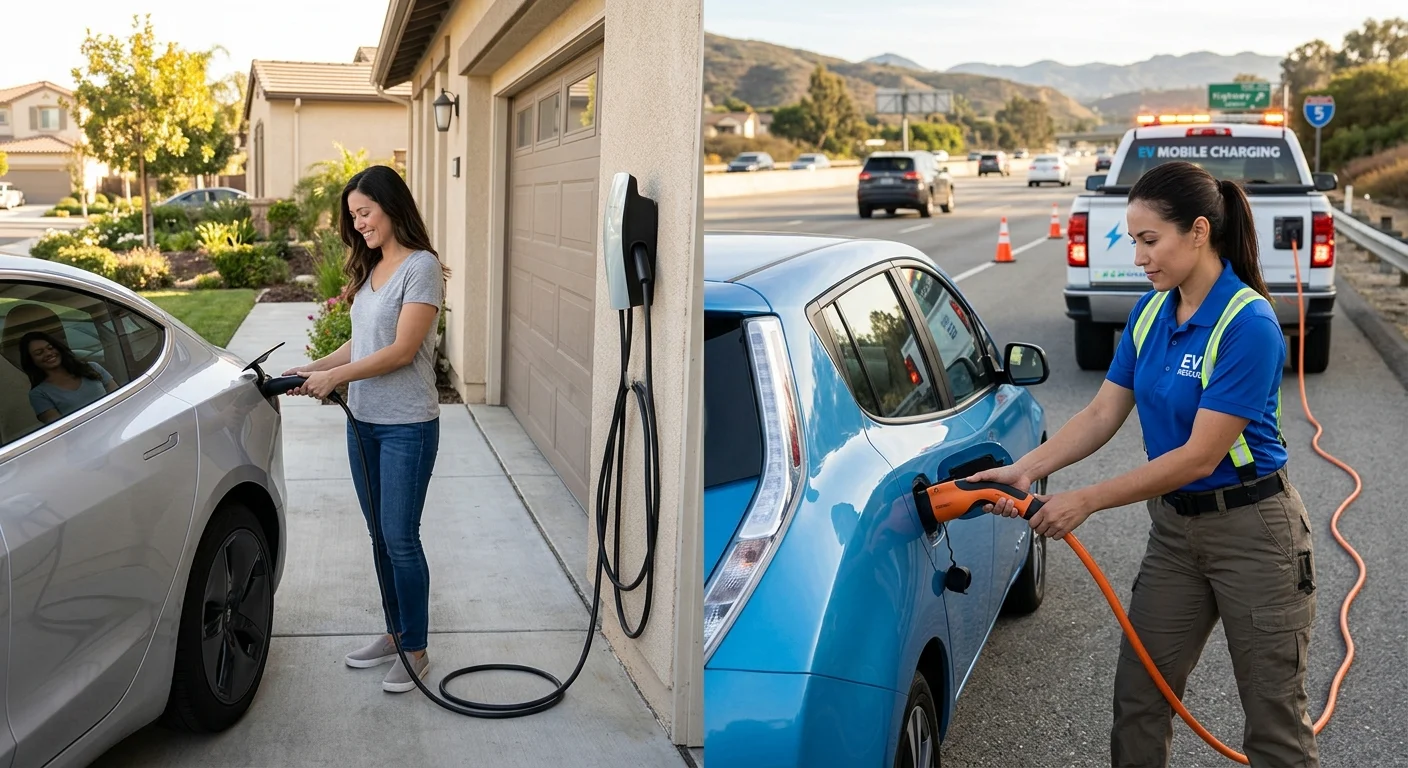
Two kinds of 240-volt work
Home charging and a roadside rescue can both use 240 volts. They still aren’t the same service, setting, or decision. One is a fixed station on your panel. The other is a truck that rolls to the car.
The US Department of Energy calls residential Level 2 a 240-volt connection. Some commercial sites use 208 volts instead of 240. Voltage alone doesn’t set how fast the pack fills. The car, the circuit, and the heat all change the result.
Level 1 is a regular 120-volt household outlet that adds energy slowly. Our guide to Level 1 charging in Phoenix heat covers that slower path. A wall outlet still has to match the equipment and the house.
A mobile operator’s 240-volt source is Level 2 at the bumper. The pros we send typically add 10 to 20 miles of range. That takes 15 to 30 minutes of charging time, never travel time. Native NACS plugs cover Tesla, with CCS or J1772 adapters for other brands.
What APS, SRP, and the other Valley utilities cover
Home 240-volt work starts with your electric bill. The Valley splits home power among five utilities. Service can change block by block inside one city. Confirm the address with the utility before you buy hardware.
Arizona Public Service covers large parts of Phoenix proper. APS also covers Surprise, Goodyear, Buckeye, Queen Creek, and San Tan Valley. Youngtown, Sun City, Anthem, and Gila Bend sit on APS as well. APS shares Chandler, Gilbert, Glendale, Scottsdale, Tempe, Peoria, Avondale, and Paradise Valley with SRP.
APS names its home EV programs on aps.com. The R-EV residential EV rate plan is marketed as EV Overnight Charging. That window is 11pm to 5am on weekdays. APS also lists a Level 2 smart-charger rebate. APS Smart Charge and Take Charge AZ round out the published list. Those are program names, not a locked dollar figure. Confirm the current offer with APS before you pay.
Salt River Project serves much of Mesa and shares cities with APS. SRP’s Electric Vehicle Price Plan closed to new enrollment after a February 2025 board decision. Existing customers may stay through the November 2029 billing cycle. Solar homes can look at the Electric Vehicle Export Price Plan. SRP Marketplace still lists a Level 2 EV charger rebate. EV Smart Charge and Business EV Charging, called BizEV, are named on srpnet.com.
Downtown Mesa has a third utility, Mesa Municipal Electric. It publishes an Electric Vehicle Time-of-Use rate called E1EV. Check mesaaz.gov if your meter sits in that pocket.
South of the county line sits ED3, Electrical District Number 3. ED3 serves the city of Maricopa and much of northern Pinal. It lists an EV time-of-use rate, EV TOU 2-10. It also lists EV smart-charger on-bill financing. ED2 covers Casa Grande, Coolidge, and Florence as well. No EV-specific program turned up on ed2.com when we checked. Ask ED2 directly before you assume a rebate exists.
Charge Pro PHX doesn’t install home stations, pull permits, or size panels. A licensed electrician handles the property side of that work. If the panel looks tight, start with when a Valley home needs a panel upgrade.
Newer streets versus older panels
Housing age changes the home charging path across the Valley. Gilbert’s stock is about 4.1% built before 1980. Newer houses often have a cleaner path to a 240 volt EV charging station. Drivers in those towns still stall on the commute. The wall box only helps when the car is in the driveway.
Sun City sits at the other extreme of the metro. About 88.9% of its housing went up before 1980. Older panels, shared walls, and carports change what an electrician can attach. That still isn’t a roadside problem until the car is somewhere else.
Read Tesla home charging on APS and SRP for the bill side. Utility copy and a rescue call stay separate on purpose.
Heat still empties the pack after a full night at home
Phoenix averages about 111 days a year at or above 100F. About 21 days hit 110F or more, per NOAA 1991-2020 normals via NWS Phoenix. July highs average near 107F, and August sits near 105F.
AAA’s 2026 study found about a 10% efficiency drop at 95F versus 75F. Recurrent reported 20 to 30% range loss above about 95F. That dataset covered 345,622 trips by 300 Phoenix-area EVs.
A full overnight charge at home can still run short on I-17. The same drain shows up on the Beeline and on US-60 east. That’s range in heat, not a claim about nearby stalls.
When the wall station can’t help
The home 240 volt EV charging station stays on the house. It can’t reach a car on I-10, Loop 202, or SR-347. A dryer outlet at a stranger’s building isn’t a charging plan. You need the owner’s okay, a safe circuit, and a connector the car accepts.
A low traction pack is only one failure. The car may refuse to charge or throw a fault. A dead 12-volt can lock the doors even with a full pack. Heat is hard on that small 12-volt battery.
If the car is parked at home and won’t take power, you need diagnosis. Call a repair shop, not a rescue truck. If you’re away from home without a usable stall, use out-of-charge recovery.
Sky Harbor mixes charging and a dead 12-volt after travel. Terminal 3, Terminal 4, and the 24th Street station have confirmed Level 2 charging. A car left a week in a hot garage can still wake dead. The wall box at home doesn’t fix that lot. Tesla’s published roadside path tows to a Supercharger or service center. Factory help doesn’t charge the car on site.
Arizona DPS Roadside Motorist Assistance will change a tire and bring gasoline or diesel. ADOT’s Incident Response Unit works Phoenix-area freeways on weekdays from 5am to 8pm. Neither program advertises bringing an EV a charge. An independent mobile operator is who brings 240 volts to the car.
If you stop on a highway, follow ARS 28-871. Get off the traveled lanes when you can. A disabled vehicle that can’t move is exempt. ARS 28-775, the Move Over law, asks other drivers to change lanes or slow. That’s for the operator working your shoulder, not a home install.
Smoke, fire, a crash, or a live traffic hazard is an emergency call first.
What to tell an electrician versus an operator
An electrician needs the address, panel photos, and the charger’s spec sheet. Permit rules vary across the Valley by city and county. Phoenix, Mesa, Tempe, and Scottsdale each run their own building desks. We couldn’t verify a single metro-wide permit checklist.
For a roadside match, share make, model, and year. Add the connector, the dash warnings, and remaining range. Pin the location with the road name, not just a pin drop. Loop 101 Agua Fria isn’t Loop 101 Price. US-60 as Grand Avenue isn’t the Superstition Freeway. Tell the operator if you’re on Gila River or Salt River Pima-Maricopa land.
Our charging levels guide for stranded drivers covers Level 2 at the bumper. That bump is mobility, not a full fill.
Mobile 240-volt help, or a tow
Mobile charging fits when the pack is empty and the car will accept power. The goal is enough range to reach a charger you already checked. It isn’t a substitute for a home overnight session. Compare that choice in home charger install versus a mobile EV rescue.
Charge Pro PHX is a referral line, not a shop. We connect you with licensed, independent local operators. The matched pro quotes you before starting and bills you directly. We don’t set prices or promise an arrival window.
A tow may be the honest call if the car won’t take energy. It may also be the call if the shoulder is unsafe for charging. Tesla factory help, when it tows, aims at a Supercharger or service center. Ford’s published roadside path tows to a charger, home, or dealer. The published radius for that tow is 50 miles. Ask the operator where the car will go and whether that site takes your plug.
Before you agree, ask what gear they’re bringing. Ask what miles they expect to add and what the quote covers. No countywide price exists because the operator and the stop set it. Confirm the number with the person on the way.
When to call us
Call when the car can’t reach a usable charger and you need bumper help. We match stranded drivers across the Phoenix area with independent mobile rescue operators. For mobile EV charging across the Phoenix area, call (602) 932-0920. The operator you get will quote the work before it starts.