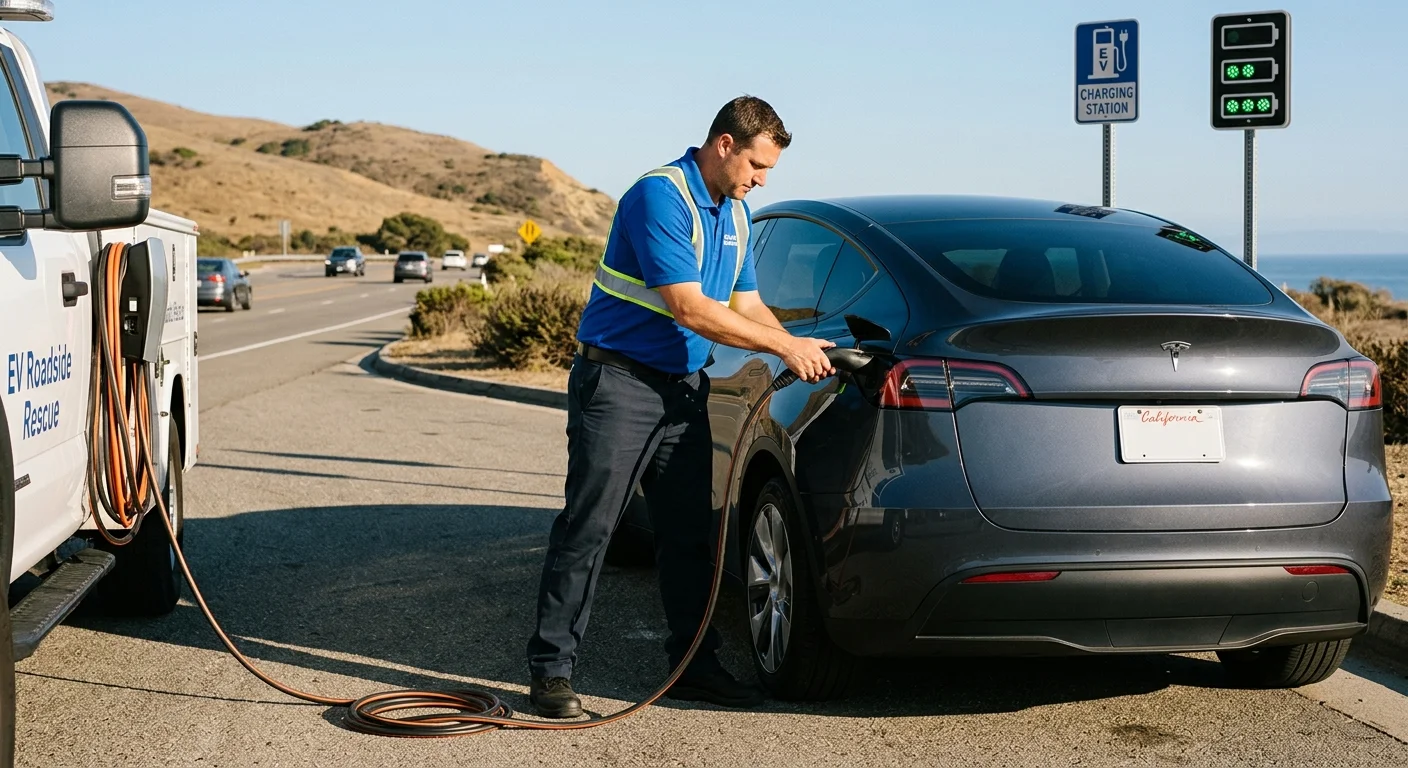
A mobile Level 2 charge is what usually gets a Phoenix-area driver moving again. The independent operators we match bring a 240-volt source to the car. They typically add 10 to 20 miles of range. The charging session itself runs 15 to 30 minutes. That’s time on the plug, not an arrival time.
Why Valley heat changes the level you need
Phoenix averages about 111 days at or above 100F. About 21 of those days hit 110F or more. July highs sit near 107F, and August sits near 105F.
Heat eats range before you ever stall. AAA’s 2026 study found about a 10% efficiency drop at 95F versus 75F. That same work put range loss near 8.5%. Recurrent looked at 345,622 trips from 300 Phoenix-area EVs. It reported 20 to 30% range loss above about 95F.
Those miles-per-hour charts assume a cooler day. They don’t assume an I-10 shoulder in August. They don’t assume the I-17 climb past Anthem toward New River. Phoenix and Sky Harbor sit about 1,135 feet. Anthem sits near 1,860, and New River near 2,140. ADOT posts a 6% maximum grade on northern I-17. Uphill miles cost more energy than the dash predicted.
The roadside level that actually helps
Level 2 is the 240-volt AC session a mobile operator can bring to you. Homes use 240-volt, and many commercial panels use 208-volt. The DOE Alternative Fuels Data Center lists a common residential rate near 7.2 kW. The wider equipment band runs from 2.9 to 19.2 kW.
A rescue truck isn’t a garage wall box. The operators we connect you with bring a 240-volt Level 2 source. Tesla cars get a native NACS plug. Other brands get a CCS or J1772 adapter. You aren’t trying to fill the pack. You want 10 to 20 miles in 15 to 30 minutes of charging. That hop can reach a Supercharger or a home 240-volt plug.
What Level 1 and DC fast do instead
Level 1 is a 120-volt household circuit. DOE-linked specs sit near 1.9 kW on a J1772 connector. The usual planning figure is about five miles of range in an hour. Those are planning numbers, not a promise.
Level 1 can help in a driveway with a dedicated, appropriate outlet. It’s a poor tool on a freeway shoulder. A plug that fits isn’t proof the circuit is safe. Confirm the outlet and the equipment before you use it. See whether a Level 1 charger is enough in this heat for the home side.
DC fast charging is the high-power public stop. Some sessions add about 100 to more than 200 miles in 30 minutes. CCS, CHAdeMO, and J3400, also called NACS, are the usual DC connectors. The car still sets the real rate, and a hot pack slows it.
That hardware stays at public and commercial sites, and it doesn’t travel with you. Tesla Superchargers are DC fast for Tesla, and for other brands those sites support. Tesla roadside tows to a Supercharger or service center. It doesn’t charge the car on site.
How a mobile Level 2 session is supposed to go
The useful goal is a next hop, not 100%. Fifteen to 30 minutes on a mobile 240-volt feed should add 10 to 20 miles. That’s a short Valley jump to a charger you already picked.
Mobile EV charging only fits if the traction pack is empty or near empty. The car also has to accept the operator’s connector. It has to sit where the operator can work off a live lane.
Give the operator the make, model, and the dash message. Name the port if you know it, NACS, CCS, or J1772. Say whether the car is silent or still showing a low-pack warning. Mention a garage gate or a shoulder on I-10, Loop 101, or Loop 202.
Charge Pro PHX doesn’t bring the truck. We match you with an independent local operator. That operator quotes you before work starts and bills you directly. We don’t set the price or own the equipment. See how a mobile EV charging truck actually helps. There’s also what Level 2 can add when you stall.
The plug still has to match the car
A charging level isn’t a connector, so the port and cable still have to match. J1772 is the common AC port on many non-Tesla cars. J3400, or NACS, is Tesla’s port and now shows up on more new EVs. CCS adds DC pins to an AC inlet.
An adapter only helps if both sides support it. Check the manual, then let the operator confirm the exact model.
If the car won’t wake, the pack may not be empty. The 12-volt battery runs the screens and the door handles. It also closes the contactor that connects the main pack. Heat shortens 12-volt life in this desert climate. A car that sat a week at Sky Harbor is a classic 12-volt scene. Terminal 3 and Terminal 4 garages have confirmed Level 2 stalls. The 24th Street station has them too. A dead 12-volt still leaves the car dark. A jump or a 12-volt swap comes first in that case.
If a charge can’t reach the car
Arizona DPS Roadside Motorist Assistance will change a tire or jump a 12-volt. It will also bring gasoline or diesel. ADOT’s Incident Response Unit works Phoenix-area freeways on weekdays from 5am to 8pm. Neither program advertises an EV charge. If the traction pack is empty, those trucks aren’t the charge you need.
Factory programs can miss the on-site charge too. Tesla tows toward a Supercharger or a service center. Ford’s published approach is a tow to a charger, home, or dealer within 50 miles. Ask for a mobile Level 2 operator if you want energy at the bumper.
A tow fits when the car won’t take the connector. It also fits when the charge port is jammed. It fits when the car sits where a truck can’t work. Use the model’s own tow points, and don’t borrow another brand’s method.
If you’re on the traveled lanes, Arizona law is specific. ARS 28-871 says leave the traveled part of a highway when you can. A vehicle that truly can’t move is exempt. Leave room for others to pass, and stay visible 200 feet each way. ARS 28-775 is the Move Over law. Other drivers should change lanes or slow for a stopped vehicle with lights on. Put your hazards on and stay out of the lane.
Police can order a disabled car removed under ARS 28-872. Ask the operator what they can do on site before anyone hooks the car.
Our out-of-charge recovery page covers the next decision. See also charge it, jump it, or wait for a tow.
Where the Valley actually strands people
Downtown nights at Chase Field drain a pack in stop-and-go. So do nights at Mortgage Matchup Center. Loop 101 Agua Fria looks flat until traffic and cabin cooling stack up.
Commutes from Gilbert, Chandler, and Mesa often start at homes with 240-volt wall boxes. Those drivers run dry on the road, not in the driveway. Newer housing in San Tan Valley and Surprise follows that pattern. So does the city of Maricopa in Pinal County. Home charging is common there, but the cars still die on SR-347 and I-10.
Sun City and Youngtown have much older housing. About 88.9% of Sun City homes were built before 1980. Youngtown is about 51.8% in that same older stock. A 240-volt circuit isn’t a given in that stock. Confirm the panel before you count on Level 2 at home.
APS and SRP split much of the Valley block by block. APS markets an R-EV overnight plan. SRP still has an Electric Vehicle Price Plan for customers already on it. Confirm your own address with the utility, because service lines don’t follow city limits.
Arizona had about 141,800 battery EVs as of 2025. A public stall can still be down or full. A mobile Level 2 session then comes to the car.
What to do in the first minutes
Get the car as far from moving traffic as you can. Hazards on, and stay behind a barrier if one exists. Don’t walk a high-speed lane looking for a plug.
Read the dash before you decide what you need. An empty pack and a car that still wakes is a charging-level problem. A dark car with a healthy-looking pack estimate is often the 12-volt. Then pick a hop with enough range for a known next plug. A short Level 2 rescue is built for that hop.
Charge Pro PHX serves the Phoenix area. The operators we connect you with are licensed and insured. They handle Tesla and every major EV brand. Call (602) 932-0920 and we’ll match you with a local operator. Confirm the connector and price with the operator before they start.