You are out of range on a Phoenix area road and the next charger is further than your battery will go. A mobile operator can roll a 240-volt Level 2 source to where you sit and add real miles, but the figure is not magic and it is not a fast charger. Here is what to expect from a real roadside Level 2 visit.
What a roadside Level 2 truck is
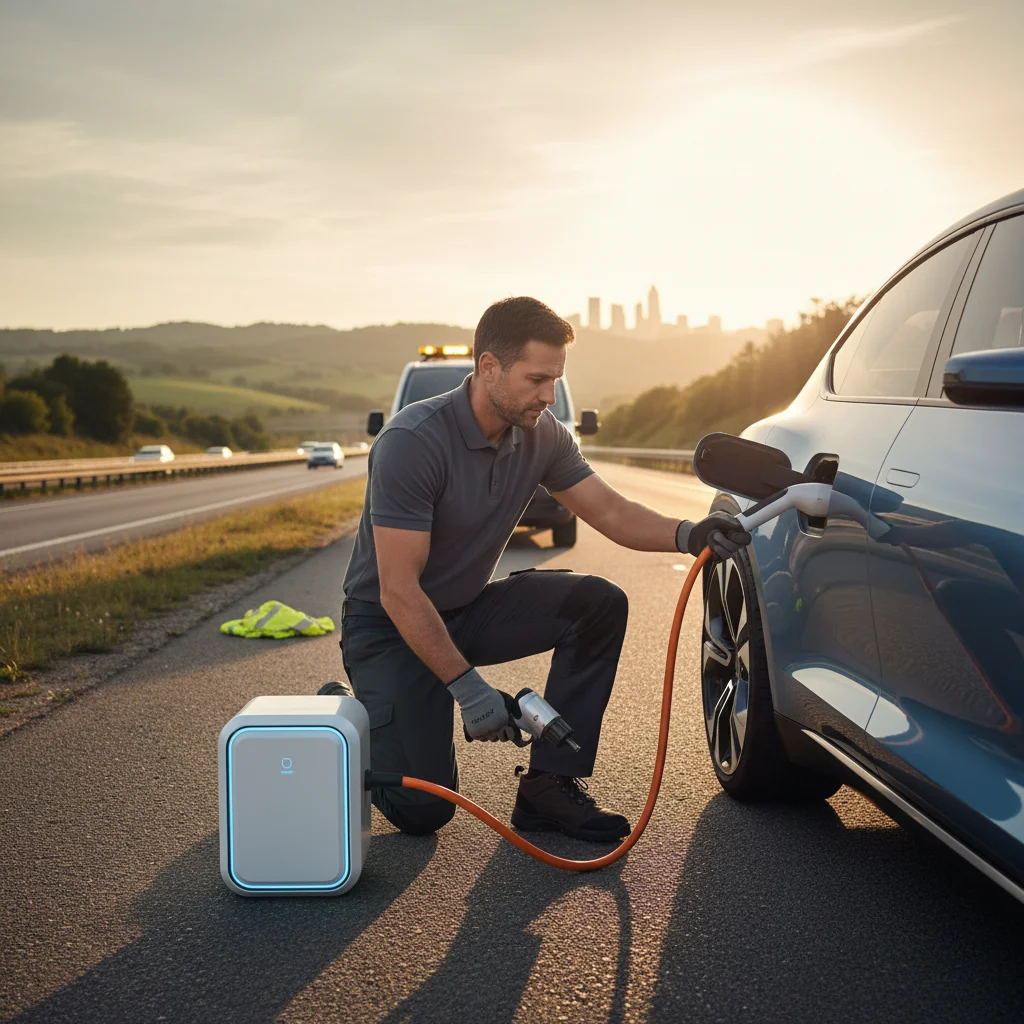
A mobile Level 2 unit is a portable 240-volt AC source that an operator brings to the car. It runs from the truck’s inverter and generator, and it delivers the same kind of energy your home wall charger delivers. The truck carries the right connector for your car, so a Tesla gets a native NACS plug, a CCS car gets a CCS handle, and a J1772 car gets the J1772 handle. The charge session is real charging time, not a battery swap or a fast-charge detour.
How much range it adds at the car
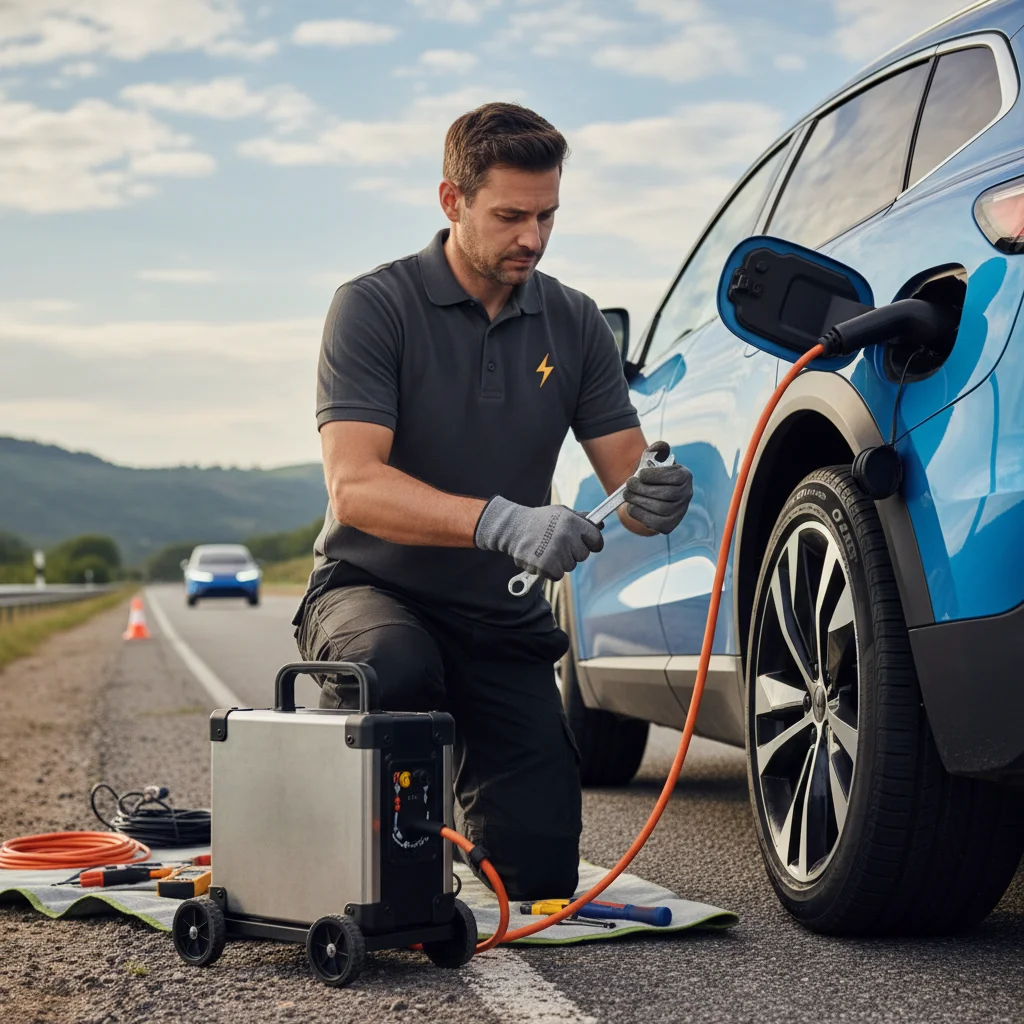
A typical session at the car adds about 10 to 20 miles of range in 15 to 30 minutes of charging. That is charging time, not travel time for the operator. The exact figure depends on your car’s acceptance rate, the temperature of the battery, and how much energy you need to make it to the next charger.
That number sounds small until you remember what it is for. The goal is enough range to reach a charger you already meant to use, or enough to drive home on a slow Level 2 top-up. It is not a full charge.
When the call makes sense
A roadside Level 2 visit is the right move when the public charger you planned to use is down, when the next charger is further than your current charge will go, or when you would rather not sit in a hot cabin for an hour. It is not the right move when the car will not wake at all, when the traction battery has a physical fault, or when the closest working charger is actually a short drive away and you can make it on what you have.
Heat is the wrinkle in the Phoenix area. Recurrent reports EVs can lose 20 to 30 percent of range above about 95F, so a car that should have made the next charger at 75F may not make it at 112F. Cabin cooling is one of the biggest draws on the battery, and sitting in stopped traffic on the I-10 with the AC running burns range faster than the dash estimates.
What to expect from the operator
The operator arrives in a truck with a portable Level 2 source, a generator, and the connectors for the major EV brands. They plug in, monitor the session, and unplug when you have enough range to reach the next charger. The operator quotes a price before any work starts and bills you directly. Charge Pro PHX does not own the trucks or set the prices. We match you with the operator.
Two practical notes for Phoenix drivers:
- ARS 28-871 says to leave the traveled part of a highway when you can. Get the car as far off the travel lane as you can before the operator arrives. A vehicle that cannot be moved is exempt.
- ARS 28-775 is the Move Over law. Approaching a stopped vehicle with flashing or warning lights, drivers must move over a lane if they safely can or slow down. Fines run $275, then $500, then $1,000 for repeats within five years.
When a tow is the better answer
A tow is the right move when the traction pack has a physical fault, when the car will not wake after a 12-volt jump, when the charge port is damaged, or when the car is in a tight parking structure where a generator is unsafe. A tow is also the right answer for an EV that has been in a crash, even a low-speed one, because the high-voltage system may need a dealer inspection before any charging happens.
For the broader picture on which call to make, see mobile EV charging vs a tow and mobile EV charging vs a tow in Arizona.
Common Level 2 roadside scenarios
The scenarios that come up most often around the Valley:
- A car at Sky Harbor East Economy lot after a long trip. The 12-volt died, the operator jumps it and adds a few miles to make it home.
- A car at Sloan Park after a Cubs spring training game. The accessory draw drained the traction pack while the family was in the stands.
- A car on SR-347 between Maricopa and the I-10 with no fast charger for many miles. The operator adds enough to reach Casa Grande or Chandler.
- A car on Loop 202 with the AC fighting a 115-degree cabin. The operator adds enough to reach a charger the driver already uses.
- A car on the I-17 north of Anthem. The climb drained the pack and the next charger is at Camp Verde.
For a deeper look at what the trucks carry, see what Phoenix mobile EV rescue trucks actually have on board.
What to do if you are stuck now
If your EV is dead or low on a Valley road right now, get the car as far off the travel lane as you can, keep hazards on, and stay in the car if that is safer. Have a location ready when you call: nearest cross street, mile marker, or landmark.
Call (602) 932-0920. The operator quotes before any work starts and bills you directly.
Frequently asked questions
How many miles does a mobile Level 2 truck add?
A typical session adds about 10 to 20 miles in 15 to 30 minutes of charging. That is charging time at the car, not travel time for the operator.
Will roadside Level 2 work for any EV brand?
The truck carries native NACS for Teslas and CCS or J1772 adapters for other major brands. For any car built for the North American market, there is a connector on the truck.
Is mobile Level 2 cheaper than a tow?
It depends on what you need. A tow takes the car to a charger. A mobile Level 2 visit adds range where the car sits. The operator quotes both, and you decide.
Can a generator-powered Level 2 truck damage my car?
No. The portable Level 2 unit delivers clean 240-volt AC at the same frequency your home charger does. The car treats it the same way it treats a public Level 2 stall.