Your EV is stranded somewhere in the Phoenix area. The question on the call is whether you need a mobile operator to bring a Level 2 charge, or a flatbed to take the car to a charger. The answer is usually obvious once you know what each one does.
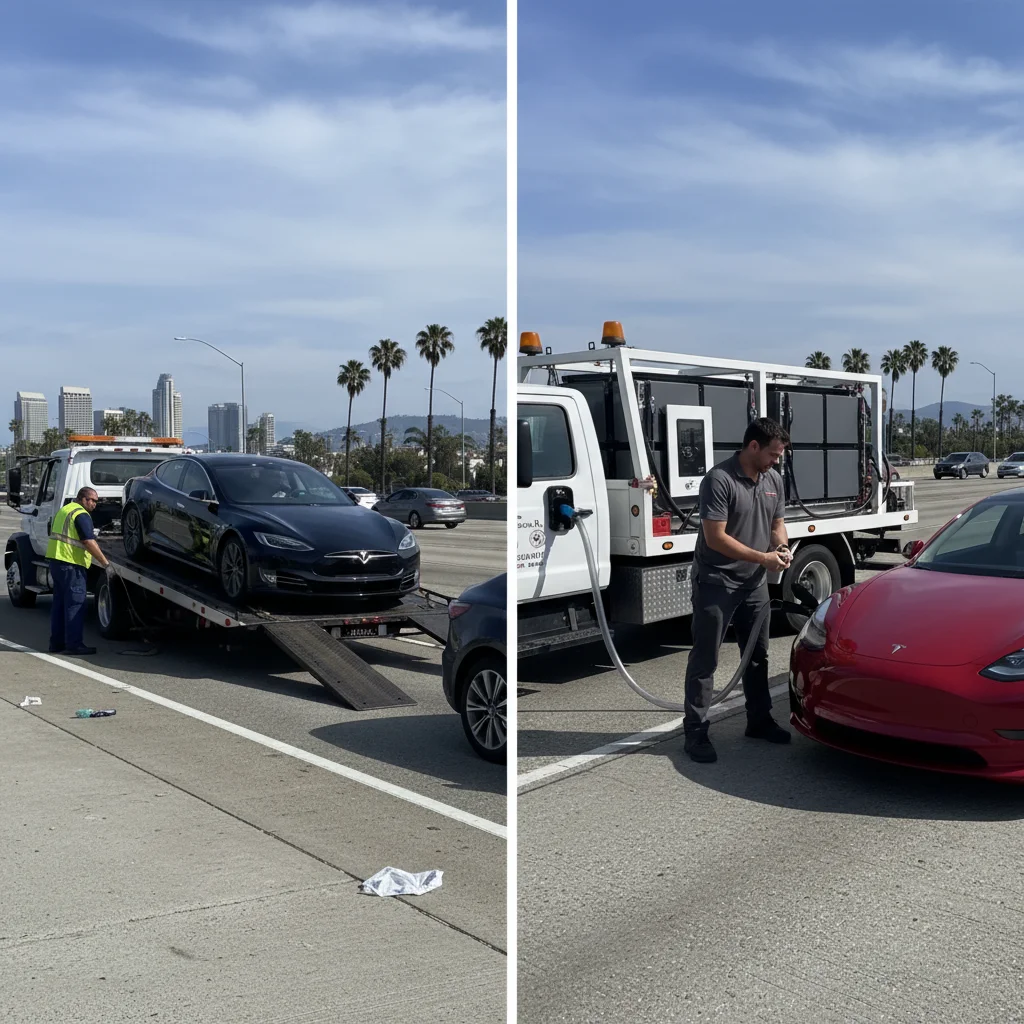
What mobile charging actually does
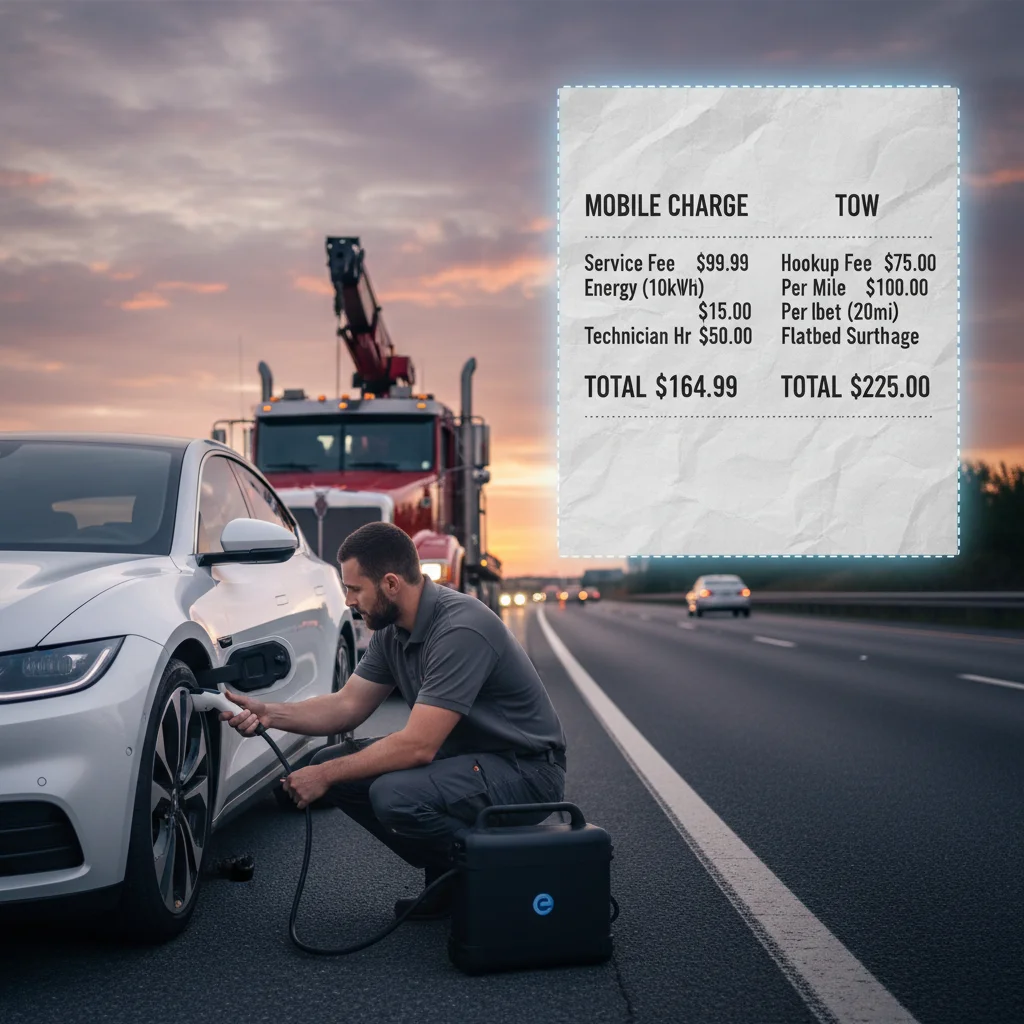
A mobile EV operator brings a portable 240-volt Level 2 source to where the car sits, plugs in with the right connector, and adds real miles while you wait. A typical session adds about 10 to 20 miles of range in 15 to 30 minutes. That is charging time at the car, not an arrival time for the operator.
The truck carries a native NACS plug for Teslas and CCS or J1772 adapters for every other major brand. The session is real Level 2 charging at the car, not a fast-charge detour or a battery swap.
What a tow actually does
A flatbed takes the car to a charger or a service center. For a Tesla, the factory roadside program tows to the nearest Supercharger or service center. For other brands, the dealer or a public fast charger is the destination.
Arizona has no statewide tow-rate cap. Cities and counties may set maximums locally under ARS 9-499.05 (cities) and ARS 11-251.04 (counties), but the price depends on the operator and the distance. Private tows need the property owner’s written authorization or a police request.
The decision matrix
Three questions decide which call to make:
- Did the car lose traction pack charge, or did the 12-volt die? If the screens are dark and the doors won’t unlock, that is the 12-volt. An operator with a jump pack wakes the car, and charging is a separate question. For the wider view, see what happens when an EV 12-volt dies.
- Can the car roll under its own power to a safe spot? If yes, a mobile Level 2 visit at that spot is faster than a tow.
- Is the next working charger further than the current range will go? If yes, mobile charging at the car makes sense. If the next charger is a short drive and you can make it on what you have, drive there.
When mobile charging is the right call
A mobile operator is the right move when:
- The next charger is further than your current range will go
- The car will wake but the traction pack is empty or near empty
- You would rather not wait in a hot cabin for a tow plus a charge session
- The car is in a place a generator can run safely (no tight indoor garage, no gas-station canopy)
For the deeper picture on what mobile Level 2 adds at the car, see roadside Level 2 charging for stranded drivers.
When a tow is the right call
A tow is the right move when:
- The traction battery has a physical fault and won’t take a charge
- The car will not wake after a 12-volt jump
- The charge port is damaged or stuck
- The car is in a tight indoor parking structure where a generator is unsafe
- The car has been in a crash, even a low-speed one, because the high-voltage system needs a dealer inspection before any charging happens
What the state agencies will and won’t do
Arizona DPS Roadside Motorist Assistance and ADOT’s Incident Response Unit are the two free motorist-help programs in the Valley. They change tires, bring gasoline or diesel, jump conventional batteries, and clear debris. Neither program advertises bringing an EV a charge. That gap is exactly what an independent mobile operator fills.
For the wider rundown on what DPS will and won’t do for a stranded EV, see Tesla flat tire coverage and the Arizona motorist help gap (the principles apply to every EV, not just Teslas).
What Tesla and other factory roadcovers do
Tesla roadside does not bring a Level 2 charge to the car. It tows to the nearest Supercharger or service center, and that tow can be billable depending on the situation. Ford tows to the nearest charger within 50 miles. Rivian and Hyundai have documented trouble getting a dead EV towed, and owners are advised to specifically request a tow.
For the full rundown on what the factory programs cover, see Tesla roadside coverage for out-of-charge and 12-volt calls.
What to do on a Valley shoulder right now
Get the car as far off the travel lane as you can. Keep hazards on. ARS 28-871 says to leave the traveled part of a highway when you can. A vehicle that cannot be moved is exempt.
Have a location ready: nearest cross street, exit number, or landmark. The closer the pin, the faster an operator can find you.
Call (602) 932-0920. The operator confirms whether a mobile Level 2 visit or a tow is the right answer, quotes before any work starts, and bills you directly.
Frequently asked questions
Does Tesla roadside bring a charge to my car?
No. Tesla tows to the nearest Supercharger or service center for a fee in most cases. An independent mobile operator can bring a Level 2 charge to your car.
Does Arizona cap tow rates?
No statewide cap. Cities and counties may set maximums locally under ARS 9-499.05 (cities) and ARS 11-251.04 (counties). The price depends on the operator and the distance.
Will DPS bring my EV a charge?
No. DPS Roadside Motorist Assistance and ADOT’s Incident Response Unit change tires, bring gasoline or diesel, jump conventional batteries, and clear debris. Neither program advertises bringing an EV a charge.
How do I pick between mobile charging and a tow?
If the traction pack is empty but the car wakes and rolls, mobile charging is usually faster and cheaper. If the car will not wake, will not roll, or has a physical battery fault, a tow is the right call.