The pack hits empty on a Valley shoulder. The car won’t roll another mile. A mobile EV charger truck is built for that moment. Independent operators bring power to the car instead of towing it away.
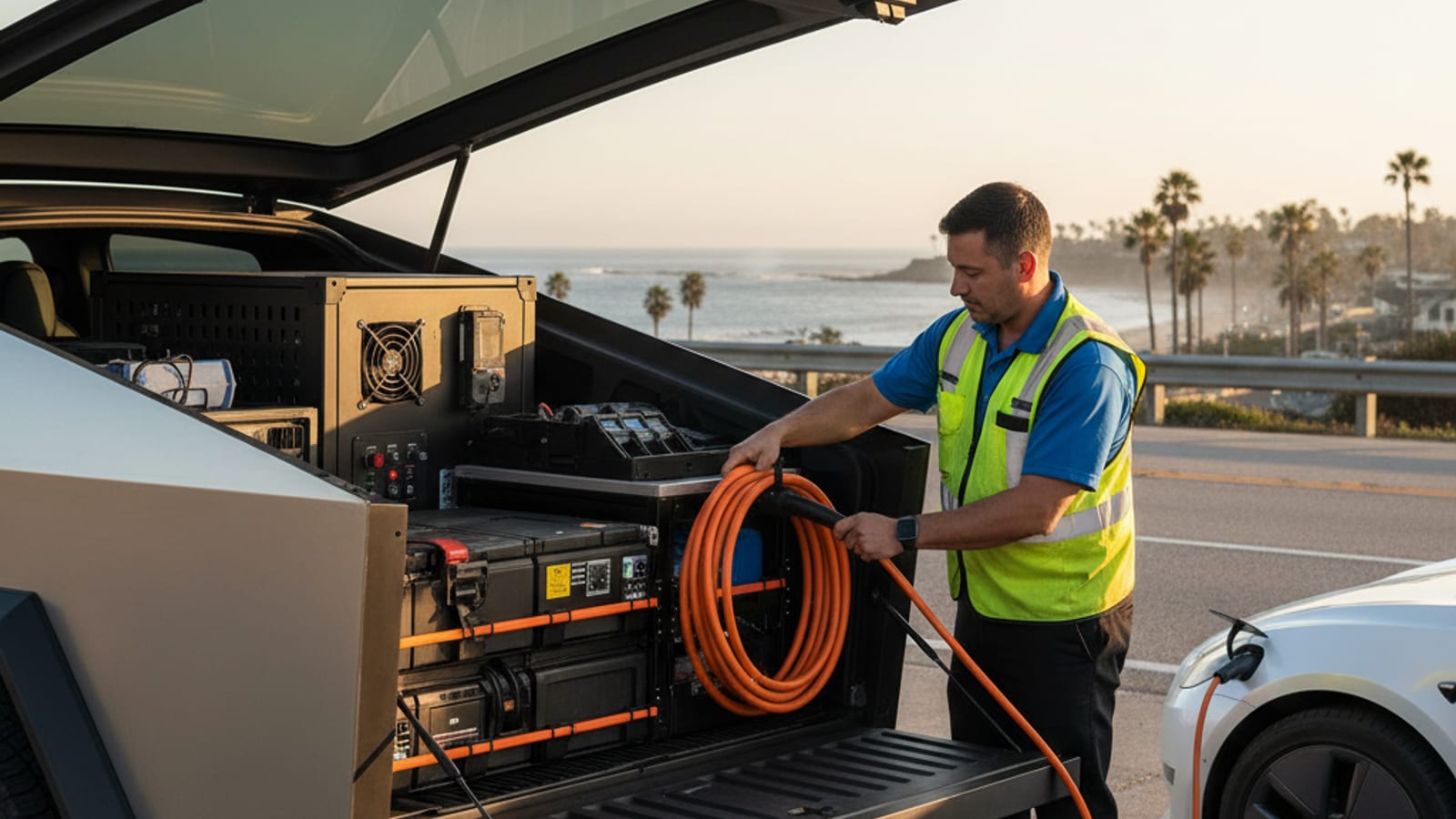
They don’t show up with a gas can. They show up with a 240V Level 2 source. Native NACS covers Tesla and other NACS cars. CCS or J1772 adapters cover almost everyone else. The point is enough range to leave the shoulder. A full charge isn’t the job.
What a mobile EV charger truck actually carries
The kit is simpler than the name sounds. It’s also more specific than a regular tow truck.
The core of it is Level 2 power at 240 volts. That’s the same voltage class as a home wall charger. It’s not a Supercharger. It’s not a Level 1 brick from a trunk. Operators in this network typically add 10 to 20 miles of range. That happens in 15 to 30 minutes of charging. Those minutes start after the cable is connected. They aren’t a travel clock.
The truck also carries the plugs that match the car. NACS is native for Tesla and for other brands that switched. CCS still shows up on a lot of Korean and German EVs. Older J1772 inlets are still on the road. A mobile EV charging stop only works if the connector fits. That’s why adapters ride along.
Many of the same operators also jump or replace a dead 12-volt battery. In desert heat, that small battery strands cars with a full pack. Door handles, screens, and the main contactor all run on 12 volts. A DC-DC converter recharges it while the car is on. It also recharges while the car is charging. If the 12-volt is dead, Level 2 may not start. The small battery has to wake first.
Arizona’s Move Over law applies when you approach a stopped vehicle with warning lights. Passing drivers must change lanes if they can. If they can’t, they must slow down. The operator is working inches from live traffic. That’s the real roadside risk, not the charge itself.
Why this kit shows up on Phoenix-area roads
The Valley isn’t a mild coastal commute. Phoenix averages about 111 days at or above 100F. About 21 days hit 110F or more. July highs average near 107F. August sits near 105F. Overnight summer lows still linger in the mid-80s.
Heat taxes both batteries. AAA’s 2026 study found about a 10% efficiency drop at 95F versus 75F. Range fell about 8.5% in that same test. Recurrent looked at 345,622 trips by 300 Phoenix-area EVs. That dataset showed 20 to 30% range loss above about 95F. Loss sat near 31% at 100F. Cabin cooling is a real draw. NREL lists climate control among the biggest loads.
The 12-volt side fails even faster here. Battery Council International, via Battery University, timed hot-climate starter batteries at about 47 months. A battery that lasts five years elsewhere can fail in two or three here. AAA calls heat the number-one cause of battery failure. Tesla features like Sentry Mode keep drawing while you park.
Then there’s grade. Northbound I-17 climbs past Anthem, New River, and Black Canyon City. ADOT posts a 6% maximum grade on that northern stretch. Forum drivers on that climb have reported about 481 Wh/mi going up. The Beeline on SR-87 posts a 7% grade into Slate Creek Canyon. US-60 east toward Apache Junction and Superior does the same kind of work. A car that looked fine on Loop 101 can arrive empty on those grades.
New East Valley and Pinal housing is young. Home charging is common there. Gilbert, Maricopa, Surprise, and Sun City West all skew new. The calls still happen on the road. A commute into Tempe can empty the wrong battery.
Level 2 on the curb isn’t a wall unit at home
A home 240-volt circuit is for overnight filling. A roadside Level 2 stop is for getting you moving.
Fifteen to 30 minutes won’t fill a long-range pack. It can add enough miles to reach a Supercharger. Read what roadside Level 2 charging can add for the physics in plain words. The operator isn’t trying to replace your APS or SRP home session.
APS serves large parts of Phoenix plus Surprise, Goodyear, Buckeye, and Queen Creek. Its R-EV plan is the overnight home rate. SRP covers much of Mesa and shares the East Valley. None of that helps you on a shoulder. A mobile stop is the backup when the car is already dead.
A personal portable charger is a different tool again. Those bricks are usually Level 1 at 120 volts. They trickle. They’re for a driveway or a long wait, not a freeway shoulder. Don’t count on one to clear I-10 before traffic stacks up.
NACS, CCS, and J1772 on the same call
Tesla owners often assume the truck is Tesla-only. It isn’t.
Operators we connect you with carry a native NACS plug. That covers Model 3, Model Y, Model S, Model X, and Cybertruck. It also covers other brands that moved to NACS. For cars that still speak CCS or J1772, the adapter comes too. That’s the whole point of non-Tesla EV rescue in the Phoenix area. A Hyundai, Kia, Ford, Chevy, Rivian, or BMW is still a match. The inlet just has to be one of those three.
Rivian is a mix. Some trucks and SUVs take NACS now. Others still need CCS on the road. Name the brand and year when you call.
Factory roadside is a different product. Tesla won’t charge you on site. It tows to the nearest Supercharger or service center. That’s a factory fee Tesla sets. Ford tows to the nearest charger, home, or dealer within 50 miles. Rivian and Hyundai/Kia owners have had trouble getting a dead EV towed. Ask specifically for a tow if that’s the path. A mobile EV charger truck exists because factory help often skips an on-site charge.
The 12-volt kit sitting next to the Level 2 cable
Plenty of “dead EV” calls aren’t empty packs. The traction battery can sit at 60% and the car still won’t wake. The 12-volt runs the computers that close the high-voltage contactors. No 12-volt, no drive. In Phoenix heat, that failure is common after a parked day. A week in a Sky Harbor garage is a classic version.
Terminal 3 and Terminal 4 garages have Level 2 charging. So does the 24th St. station. EVPassport installed charging at PHX in 2022. A car that never got plugged in can still come back dark. Sentry Mode on for a week will do it too.
Operators can jump the 12-volt on site. They can replace it when the cell is cooked. That’s a different job from the 240-volt rescue. It’s often the right one. Tesla 12-volt failures in desert heat walk through the signs. If the screens are black and the handles are dead, start there. Don’t assume you need a charge.
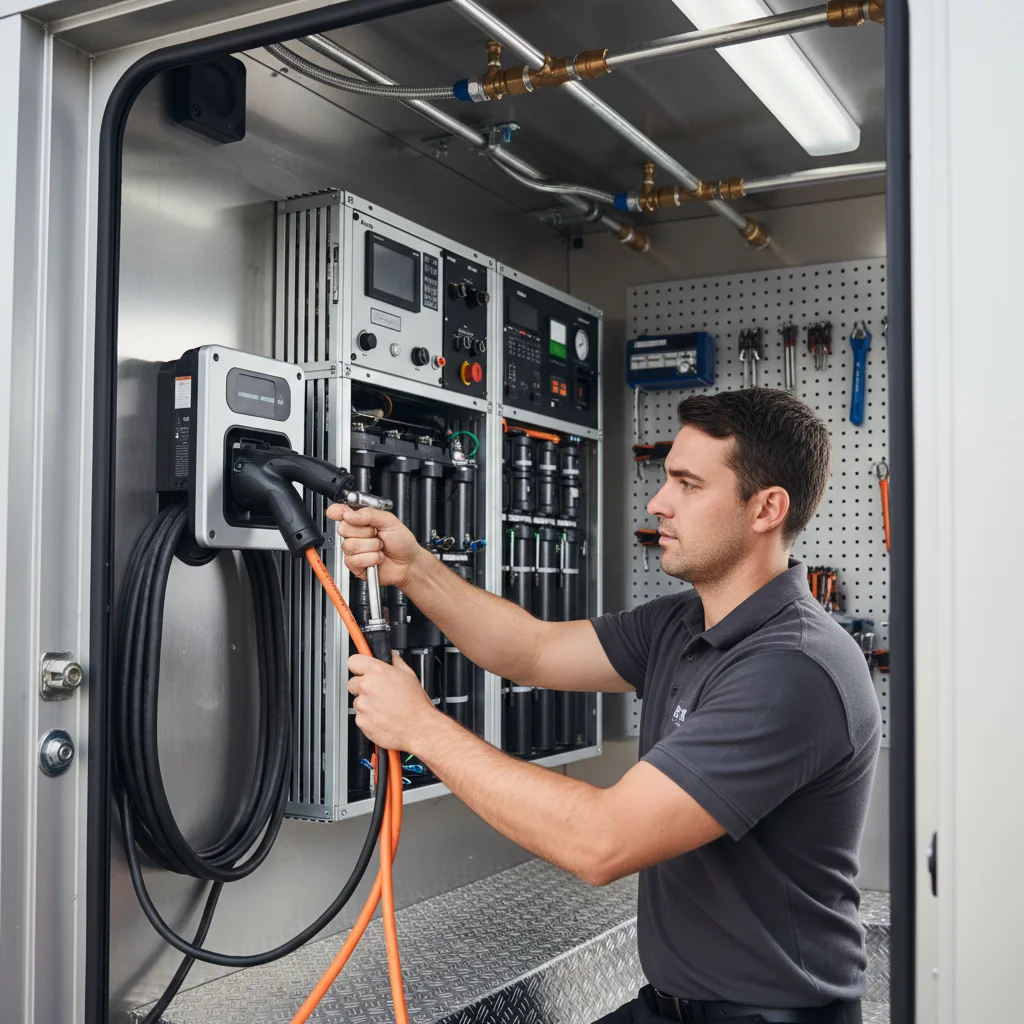
What the stop looks like on a Valley shoulder
Charge Pro PHX doesn’t dispatch a fleet. We match a stranded driver with an independent local operator. The operator quotes you before work starts. They bill you directly. We don’t publish hours, prices, or arrival windows. We don’t own trucks.
You call with a pin, a model, and what the car is doing. Empty pack, black screens, or a charge port that won’t wake are different jobs. The operator confirms the kit. Then they come to you.
Get off the traveled lanes when you can. ARS 28-871 is the rule on highway shoulders. Don’t stop in the live lanes if you can get off them. A vehicle that truly can’t move is exempt. Leave room for traffic to pass. Stay visible 200 feet in each direction. If you can creep to a ramp or a lot, do that.
On Phoenix-area freeways, two state programs may already be nearby. Arizona DPS Roadside Motorist Assistance can change a tire. It can bring gasoline or diesel and jump a battery. It doesn’t advertise EV charging. ADOT’s Incident Response Unit works weekdays from 5am to 8pm. It doesn’t advertise an EV charge either.
Once the operator is on scene, the 240-volt cable goes into your inlet. The car should show a Level 2 session. After 15 to 30 minutes of charging, you usually have 10 to 20 miles. That’s often enough to leave the shoulder. You can then reach a charger you already chose. See how a mobile EV charging truck actually helps you for the full sequence.
Arizona has no toll roads and no toll express lanes. You won’t need a transponder to sit on Loop 202 South Mountain. You’ll need people to move over. Flashing lights on the truck trigger the Move Over law under ARS 28-775.
Heat, monsoon, and the roads that drain a pack
Summer is the obvious season. Monsoon still matters. Official monsoon runs June 15 to September 30. Haboobs can drop visibility to near zero. Flash floods follow. ARS 28-910 is the Stupid Motorist Law. Don’t drive around a barricade into floodwater. The emergency response can be billed to you. Don’t sit in a wash. Don’t send an operator into water you already crossed. Pull to high, visible ground and wait.
Event drains are a Phoenix-area specialty. Mortgage Matchup Center downtown dumps a lot at once. Chase Field does the same after a Diamondbacks night. State Farm Stadium in Glendale, Arizona, is another dump. Phoenix Raceway is in Avondale, not Phoenix, despite the name. A car that arrived at 40% can leave lower than the nav showed.
North of the city, the I-17 climb is the one drivers underestimate. Out of charge on I-17 covers Anthem toward Black Canyon City. The nav often undersells the uphill Wh/mi. West Valley Loop 101 Agua Fria is flatter. East Valley Loop 101 Price is flatter too. Heat still eats range on both. US-60 is Grand Avenue on the northwest side. It’s the Superstition Freeway on the east. Those are different segments of the same route. Name the one you’re on when you call.
What this truck won’t do
It won’t DC fast-charge you to 80%. Level 2 is Level 2.
It won’t replace Tesla roadside, AAA, or your insurer. Those programs often tow. A mobile charge is the other fork. If the car has a mechanical failure, charging won’t fix it. A flat or a flooded floor is the same story.
It won’t install a home charger. APS has a Level 2 smart-charger rebate and APS Smart Charge. SRP has a Level 2 rebate through the SRP Marketplace. SRP also runs EV Smart Charge. Those are home and workplace programs. A roadside truck is the opposite tool.
It won’t guess a station for you if you have no plan. Charging apps still matter. Pick a stall you can actually reach with 10 to 20 miles. Don’t treat the boost as a road trip.
The brand behind this page won’t pretend to be the crew. Charge Pro PHX connects you with independent operators. The pros we connect you with are licensed and insured. We hold no trade license for this work. We employ no technicians. The person on the shoulder is the operator you were matched with.
After the cable comes off
You should leave with a next stop, not a hope. Sky Harbor is one place you can name. Terminal 3 has Level 2 charging on Level 1 west, Level 3, and Level 7. Terminal 4 has it on Level 4 east, zone B. The 24th St. station has it too.
Everywhere else, use the app you already trust. ADOT’s NEVI plan is adding DC fast sites along I-10, I-17, and I-8. Construction is underway in 2026. Confirm live status before you roll.
If the 12-volt was the failure, get it tested soon. A jump that dies again in a hot lot is a pattern. Replacement is often the real fix in this climate.
When you’re ready to call, Charge Pro PHX is at (602) 932-0920. We pass the trip to an independent operator. They quote before they start. They tell you what they’re bringing. A mobile EV charger truck is only useful if the kit matches the car. NACS, CCS, or J1772, plus 240 volts, is the match.
Frequently asked questions
What does a mobile EV charger truck carry?
Independent operators bring a 240V Level 2 source to the car. They carry a native NACS plug for Tesla and other NACS inlets. CCS or J1772 adapters cover most remaining EVs. The charge typically adds 10 to 20 miles of range. That takes 15 to 30 minutes of charging.
Can the same truck help a Tesla and a CCS car?
Yes, if the operator has the right adapter on board. NACS is native. CCS and J1772 ride as adapters. Name your brand and year when you call. The matched operator can then bring the inlet you have.
Is this the same as Tesla roadside or a state freeway crew?
No. Tesla roadside tows a dead car to a Supercharger or service center. It doesn’t charge on site. Arizona DPS motorist help can jump a battery. ADOT’s Incident Response Unit can too. They bring gasoline or diesel. They don’t advertise EV charging. A mobile EV charger truck is the on-site Level 2 option.