Tesla 12v battery failure in Phoenix heat usually looks like a brick. The car’s dark. The app is silent. The traction pack can still be full. Heat is the reason. Starter batteries last about 47 months in hot climates, per Battery Council International work via Battery University. The 12-volt in a Tesla follows that same desert clock.
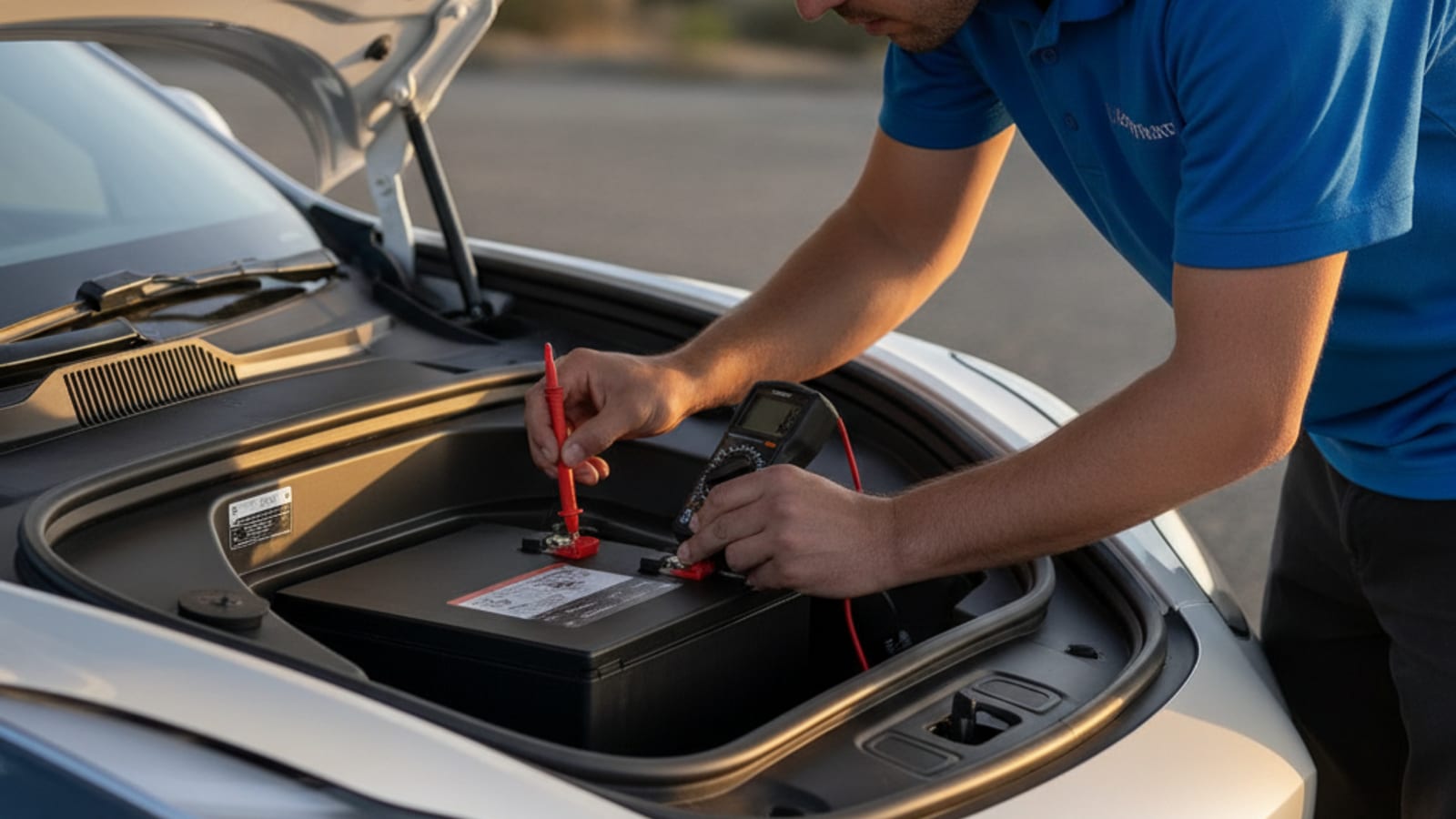
Phoenix heat shortens the small battery, not just range
Phoenix averages about 111 days a year at or above 100F. About 21 days hit 110F or more. Those figures are NOAA 1991-2020 normals through NWS Phoenix. July highs average near 107F. A Tesla in a surface lot never really cools.
AAA calls heat the number-one cause of battery failure. A battery good for five years elsewhere can fail in two or three here. An EV 12-volt lives in the same oven.
Range loss is a different problem. AAA’s 2026 study found about a 10% efficiency drop at 95F versus 75F. Recurrent found 20 to 30% range loss above about 95F from 345,622 trips by 300 Phoenix-area EVs. None of that is why the dash is black.
A dead 12-volt strands the car even with a full traction battery. The 12-volt runs the door handles and the screens. It also runs the contactor that connects the main battery. A DC-DC converter only recharges the 12-volt while the car is on or charging. Tesla features like Sentry Mode and Cabin Overheat Protection draw power while parked. In a 107F lot, those features work hard.
Overnight charging does nothing for a Tesla left unplugged at the airport. APS markets the R-EV plan as EV Overnight Charging, 11pm to 5am weekdays. The Valley splits among APS, SRP, Mesa Municipal Electric, ED3, and ED2, sometimes block by block.
The 12-volt is the on switch
The small battery still has to boot the modules that make the car a car. Handles, latches, the center display, and the network sit on that 12-volt rail. The last job is the contactor. If that relay stays open, the high-voltage pack can’t feed the motors.
You can have plenty of percent left and still have a silent cabin. That’s Tesla 12v battery failure, not a pack swap. Tesla’s high-voltage warranty is VIN-specific in the Tesla app. It covers the drive battery, not a published 12-volt price.
Current Model Y manuals describe a lithium-ion low-voltage battery. Newer Model 3 and Y cars use that lithium 12-volt. Older Model S and X cars used a conventional lead-acid 12-volt. Heat still cooks both chemistries on a Valley lot. We couldn’t confirm a published Phoenix-area failure rate by model year. The 47-month hot-climate figure is the best verified clock we have. For lithium-specific stalls, see newer Model 3 and Y lithium 12-volt failures.
Where Valley Teslas actually go quiet
The highest-value stall is a trip car at Phoenix Sky Harbor International. Level 2 charging is confirmed in the Terminal 3 garage, the Terminal 4 garage, and at the 24th Street station. None of that wakes a 12-volt that sat a week in a hot garage. Our Sky Harbor dead-EV guide covers charge versus jump when a work vehicle won’t wake.
Sun City has the oldest housing stock in the service area. About 88.9% of homes were built before 1980. Youngtown is next, at 51.8%. The far-suburb belt is the opposite. Maricopa, Surprise, Sun City West, and Gilbert have much newer stock. Home charging is common there. The 12-volt calls still happen on the road after a parked day at work.
Chase Field downtown and State Farm Stadium in Glendale, Arizona, cook cars in open lots. Phoenix Raceway is in Avondale, not Phoenix, despite the name. A Tesla can sit in sun through a race weekend.
A Surprise commute on Loop 101 Agua Fria is a heat-and-AC drain. An Anthem or New River run on I-17 is a grade drain. ADOT posts a 6% maximum grade on northern I-17. Both trips can leave a parked Tesla cooking after. Range on arrival doesn’t matter if the car won’t wake.
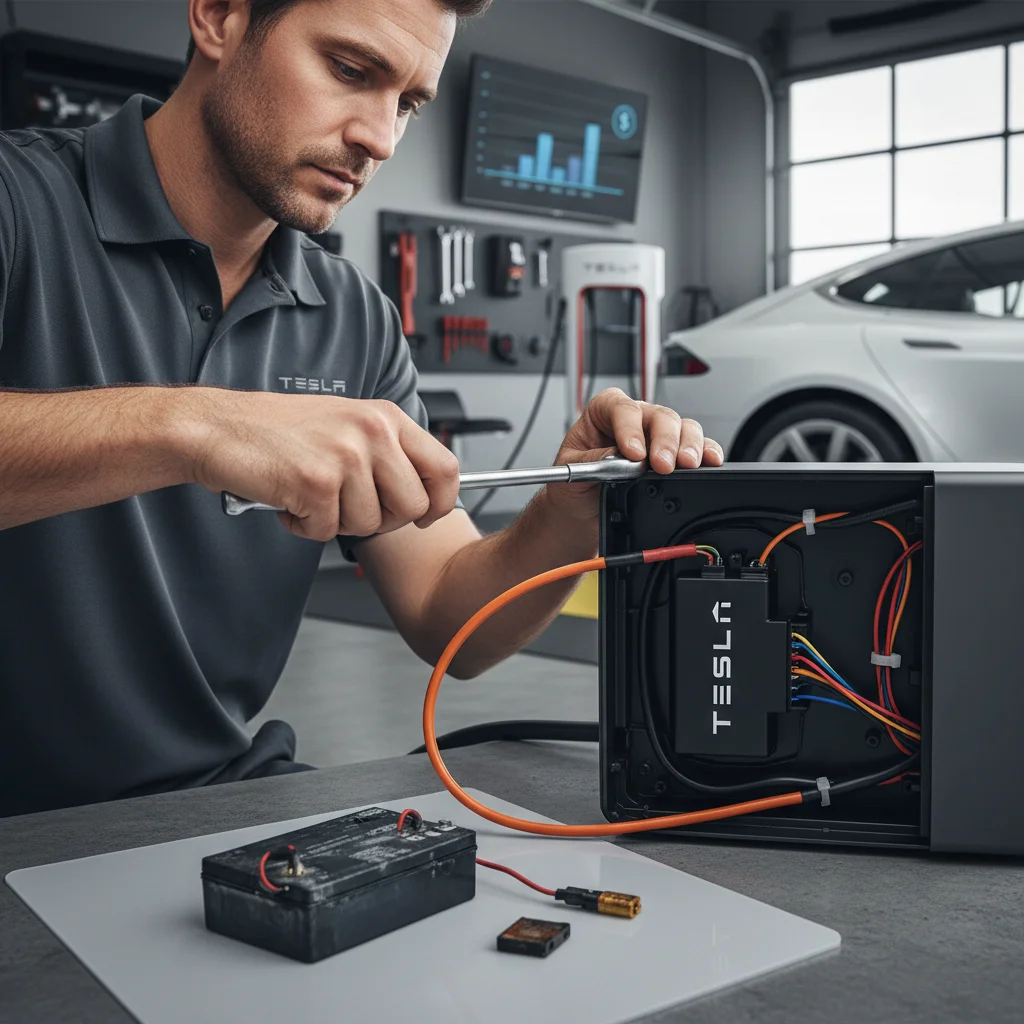
A jump can wake it, not finish the job
Tesla’s current Model Y manual identifies positive and negative jump posts after the hood is open. The wires behind the tow-eye cover only release the hood latches. Tesla says they can’t charge the low-voltage battery. How to jump a Tesla from the bumper tow hook covers that hood-release step. A jump pack on the 12-volt posts can bring screens back. That’s a diagnostic step, not a repair. If the 12-volt failed, it’ll fail again after you pull the pack.
Tesla tells owners to request roadside through the Tesla app. Tesla doesn’t charge the car on site. Factory help tows to a Supercharger or service center. For a dark 12-volt, a tow is the long way around a jump. The operators we connect you with can jump a Tesla 12-volt on site. They quote you before any work starts. They bill you directly. We don’t set that price.
Arizona DPS Roadside Motorist Assistance can jump-start a dead battery. Its published materials name gasoline and diesel. They say nothing about EV charging. ADOT’s Incident Response Unit works Phoenix-area freeways weekdays from 5am to 8pm. A state jump may wake a 12-volt. It won’t add miles to the traction pack.
If you’re on a freeway, ARS 28-871 applies outside a business or residence district. Don’t sit on the traveled part if you can get off it. A vehicle disabled so badly it can’t move is exempt. ARS 28-775 is the Move Over law. Move over a lane if you can. If you can’t, slow down.
What a 12-volt job actually costs here
No verified installed price for a Tesla 12-volt turned up for the Phoenix area. Tesla service centers don’t publish a local 12-volt menu we could confirm. Charge Pro PHX doesn’t set prices. The operator who shows up quotes the job before starting. Ask whether the quote is a jump, a replacement, or a tow. Ask which battery spec they have on the truck. Lead-acid and lithium 12-volts aren’t the same part.
Replacing a Tesla 12-volt after desert heat is the follow-up if a jump won’t hold. Don’t treat a second no-start the same week as bad luck. That battery is done.
If the car wakes and the traction pack is actually empty, that’s a different call. Independent operators bring a 240V Level 2 source to the car. Typical charging adds about 10 to 20 miles of range in 15 to 30 minutes of charging. That’s charging time, never an arrival time. Tesla roadside rescue is the match when you need that on-site charge.
How Charge Pro PHX matching works
Charge Pro PHX is a referral line for the Phoenix area. We match stranded EV drivers with independent local mobile rescue operators. The pros we connect you with are licensed and insured. We don’t hold a trade license. We don’t own trucks or equipment. We don’t set prices, and we don’t publish hours or arrival times.
If your Tesla won’t wake, call (602) 932-0920. We’ll match you with a local operator. Tell them the car is dark. Say whether the last range reading still looked fine. That’s enough to sort a 12-volt call from an empty-pack call.
How can I tell Tesla 12v battery failure from a dead pack?
A completely dark car, with no app response and no door action, is almost always the 12-volt. High-voltage trouble usually still powers the cabin. Jump the 12-volt posts. If the car wakes and still shows plenty of percent, the small battery failed.
Can I jump a Tesla from another car?
Tesla’s Model Y jump page assumes an external low-voltage supply such as a portable jump starter. If you use another vehicle, Tesla says to follow that other vehicle’s instructions. Use the 12-volt posts, not the charge port. A Tesla must not jump another car. Why your Tesla shouldn’t jump another car explains that limit.
How long does a mobile 12-volt job take in the Phoenix area?
No verified on-site replacement time is published for this metro. Don’t treat a number you saw on a forum as a quote. Charging time, if you also need miles, is typically 15 to 30 minutes once the operator is connected. That’s charging time, never an arrival time. For a 12-volt jump or swap, the operator tells you the work and the price before starting.