The Level 1 charger that came in your trunk is the most basic way to refill an EV, and in Phoenix it is the one most likely to leave you short. A Level 1 cord plugs into a normal 120-volt household outlet and drips a slow, steady charge into the traction pack overnight. Most EVs gain only 3 to 5 miles of range per hour on it. In a mild climate that is fine for a commuter who plugs in every night. Here, where garages hit 115 degrees in July and the Phoenix metro runs about 111 days a year at or above 100F, the same cord quietly stretches from a four-hour fill to a seven-hour one and the morning plan falls apart.
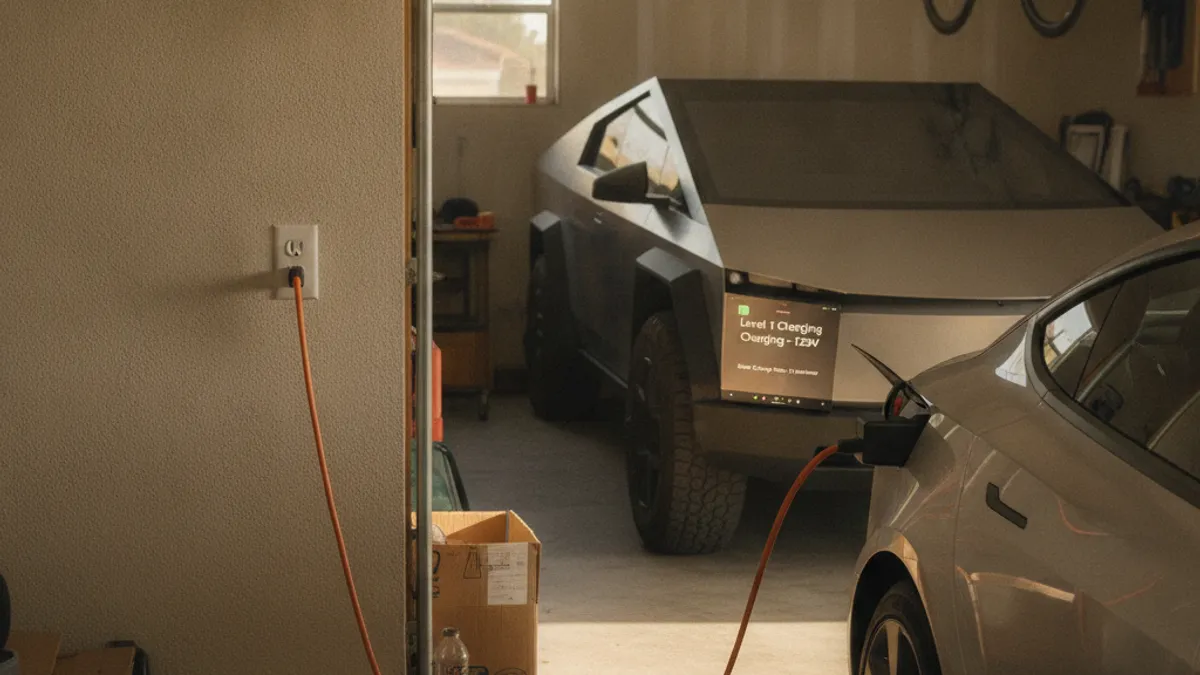
What a Level 1 charger actually is
A Level 1 charger is not a special device. It is the small cord set your automaker shipped with the car: a box on one end, a J1772 or NACS plug on the other, and a three-prong household plug in the middle. It draws about 12 amps at 120 volts, which works out to roughly 1.4 kilowatts, or about 1 kilowatt-hour of energy per hour.
That is a slow pour. A 60-kWh battery holding 200 miles of range takes 60 hours to refill from empty on Level 1. Nobody runs a pack to empty. The realistic case is topping up a partial drain overnight. A 12-hour overnight at 1 kW adds about 12 kWh, which is roughly 40 miles in a small pack or 30 miles in a big one.
The advantage is that the outlet is already there. No panel work, no electrician, no permit. A renter with a garage plug and a long extension cord can use the same setup. That is also why Level 1 is often the first charger a new EV owner uses, especially before they decide whether to install a 240-volt Level 2 unit.
What heat does to a slow charge
Phoenix summers push garage temperatures past the threshold where both the charger and the traction pack start protecting themselves. Published research cited in the Phoenix EV battery care guide puts the derate point around 100F for the pack and similar for many onboard charger components. Above that, the car throttles incoming charge to keep cells cool.
The result is straightforward. A Level 1 session that normally finishes in four hours stretches past six in a hot garage, and a long July night can hit seven hours before the gauge stops climbing. You unplug at 6 a.m. thinking you topped up. The screen says 80 percent, not 100. By the time you reach the Santan or the I-10, the estimate has slid further because cabin cooling at 107F adds another 20 to 30 percent range loss on top of what derating already cost. Recurrent and AAA both publish numbers in that band for hot conditions.
A Level 1 cord in a Phoenix garage is not charging slowly because the cord is weak. It is charging slowly because the car is deliberately limiting how much heat it will add to a hot pack.
Why Level 1 still works for some Phoenix drivers
The math changes if the daily drive is short and the garage is shaded. A driver who covers 25 miles a day and parks under a carport or in a conditioned garage that holds 85 degrees can plug in overnight and wake up to a full pack. The slow rate is fine because the deficit is small. The problem only shows up when overnight heat meets a real commute.
The other case where Level 1 works is the apartment dweller with an outlet in the assigned parking spot. No panel work, no permission needed, and the slow drip covers a daily run to the office if the office has its own charger for the daytime top-up. Tempe, with its dense apartment core around ASU, is the place this pattern shows up most often, since so much of its housing predates 1980 and most units have no dedicated 240-volt circuit.
If that fits your situation, home EV charging versus a mobile rescue walks through whether you even need a faster setup.
When Level 1 is not enough
Three patterns show up in Phoenix calls that trace back to a Level 1 cord.
The first is the hot garage derate. A driver in Gilbert or Chandler plugs in at 10 p.m. with the pack at 30 percent. By 5 a.m. the pack is at 85 percent instead of 100, and the day’s commute eats the rest before the next plug-in. The car did not fail. The math just did not add up in July.
The second is the long commute. A driver in Buckeye or San Tan Valley runs 60 to 80 miles a day into the East Valley for work. Level 1 cannot refill that overnight, even in perfect conditions. The pack slides lower each night until the car will not start on a Monday morning.
The third is the parked-and-drained visit, common at Sky Harbor or any event lot. The Level 1 cord stays home because nobody packed it. The 12-volt battery in the car drains over a long sit in the heat, and when the driver returns the screens are dark. That is a different job, but it is the same lesson: the slow home plug did not protect the car while it sat.
What Level 1 cannot do that Level 2 can
A Level 2 charger runs on 240 volts and pulls 16 to 40 amps depending on the unit and the circuit. Even a small 16-amp Level 2 unit pushes about 3.8 kW, roughly three times the rate of Level 1. A full-size 40-amp unit pushes 9.6 kW, closer to seven times. That is what gets a pack from 20 percent to 100 in a normal Phoenix evening, even with some derating in the heat.
The reason this matters in Phoenix is not just speed. It is the time window. A Level 2 unit can finish a full charge in the cooler pre-dawn hours before the garage hits its peak. Level 1 keeps charging while the garage is hottest, which is exactly when the car is throttling back the most. A faster cord that finishes early gets more of the energy in before derating kicks in.
For drivers who want a real home setup, a panel upgrade is sometimes needed first. The Valley panel upgrade for an EV charger post walks through what that looks like on APS and SRP service. Neither utility installs chargers. A licensed electrician does that work, and Charge Pro PHX is not part of that pipeline.
Where mobile rescue fits
Charge Pro PHX is the referral line for drivers who already missed the window. We match stranded drivers with independent local operators who bring a 240-volt Level 2 source to the car. The operator adds 10 to 20 miles of range in 15 to 30 minutes of charging time at the vehicle. That is enough to reach a charger you already meant to use, or to get home and rethink the garage setup.
The match works for mobile EV charging at the car, for out-of-charge recovery when the pack is fully drained, and for 12-volt battery jumps when the heat got to the small battery first. None of these replace a working home charger. They cover the night a Level 1 cord could not.
The short answer
Level 1 in Phoenix is enough when the daily drive is short, the garage is shaded or conditioned, and the pack is not deeply depleted. It stops being enough the moment any of those break: a longer commute, a hot enclosed garage, or a return from a trip where the 12-volt sat and drained. The cord did not fail. The summer did what summers do here.
If you are heading into a heat week and the gauge is sliding, call (602) 932-0920 before the morning commute. Have a location ready. The operator will quote before any work starts.