A home Level 2 charger is the daily fill for most Valley EVs. A mobile rescue is the call when that charger didn’t run. APS and SRP can help with a wall-box install. They can’t charge a car that’s already stranded.
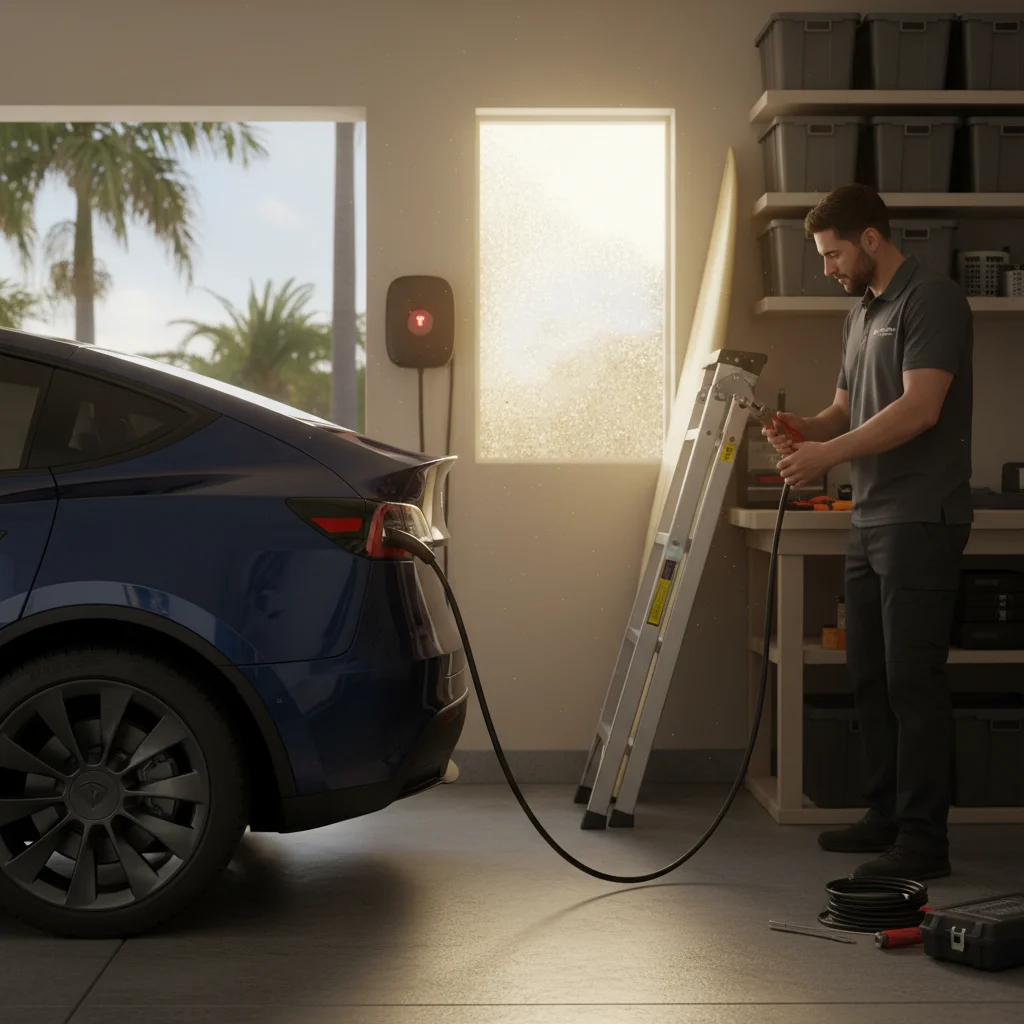
That’s the ev charger installation vs roadside split. One job is electrical work at the house. The other is an independent operator bringing 240 volts to the car. Charge Pro PHX only matches the second job. We don’t pull permits, run conduit, or sell chargers.
Home charging and rescue aren’t the same trade
Overnight charging is the habit that makes an EV easy. You plug in after dinner and want usable range by morning. In newer East Valley and West Valley tracts, that’s the normal pattern. Gilbert’s housing is mostly post-1980, so home charging is common there. Surprise and Sun City West sit under 3% built before 1980. Maricopa, the city in Pinal County, is newer still.
Older West Valley streets are a different electrical story. In Sun City, about 88.9% of homes were built before 1980. Youngtown sits near 51.8% built before 1980. Those panels often need a hard look before a 240-volt circuit goes in. That’s an electrician’s job, not a roadside match. If the panel is the blocker, read when a Valley home needs a panel upgrade.
A permitted wall box still fails in this climate. Phoenix heat can kill an overnight session. So can a tripped breaker, a cooked 12-volt, or a cable that won’t handshake. That’s when a mobile charge earns its keep.
What APS and SRP actually help with
The Valley isn’t one electric company, and service can change block by block. Treat a city-level map as a hint only. Confirm your address with the utility before you buy a charger.
APS covers large parts of Phoenix, plus Surprise, Goodyear, Buckeye, Queen Creek, San Tan Valley, Sun City, and Anthem. Chandler, Gilbert, Glendale, Scottsdale, Tempe, Peoria, and Avondale are split with SRP. Paradise Valley the town isn’t the Phoenix village of the same name. The APS and SRP split still applies there. SRP covers much of Mesa and shares those East Valley and central cities.
APS publishes a Level 2 smart-charger rebate and the R-EV residential EV rate plan. That’s marketed as EV Overnight Charging, 11pm to 5am on weekdays. Ask APS which programs still apply to your meter. We couldn’t confirm a rebate amount. Get the current figure from APS before you pay a contractor.
SRP publishes a Level 2 EV charger rebate through the SRP Marketplace. EV Smart Charge and Business EV Charging, called BizEV, are on the books. The Electric Vehicle Price Plan closed to new enrollment after a February 2025 board decision. Existing customers may stay through the November 2029 billing cycle. Solar homes can look at the Electric Vehicle Export Price Plan. We didn’t log a verifiable rebate amount, so confirm it with SRP before you sign.
Arizona doesn’t observe daylight saving time. APS overnight hours stay 11pm to 5am on the clock you already use.
Downtown Mesa has Mesa Municipal Electric, about 5.5 square miles around downtown and more than 18,000 customers, with an E1EV time-of-use rate. The city of Maricopa sits in Pinal County, not Maricopa County. ED3 serves that city and much of northern Pinal, with EV TOU 2-10 and EV smart-charger on-bill financing. ED2 serves Casa Grande, Coolidge, and Florence. No EV-specific program showed up on ED2’s site when this was checked.
Arizona has no state EV rebate and no state EV tax credit. The federal clean-vehicle credits ended for vehicles acquired after September 30, 2025. Utility programs are the local help that remains. None of them dispatch a truck at dawn.
Tesla owners who want bill math, not an install, can read how Tesla home charging bills work on APS and SRP.
Questions for an electrician, not a rescue dispatcher
If you’re comparing ev charger installation vs roadside help, name the job first. Installation is electrician work. Rescue is a mobile charge or a 12-volt jump. We don’t install, and we don’t name a contractor. Look for an electrician who does EVSE work, then vet them yourself.
Ask whether your city requires a permit for a new 240-volt circuit. Phoenix, Mesa, Gilbert, Chandler, Tempe, and Scottsdale each run their own building desks. CDPs like Sun City, Anthem, and San Tan Valley don’t have city hall, so ask Maricopa County or Pinal County based on the parcel. We didn’t find a Valley-wide permit rule we could cite. The city or county that would issue the paper is the authority.
Ask for a panel capacity check before you lock a wall-connector quote. Older Sun City and Youngtown stock is where that talk usually starts. Newer Gilbert and Maricopa houses can still need a dedicated circuit.
Ask who files the APS or SRP rebate form. Some electricians handle Marketplace paperwork, and some leave it to you. If the charger model isn’t on the utility list, you may get nothing. Check aps.com or srpnet.com before you buy the box.
Don’t ask us for a workmanship warranty or a bond. That’s the electrician’s file. Charge Pro PHX holds no trade license. We match stranded drivers with independent mobile operators. The operators we connect you with are licensed and insured. They quote you before they start and bill you directly.
For inland Pinal houses, see EV charger installation across San Tan Valley and the inland Pinal belt.
When overnight charging doesn’t happen
Most wall-box failures show up at breakfast, with a sliver of range and a car that still has to move.
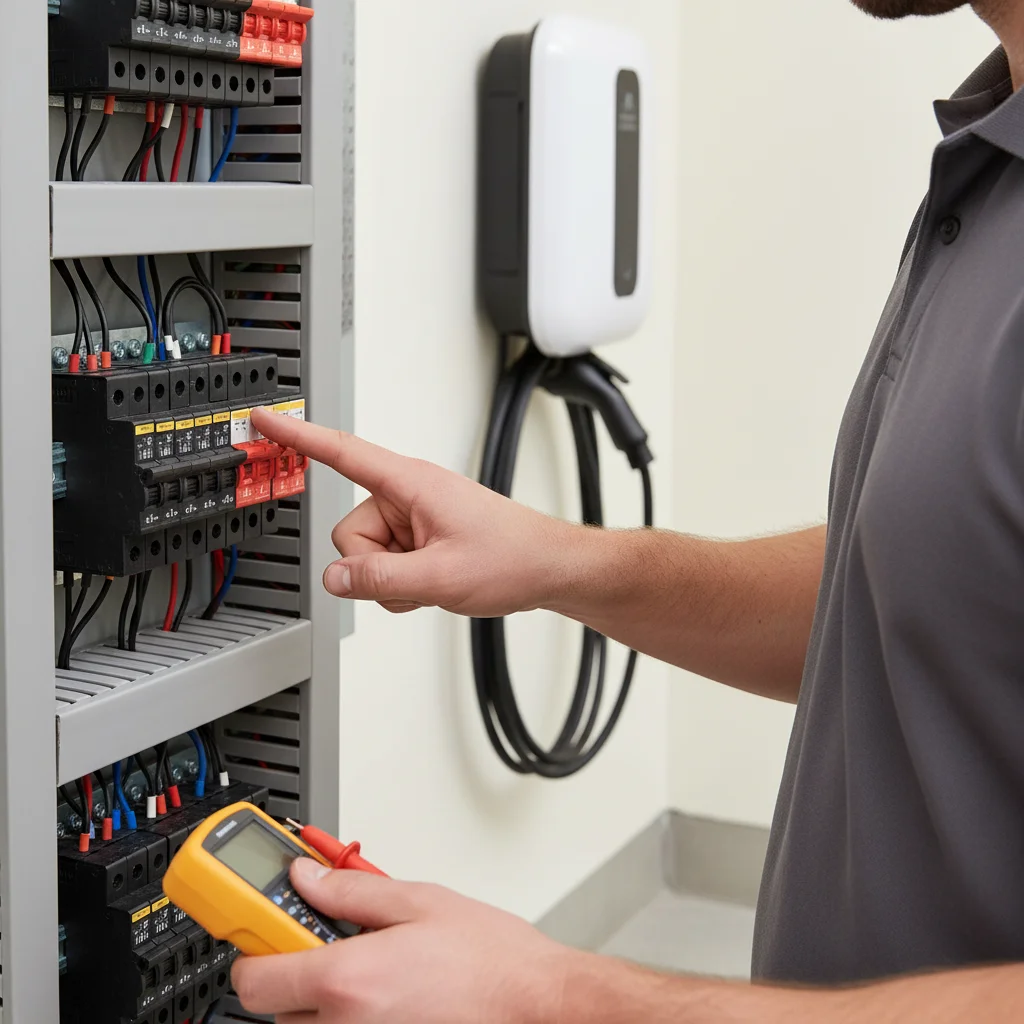
Check the breaker first. A Level 2 circuit runs hard for hours, and an older panel can trip. One reset might restore the session. A breaker that keeps tripping is an electrician problem. We’ve walked through why an EV charger keeps tripping the breaker.
Read the charger’s lights. Solid green usually means ready. Blinking red or amber usually means a fault. Phoenix averages about 111 days a year at or above 100F, with about 21 days at or above 110F. July highs average near 107F, and August sits near 105F. Overnight summer lows still hang in the mid-80s. A closed garage doesn’t erase that heat.
Sometimes the car stopped the session to protect the pack. Unplug, wait a minute, and retry once. If it fails again, stop guessing at dawn.
A dead 12-volt can mimic a charging failure even with a full traction pack. The 12-volt runs the screens, the door handles, and the contactor that connects the main battery. If the car won’t wake, you need a jump or a replacement on site. Heat shortens that small battery. Battery Council International work, via Battery University, found starter batteries last about 47 months in hot climates versus 59 in cool ones. AAA calls heat the top cause of battery failure.
If the car sat at Phoenix Sky Harbor, start with the 12-volt. Level 2 charging is confirmed in the Terminal 3 garage, the Terminal 4 garage, and at the 24th Street station. A week in a hot garage can still cook the small battery.
The ordered checks live in your EV was plugged in overnight and still didn’t charge.
What state roadside help will and won’t do
Arizona does run free motorist help. Neither program advertises charging an EV. Arizona DPS Roadside Motorist Assistance can change a tire, bring gasoline or diesel, jump a dead 12-volt, add water, and call a tow. Its published materials name gasoline and diesel. They say nothing about charging an empty traction pack. ADOT’s Incident Response Unit works Phoenix-area freeways from 5am to 8pm on weekdays. It clears crashes and debris, changes tires, and helps stranded motorists. No EV-specific charging is listed.
If you’re on a highway shoulder, ARS 28-871 still applies. Get off the traveled lanes when you can, and stay visible 200 feet in each direction when it’s practical. ARS 28-775, the Move Over law, asks other drivers to change lanes or slow down for a stopped vehicle with lights on.
Those programs can help a flat. They won’t bring a 240-volt source to a Tesla, a Rivian, or a CCS car. Tesla doesn’t charge on site either. It tows to a Supercharger or a service center. Ford tows to the nearest charger, home, or dealer within 50 miles. None of that installs a wall box or tops you up in the driveway.
What a mobile operator puts into the car
The operators we connect you with bring a 240-volt Level 2 source to the car. Tesla uses a native NACS plug. Other brands use a CCS or J1772 adapter. Typical charging adds about 10 to 20 miles of range. That takes 15 to 30 minutes of charging. That’s charging time, not a promise of when someone arrives. The operator quotes you before work starts and bills you directly. They can also jump or replace a dead 12-volt on site.
This is mobile EV charging, not a panel upgrade. It isn’t a truck filling the whole pack. It’s enough range to reach a workplace charger or a Supercharger while the electrician books the repair. Same voltage, different reason to call: home 240-volt charging versus a mobile 240-volt rescue.
Heat still cuts range once you roll. AAA’s 2026 study found about a 10% efficiency drop and an 8.5% range loss at 95F versus 75F. Recurrent used 345,622 trips from 300 Phoenix-area EVs. It reported 20 to 30% range loss above about 95F, near 31% at 100F. A 10 to 20 mile top-up is a bridge, not a week of commuting.
Who to call for which job
Don’t treat mobile rescue as a replacement for a permitted circuit. The rebate and the overnight rate exist so the regular fill happens at home. On APS R-EV, those overnight hours are 11pm to 5am on weekdays. Rescue is the backup when that plan breaks. If the wall box stays down, an operator can return to the driveway. Each visit is a new quote.
If you want a Level 2 install, call an electrician and your utility. Start with APS, SRP, Mesa Municipal Electric, ED3, or ED2, based on the bill. Ask about the named rebate and the rate plan. Confirm permit rules with the city or county. Charge Pro PHX won’t run that job.
If the car is already low or already stuck in the driveway, that’s a rescue match. We connect you with independent local operators who handle Tesla and every major EV brand. Call (602) 932-0920 when you need that match. The operator quotes before starting. You’re not buying an arrival time from us.