If you searched ev charger installation san tan valley, you want a 240-volt Level 2 circuit at home. In this northern Pinal County CDP, that job often starts in a newer garage. ACS 2020-2024 figures put the population at 109,189. Only 2.5% of housing here was built before 1980. The wall unit still isn’t the whole project. You need an electrician, a spare-capacity check, and a permit answer from the county. Charge Pro PHX doesn’t install chargers or send electricians to your panel. We match stranded drivers with independent mobile operators when the Pinal commute still leaves you short.
A Level 2 install is a circuit, not a box
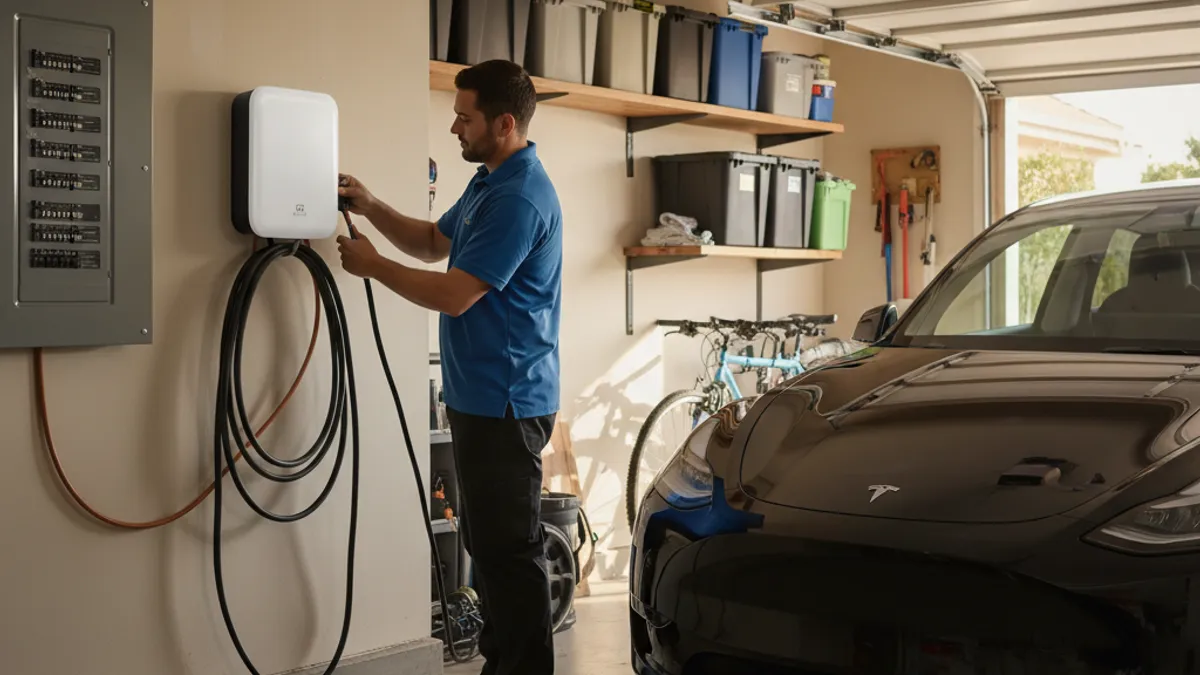
Most shoppers picture a compact wall unit over the parking pad. The hardware is the simple piece of the job. The real work is the dedicated 240-volt circuit behind it. That’s the same kind of circuit a dryer uses. An electrician adds a breaker and pulls new wire to where you park. Spare panel room, wire length, and county paperwork decide how hard that is.
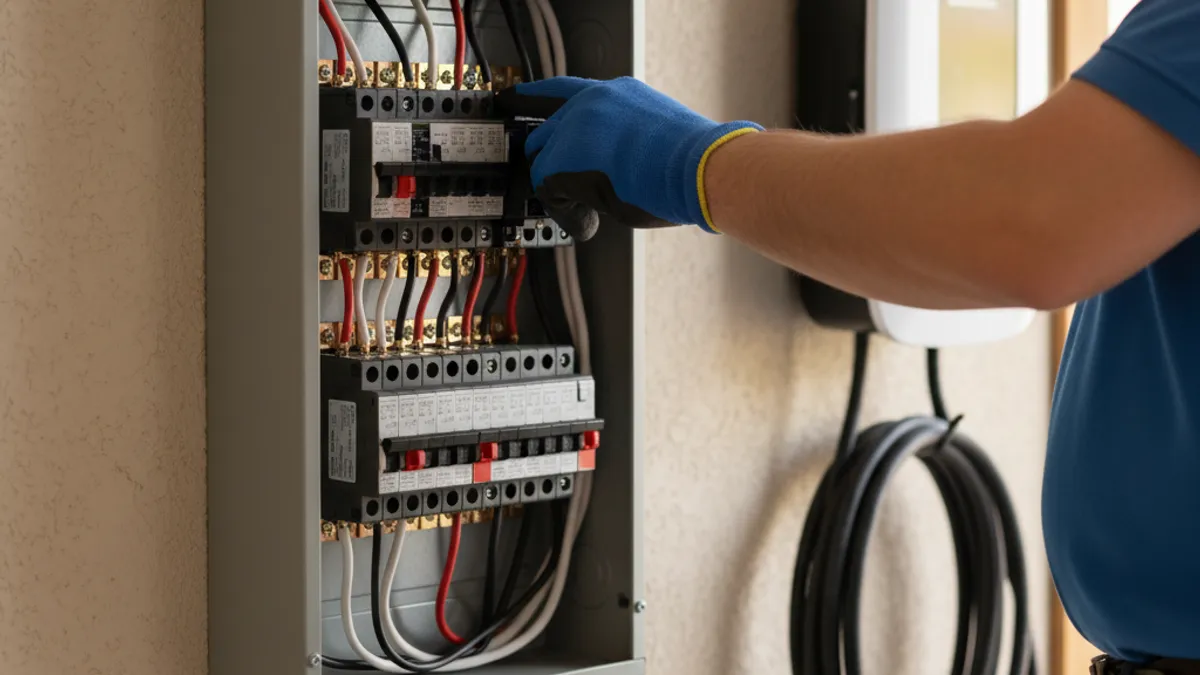
A careful installer will add up household load first. They should do that before promising a 40- or 48-amp circuit. If they never ask about the panel, get another quote. We don’t size panels or pull permits, and licensed electricians do. Ask to see that load check in writing.
Why San Tan Valley jobs differ from older Valley streets
Older East Valley cores can sit on tight services, and this community doesn’t match that stock. Verified ACS data shows 2.5% of homes predate 1980. The Pinal far-suburb belt is among the newest housing in the metro. Home charging is common here for that reason. Many Johnson Ranch and Circle Cross Ranch garages already have room for a 240-volt add-on.
A long run from a rear panel to a side pad adds labor. A house may already have a heat pump and other large 240-volt loads. That house can sit closer to full than it looks. Two neighbors in Pecan Creek can still hear different numbers. The difference is the circuit path, not the logo on the wall unit.
If an electrician wants a panel swap, pause. Read when a Valley home needs a panel upgrade for EV charging. Confirm the load math first, and don’t approve a swap on a hunch. Some homes can use a load-management device on the charger. It throttles the session when the house is already drawing hard. Ask whether that option was even on the table.
Copper Basin, Skyline Ranch, and Morning Sun Farms follow the same pattern. New streets and new panels still leave a long drive after breakfast. The electrician’s job is the garage, and the commute is still yours.
Neighborhoods, roads, and the commute the garage can’t cover
San Tan Valley covers about 75.8 square miles of unincorporated northern Pinal County. The Census Gazetteer point sits near 33.1786, -111.5628. Local ZIPs are 85142, 85140, and 85143. It’s one of the largest CDPs in Arizona. There’s no city hall and no city building department.
Daily driving still points north on Hunt Highway, Ironwood Drive, and Gantzel Road. Those roads feed the run toward Queen Creek and US-60. From the ranch subdivisions, that’s a real East Valley commute. Summer heat cuts range on that drive. Recurrent’s published Phoenix-area work found EVs can lose 20 to 30% of range above about 95F. Loss sat near 31% at 100F in that same work. NWS Phoenix normals show about 111 days a year at or above 100F. A home charger in the garage can’t refill the car on Hunt Highway.
The install question and the rescue question sit together. You charge overnight in a new subdivision. Monday’s northbound miles can still empty the pack. If you stall on that belt, operators we match bring a 240-volt Level 2 source to the car. Typical charging time is 15 to 30 minutes for about 10 to 20 miles of range. That’s plug time, never an arrival time. The roadside version of this geography is in mobile EV rescue in San Tan Valley on the Pinal commute.
Check APS at your address before you buy hardware
Research lists Arizona Public Service as the utility for San Tan Valley. Treat that as directional, because Valley electric service can split block by block. Confirm your own address with APS before you pick a charger around a rate plan.
APS publishes named EV programs you should verify on aps.com. The R-EV residential plan is marketed as EV Overnight Charging from 11 p.m. to 5 a.m. on weekdays. There’s a Level 2 smart-charger rebate and an APS Smart Charge program. We’re not publishing dollar amounts, and programs change. Confirm current terms on aps.com before you count on a rebate or a rate.
Overnight scheduling matters more than the color of the charger. Phoenix July highs average near 107F, and August sits near 105F. A garage in Circle Cross Ranch gets hot. Charging in the 11 p.m. to 5 a.m. window is the point of the APS plan. It also keeps the session out of the worst afternoon heat. For the Tesla-specific bill picture, see how Tesla home charging bills work on APS and SRP.
The city of Maricopa sits in Pinal County, not Maricopa County. Electrical District No. 3 serves that city and much of northern Pinal. ED3 publishes EV TOU 2-10 and on-bill smart-charger financing. San Tan Valley itself is listed under APS in the same research pass. Don’t assume a Maricopa neighbor shares your rate. Queen Creek is also listed as APS. Casa Grande, Coolidge, and Florence sit on ED2. No EV-specific program was found on ED2’s site when that file was read.
Permits: what we couldn’t confirm, and who to ask
San Tan Valley is a census-designated place, not an incorporated city. Electrical work here routes through Pinal County. We looked for a published, EV-specific charger permit rule for this CDP. No verifiable ordinance or fee turned up in the research behind this page. That isn’t the same as permission to skip paperwork.
Ask the county, in writing, what they require for a new 240-volt residential circuit. Ask the electrician who will pull it. A reputable installer includes that step in the job. Someone who offers to skip it isn’t doing you a favor. An unpermitted circuit can become an insurance problem after a fire. It can also turn into a disclosure issue when you sell. We can’t quote a county fee, so confirm the current amount with Pinal County before you pay.
Don’t copy a Mesa, Gilbert, or Chandler checklist and assume it applies. Those are incorporated cities, and this community isn’t. The county sets the rule here. The electrician should schedule any inspection the county wants. If a quote never mentions that conversation, ask why.
What to ask before you hire an electrician
Use this list when you call around. Charge Pro PHX is a referral line for stranded drivers. We don’t bid charger installs for your garage.
- Will you put a load calculation in writing before you order hardware?
- Does this panel have headroom, or are you steering me toward an upgrade?
- Who handles the Pinal County permit, and is that in the price?
- What amperage is the circuit, 40 or 48 amps?
- How long is the wire run from panel to parking, and is that priced?
- Can the charger schedule on APS R-EV hours, 11 p.m. to 5 a.m. weekdays?
Clear answers beat a cheap number for the box alone. The low quote that never measured the run is the one that grows later. If two quotes disagree on a panel upgrade, stop and compare the load sheets.
Federal clean-vehicle tax credits ended for vehicles acquired after September 30, 2025. Arizona has no state EV rebate and no annual EV registration surcharge as of 2026. APS rebate names are fair to ask about, but we won’t invent dollar figures.
How to stay charged while the install is still open
The part people skip is the wait after you buy the car. The electrician isn’t done, and you still have to get north toward Queen Creek or the US-60. A 120-volt household outlet, Level 1, only trickles range. In heat it can feel even slower, and that trickle rarely matches a Pinal commute.
Public charging can help when a site is working. We won’t guess how far the nearest stall sits. Inventories go stale, and this page won’t invent a map. Check a live app on the morning you drive. If a stall is down or full, you still need a plan.
Independent operators we match bring a 240-volt Level 2 source. They meet you in the driveway or on the shoulder. They use a native NACS plug, plus CCS or J1772 adapters for non-Tesla EVs. They quote you before they start and bill you directly. Charge Pro PHX owns no trucks and employs no technicians. We don’t set prices or promise when someone arrives. The operator’s quote is the number that matters.
A typical on-site session adds about 10 to 20 miles of range. Charging time is usually 15 to 30 minutes. That’s plug time, not a clock on the highway. It’s enough to reach home or a working public stall. Then you sort the install on your schedule. Compare that bridge with a finished wall unit in home charger install versus calling a mobile EV rescue. The 240-volt difference, home versus truck, is in home 240-volt charging versus a mobile 240-volt rescue.
When the new charger is live and the car still won’t move
Installs fail after the sticker goes on the panel. Breakers trip, GFCI devices open, and the car reports a charge error at 4 a.m. You need to leave for the US-60 run, and the garage session never happened. That isn’t only an electrical punch list. It’s a stranded-car problem on a workday morning.
Call the installer on the warranty, then decide whether you can wait. If you can’t, a mobile operator can put range in the pack. Heat makes this more common, because cabin cooling and parked-car features draw power. A cooked 12-volt can leave the car dark even when the traction pack isn’t empty.
A dead 12-volt shuts the car down even with a full high-voltage battery. The small battery runs door handles, screens, and the contactor that connects the main pack. Battery Council International work, via Battery University, tracked starter batteries in heat. They last about 47 months in hot climates versus 59 in cool ones. AAA calls heat the top cause of battery failure. If the car won’t wake, say so when you call. Operators we match can jump or replace a 12-volt on site. They handle Tesla and every major EV brand.
Arizona DPS Roadside Motorist Assistance will change a tire, bring gasoline or diesel, and jump a conventional battery. Its published materials don’t mention EV charging. ADOT’s Incident Response Unit works Phoenix-area freeways 5 a.m. to 8 p.m. weekdays. It also doesn’t advertise an EV charge. If you’re empty on Hunt Highway, don’t assume a state truck will plug you in.
If you’re on the traveled part of a highway, ARS 28-871 says get off it when you can. A vehicle disabled so badly it can’t move is exempt. Leave room for traffic and stay visible 200 feet each way. ARS 28-775 is the Move Over law. Other drivers must move over or slow down for a stopped vehicle with warning lights.
Apache Junction, Gold Canyon, and the rest of the belt
The install in your garage doesn’t cover the miles after you leave. Apache Junction and Gold Canyon sit on the US-60 Superstition side. Casa Grande sits south on the I-10 run, and Maricopa sits west on SR-347. Those are separate communities with their own utilities and their own roads. A finished Level 2 at home still leaves you exposed on those belts in July.
Plan the commute around heat the same way you plan the circuit. Precondition the cabin while you’re still plugged in. Don’t start a northbound run at 4% because last night looked fine on a mild day. Tesla factory roadside, for an empty pack, tows toward a Supercharger or a service center. It doesn’t charge you on the spot. See mobile EV charging for what those operators bring. The road still wins on a 110F afternoon.
Frequently asked questions
How much does EV charger installation cost in San Tan Valley?
No verified typical price turned up for this CDP. Electricians quote from panel capacity, wire length, and hardware. APS lists a Level 2 smart-charger rebate by name. Confirm the current amount with APS. Get at least two quotes and a written load calculation.
Do I need a permit to install an EV charger in San Tan Valley?
We couldn’t confirm a published EV-specific permit rule for this unincorporated Pinal County community. Ask Pinal County what they require for a 240-volt residential circuit. A reputable electrician pulls whatever permit the county wants and schedules the inspection.
Can I drive while I wait on the installer?
A 120-volt outlet adds range slowly while you wait. Independent operators we match can deliver a 240-volt charge at the car. They quote before they start and bill you directly.
After the wall unit is up
Keep the APS overnight window and the installer’s number. Keep a plan for Hunt Highway when the session fails. For the local charging-and-rescue picture in this CDP, start at EV charging in San Tan Valley.
Charge Pro PHX matches stranded EV drivers with independent local mobile rescue operators. We own no trucks, employ no technicians, and don’t perform the work. Call (602) 932-0920 when you need that connection.