Phoenix heat is the core of electric vehicle battery maintenance in this metro. NOAA normals via NWS Phoenix count about 111 days at or above 100F. About 21 more days hit 110F or higher. July highs average near 107F, and August sits near 105F. Overnight summer lows stay in the mid-80s, so packs rarely cool. That calendar ages the traction pack and the 12-volt together.
Two batteries share the same heat, not the same job
An EV in Phoenix, Mesa, or Glendale, Arizona, still carries two battery systems. The traction pack moves the car and prints your range. The 12-volt runs locks, screens, and the contactor that wakes the pack. Desert heat stresses both, and it does it on different clocks.
When the traction pack runs low, you still get warnings. The car keeps rolling until the estimate hits empty. A dead 12-volt is quieter and easier to misread. The car can look fully charged and still refuse to wake. The screen stays black, and the door handles go dead. The high-voltage pack never gets the signal to connect. Our guide to which EV battery matters when you’re stranded sorts those symptoms.
That’s the mix-up that looks like a dead pack. People treat every battery warning as a pack problem. In this climate, the small battery often fails first. Battery Council International work, via Battery University, tracked starter-battery life by climate. Hot-climate batteries last about 47 months versus 59 in cool ones. A five-year battery elsewhere can fail in two or three here. AAA names heat as the top cause of battery failure. It recommends AGM batteries for hot areas.
A DC-DC converter only recharges the 12-volt while the car is on. It also tops the 12-volt while the car is charging. Sentry Mode and Cabin Overheat Protection keep drawing power while you park. Leave a Model Y at Phoenix Sky Harbor for a week. That drain plus garage heat is a classic no-start. Terminal 3 and Terminal 4 garages have confirmed Level 2 stalls, per skyharbor.com. East Economy lots and the 24th St. station lot still bake a parked car. A car that sat plugged in can still wake with a cooked 12-volt. Tesla 12-volt failures in desert heat walk through that pattern.
Sloan Park in Mesa, Salt River Fields by Scottsdale, and Phoenix Raceway in Avondale all cook parked cars. A long event park is a 12-volt test, not a pack test.
Published heat numbers, not a guess about your pack
We won’t invent one degradation rate for every Valley EV. Makes and chemistries differ, and makers update the figures. What we can cite is published heat research. That’s not a private estimate of your car.
AAA’s 2026 study found about a 10% efficiency drop at 95F versus 75F. Range fell about 8.5% in that same comparison. A 250-mile car did just under 230 miles. Recurrent reports EVs can lose 20 to 30% of range above about 95F. Loss sits near 31% at 100F in that work. That dataset included 345,622 trips by 300 Phoenix-area EVs. Geotab compared pack aging in hot climates versus mild ones. Cars that spend more than 35% of days above 27C age faster. That extra aging is about 0.4% per year in Geotab’s work. NREL reports cabin cooling as one of the biggest extra draws.
Those figures are planning context, not a warranty claim. They’re not Tesla’s numbers, and we won’t pretend they are. tesla.com wasn’t fetchable for a manufacturer range figure, so we won’t invent one. Your owner’s app and the service screen remain the source for your pack. For Tesla pack aging here, read how long Tesla batteries last in Phoenix heat.
Cabin cooling on a Loop 101 commute is a daily load. So is preconditioning in a Tempe lot before an ASU class. The traction pack isn’t failing when range dips on a 107F afternoon. It’s extra thermal work, whether you’re on Loop 101 or leaving State Farm Stadium in Glendale, Arizona.
Grades, old houses, and monsoon days
Phoenix sits about 1,135 feet at Sky Harbor. Northbound I-17 is a different climate by the time you reach Anthem. Anthem sits about 1,860 feet, and New River is about 2,140. Black Canyon City is about 2,000. ADOT posts a 6% maximum grade on that northern climb. SR-87, the Beeline toward Payson, posts a 7% grade into Slate Creek Canyon. US-60 east through Apache Junction toward Superior adds elevation too.
A loaded EV on those grades uses more energy than a flat central Phoenix run. Check the maker’s guidance more often on those climbs. The I-17, the Beeline, and the Superstition Freeway are the usual ones. City loops on Loop 202 South Mountain still add heat soak.
Sun City is 88.9% built before 1980, and Youngtown is 51.8%. Gilbert is only 4.1% that old. Maricopa, the city in Pinal County, is 1.9%. Surprise and Sun City West sit under 3%. The calls we match there are usually on the road after a long SR-347 or US-60 run.
Don’t treat Paradise Valley the town as the Paradise Valley urban village inside Phoenix. Don’t treat Maricopa the city as Maricopa County. Salt River Pima-Maricopa and Gila River set their own road rules. So do Fort McDowell Yavapai and Ak-Chin.
Monsoon season runs June 15 to September 30. Haboobs can drop visibility to near zero. Drive around a barricade into floodwater and ARS 28-910 can bill you for the response. Annual rainfall is only about 7.2 inches. Heat is the daily stress, not the rain.
Home charging on APS, SRP, and the rest
The Valley splits among five utilities, sometimes on the same block. Confirm your address, and don’t assume your neighbor’s rate.
APS serves large parts of Phoenix, plus Surprise, Goodyear, Buckeye, and Queen Creek. It publishes the R-EV residential EV rate, marketed as EV Overnight Charging from 11pm to 5am on weekdays. It also names a Level 2 smart-charger rebate, APS Smart Charge, and Take Charge AZ.
SRP serves much of Mesa and shares East Valley cities with APS. Its Electric Vehicle Price Plan closed to new enrollment after a February 2025 board decision. Existing customers may stay through the November 2029 billing cycle. SRP also names an Electric Vehicle Export Price Plan for solar homes. There’s a Level 2 rebate through the SRP Marketplace, plus EV Smart Charge and BizEV.
Mesa Municipal Electric covers about 5.5 square miles around downtown Mesa. It offers an E1EV time-of-use rate. ED3 serves Maricopa and much of northern Pinal with EV TOU 2-10. ED2 serves Casa Grande, Coolidge, and Florence. No EV-specific program showed up on ED2’s site when we checked.
Overnight charging on a named plan still helps the pack. A midday session in 105F air heats the cells more. Program dollar amounts aren’t something we’ll invent. Start with the Phoenix area EV charging hub before a longer drive.
Arizona has no annual safety inspection. EVs are exempt from Maricopa County emissions testing. Battery care here is mostly software, charging windows, tires, and cabin filters. For the non-pack calendar, use our EV maintenance schedule owners actually need. Tesla, Rivian, Ford, Hyundai, Chevrolet, and Kia each set their own charge limits and update cadence. We can’t confirm one ideal percentage for every Valley car.
If heat strands you, which call to make
Arizona DPS Roadside Motorist Assistance will change a tire and jump-start a conventional battery. It can bring gasoline or diesel. Its published materials don’t mention EV charging. ADOT’s Incident Response Unit works Phoenix-area freeways from 5am to 8pm weekdays. It doesn’t advertise an EV charge either. Independent mobile operators take those EV calls.
Charge Pro PHX is a referral line. We match you with a local operator. We don’t own trucks, and we don’t set the price. The operator quotes you before starting and bills you directly.
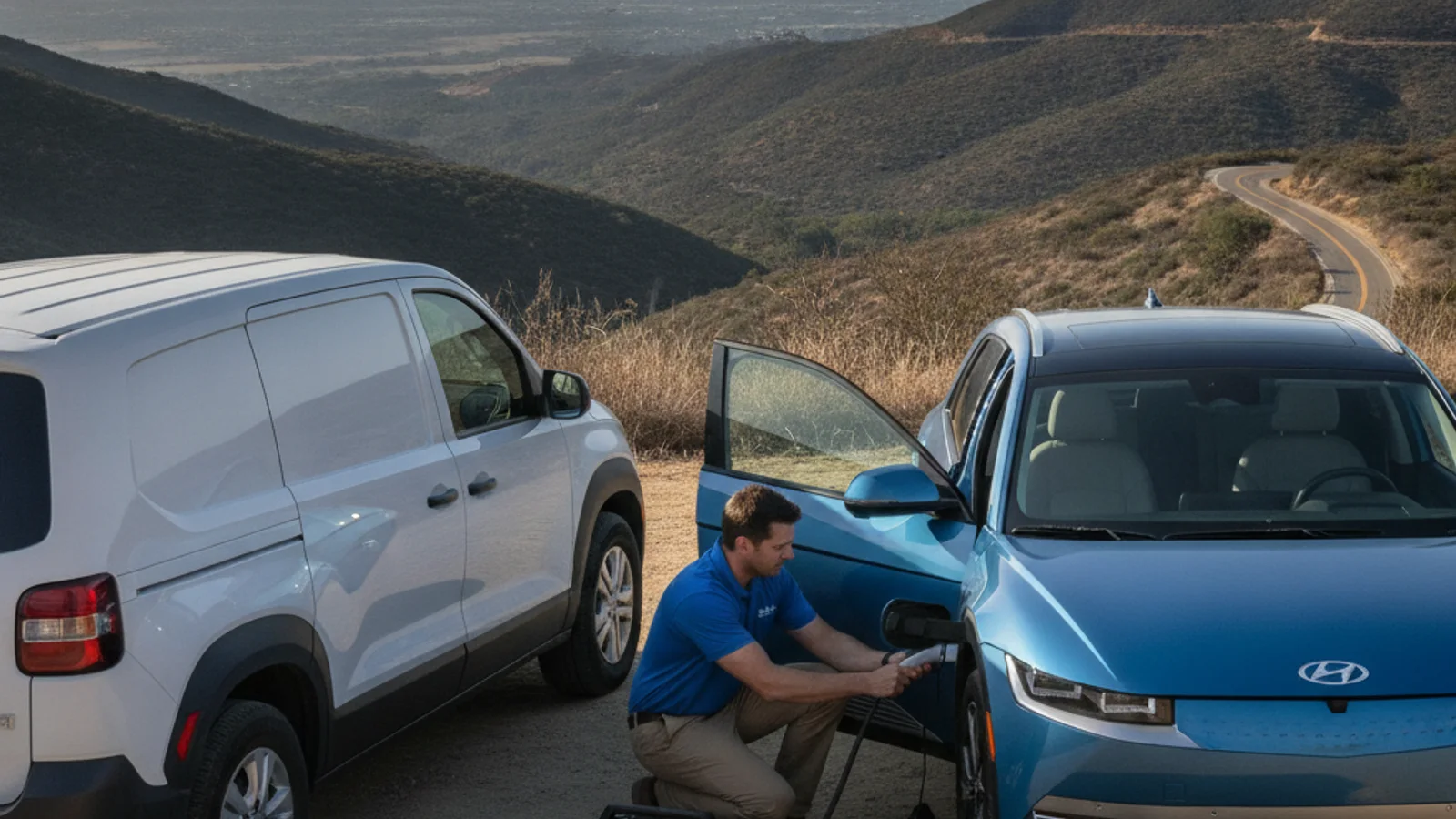
If the pack is empty, the operator brings a 240V Level 2 source. Native NACS for Tesla, with CCS or J1772 adapters for other brands. Typical add is 10 to 20 miles of range. That’s in 15 to 30 minutes of charging, not an arrival time. Mobile EV charging is the on-site option when you still need miles.
If the car won’t wake, start with the 12-volt. Ask for a jump or replacement on site. That’s often the faster path after a hot park at Chase Field, Mortgage Matchup Center, or Sky Harbor. Factory Tesla roadside, as documented, tows to a Supercharger or service center. Ford tows to a charger, home, or dealer within 50 miles. Signs your EV 12-volt needs replacement help you catch that before a lockout.
ARS 28-871 says get off the traveled lanes when you can. A disabled vehicle that can’t move is exempt. Leave room for traffic and stay visible 200 feet each way. ARS 28-775 asks other drivers to move over or slow for warning lights.
If the car charges and drives, pack health is a service-center question. Roadside operators get you moving. They don’t replace a traction pack or settle a warranty.
If you’re already stuck, call (602) 932-0920. We’ll connect you with an independent operator. That operator quotes the work before it starts.