Phoenix heat cooks the small 12-volt long before the traction pack gives out. If you’re seeing slow screens or weak door handles, pay attention. A replacement alert is a summer deadline, not a maybe. AAA calls heat the number-one cause of battery failure. In this Valley, waiting until June is how cars lock their owners out.
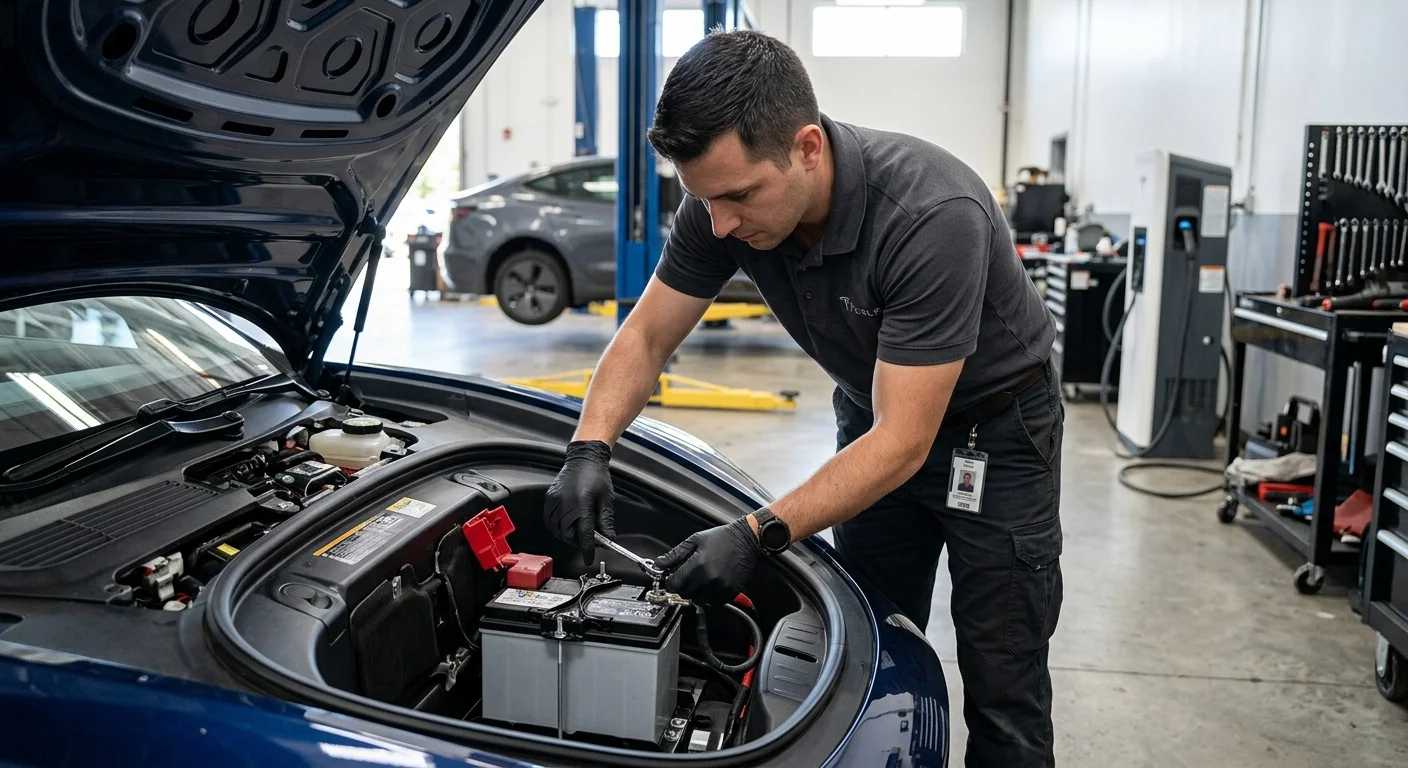
Heat, not mileage, is what ends most 12-volt packs here
Phoenix logs about 111 days at or above 100F in a normal year. About 21 of those days hit 110F or more. Those figures come from NOAA 1991-2020 normals via NWS Phoenix. July highs sit near 107F, and August sits near 105F. Overnight summer lows hang in the mid-80s, so the case never really cools. The record high is 122F, set June 26, 1990.
Battery Council International work, via Battery University, put hot-climate starter life at about 47 months. Cool climates got about 59 months on the same work. A battery good for five years in a mild city can fail faster here. Two or three years is a realistic desert window. AAA recommends AGM batteries for hot areas. That’s still the chemistry in most EV 12-volt trays. Some newer cars have moved to a lithium auxiliary cell.
This isn’t a traction-pack story. How Phoenix heat changes EV battery care covers the big pack. The small battery runs on a shorter clock, and summer starts it early.
Tesla features like Sentry Mode and Cabin Overheat Protection keep drawing while the car sits. A DC-DC converter only recharges the 12-volt while the car is on or charging. A week at Sky Harbor with Sentry Mode on can leave the 12-volt dead. The same drain happens on a Model Y in a Sun City driveway. Youngtown’s older streets see the same parked-car pattern. So do uncovered lots along Loop 101.
Sun City has some of the oldest housing in the service area. Most homes there were built before 1980. Cars sit on uncovered drives for hours. Gilbert, Surprise, and Sun City West skew much newer, so home charging is common there. The 12-volt still cooks on the commute, in a work garage, or at a game.
The small battery is what lets the big one work
The traction pack moves the wheels. The 12-volt runs the computers, locks, lights, and screens. It also closes the contactors that connect the high-voltage pack. If the 12-volt is flat, those contactors never close. A full main pack then sits there doing nothing.
You’ll get a dark screen and dead handles. The car won’t enter drive. It looks like the EV died, but often it hasn’t. The little battery just can’t wake the rest of the car. That’s why a dead 12-volt can lock the car in desert heat.
You may not open the charge port either. Some cars won’t release interior handles. People then assume they need a tow to a Supercharger. They needed a 12-volt rescue.
Signs to catch before June, not after a lockout
Don’t wait for a silent car in a Terminal 4 garage. Tesla and several other brands put a direct line on the screen. You’ll see “12V battery replacement due” or a low-voltage warning. That isn’t a suggestion. Schedule the swap. Tesla 12-volt failure signs you can catch before a lockout walks the Tesla-specific alerts.
The center screen is the next tell. It boots slowly, freezes, or goes black for a second. On a 107F afternoon that looks like software. It’s often the 12-volt sagging under load.
Door handles and the fob get flaky next. Handles don’t present, and the fob needs two clicks. You start blaming the phone app. Check the small battery before you buy a new fob.
Lights and windows follow, and interior lamps flicker. A window crawls down. Headlamps look dull at dusk on Loop 101 Price or Agua Fria. Accessories share that same 12-volt rail.
Then the car stops waking when you press the brake. There’s no chime, no drive mode, and no path to a charger. That’s the 12-volt failing to start the boot sequence.
Random service banners show up too. Control units brown out and throw codes that don’t match each other. A shop that only chases the scary code can miss the weak 12-volt behind it.
Age still matters, and heat shortens it. In mild climates people talk about three to five years. Here you should think closer to two or three if the car lives outside. Those Battery Council months are the reason. If the car is in that window and the screen already lags, don’t wait for monsoon season.
BMW drivers get a blunt replace-battery message that often means the 12-volt, not the pack. That’s the BMW i4 12-volt story in other words. Nissan Leaf owners see a car that simply won’t start. Same small battery, different badge. Rivian R1T and R1S trucks still need that tiny pack to wake. So do Mach-E crossovers and Hyundai Ioniq 5s.
Replace it before summer, not after the first stall
Schedule EV 12V battery replacement in spring, not after the first stall. Sitting through July with a three-year-old AGM is how driveway cars become bricks. West Valley streets in Surprise, Goodyear, Buckeye, and El Mirage bake hard. So does a Phoenix cul-de-sac. East Valley cars in Mesa, Gilbert, Chandler, and Queen Creek don’t get a pass. Tempe lots around ASU bake too. Scottsdale and the town of Paradise Valley cook parked cars on desert streets. The NOAA heat counts cover the metro.
If the car died once and came back after a jump, that’s the last warning. A jump only wakes the computers long enough for the DC-DC to charge the 12-volt. It can also get you far enough to creep to a shop. It doesn’t restore a cooked plate. Drive on it and you can stall again at a light on the Superstition Freeway. You can also stall in a lot at Chase Field after a Diamondbacks night.
Northbound I-17 toward Anthem and New River adds grade on top of heat. That climb is a traction-pack problem when you’re empty. It’s a 12-volt problem when the car won’t wake in a trailhead lot. Replacing a Tesla 12-volt after desert heat is the Tesla-shaped version of this same advice. Other brands follow the same heat clock.
Empty pack or dead 12-volt: don’t mix them up
If the screens work and the car shows zero percent, that’s a traction-pack problem. A mobile Level 2 charge can add 10 to 20 miles of range. That takes 15 to 30 minutes of charging, not travel time. If nothing lights up, start with the 12-volt. Jumping the high-voltage system is never the move.
What a 12-volt replacement costs, and what to confirm
No verified parts-and-labor menu for Tesla, Rivian, or Mach-E 12-volt swaps turned up here. Shops don’t publish a Valley-wide rate. Charge Pro PHX doesn’t set prices either. An independent operator or a service center quotes you before they start.
Don’t trust a blog range that was never sourced. Ask the shop whether the car uses AGM or a lithium auxiliary cell. Newer Model 3 and Model Y cars moved to a lithium 12-volt. Older cars and most other brands still use AGM. Lithium cells cost more in most markets, but this page won’t invent a figure. Confirm the current quote before you pay.
Labor depends on where the battery lives. Some sit under frunk cowl trim. Some sit under a rear seat. The owner’s manual names the spot for your VIN. That’s the document to follow, not a generic diagram.
Utility EV programs don’t cover this part. APS R-EV overnight charging, 11pm to 5am on weekdays, is about the traction pack. SRP’s Electric Vehicle Price Plan closed to new enrollment after a February 2025 board decision. Existing customers may stay through the November 2029 billing cycle. Mesa Municipal Electric’s E1EV rate and ED3’s EV TOU 2-10 are the same idea. They aren’t a 12-volt warranty.
Arizona has no annual safety inspection that would catch a weak 12-volt. EVs skip emissions testing in Maricopa County Area A. Hybrids don’t get that skip. Nobody’s going to flag this at a state lane. The warning has to come from the car, or from you.
A hot garage after a trip is a classic drain
Phoenix Sky Harbor is the highest-value version of this failure. Parking includes the Terminal 3 and Terminal 4 garages. East Economy garages A and B and the East Economy surface lot are in the mix too. There’s also the 24th St. station lot. Level 2 charging is confirmed in the Terminal 3 garage. Stalls sit on Level 1 west, Level 3, and Level 7. The Terminal 4 garage has it on Level 4 east in zone B. The 24th St. station has charging too. EVPassport installed that PHX charging in 2022. The PHX Sky Train links East Economy to the terminals.
Charging the traction pack in the garage doesn’t automatically save a 12-volt that already sat dead. If the car won’t wake, it may not start a charge session either. A week away with Sentry Mode on is a lot to ask of a tired AGM.
Phoenix-Mesa Gateway has Hourly, Daily, and Ray Road Economy lots, with a free Economy shuttle. Whether Gateway’s official amenities include on-site EV charging could not be confirmed from conflicting sources. Don’t plan the trip around an assumption either way. Plan around a car that may not wake after days in the heat.
The same parked-car pattern shows up at Cactus League lots. Sloan Park in Mesa is one. Salt River Fields sits on Salt River Pima-Maricopa land by Scottsdale. Camelback Ranch is in Glendale, Arizona. Surprise Stadium is another long sit. Mortgage Matchup Center downtown and State Farm Stadium in Glendale, Arizona, do the same. Phoenix Raceway is in Avondale, not Phoenix, despite the name. The car looks fine when you walk away. The 12-volt is the part that quits while you’re inside.
If you want to swap it yourself, slow down
Some owners can change a 12-volt. It isn’t the same job as a gas-car battery in an open engine bay. You’re working around trim, sensors, and a high-voltage vehicle. Follow the owner’s manual for that VIN. Locations move by year and brand.
Most manuals want service mode before you pull the negative cable. Disconnect negative first, then positive, so you don’t short a wrench to the chassis. Reverse that on install: positive first, then negative. If any of that sounds fuzzy, stop. The pros we connect you with can jump a dead 12-volt on site. They can replace one when that’s the job. They quote before they start and bill you directly.
When the car is already dead on a Valley shoulder
Get off the traveled lane if the car will still roll. ARS 28-871 says you can’t stop on the traveled highway when you can get off it. That applies outside a business or residence district. A vehicle that’s truly disabled and can’t be moved is exempt. Leave room for other traffic to pass. Stay visible from 200 feet in each direction. ARS 28-775, the Move Over law, is why flashers matter. Other drivers have to move over a lane when they can, or slow down.
Arizona DPS Roadside Motorist Assistance jump-starts batteries, changes tires, and brings gasoline or diesel. Its published materials don’t mention EV charging. ADOT’s Incident Response Unit works Phoenix-area freeways on weekdays from 5am to 8pm. It also doesn’t advertise EV charging. Confirm what they can actually do before you wait on them.
If the car needs a correct EV jump, use the published jump points in the manual. Never try to feed 12 volts into the high-voltage system. How to jump start an electric car in desert heat covers the safety shape.
Police can order a disabled vehicle removed under ARS 28-872. Arizona sets no statewide tow-rate cap, so don’t treat a stall as a free wait.
Who to call when you need an on-site jump or swap
Charge Pro PHX is a referral line for the Phoenix area. It doesn’t own trucks, doesn’t employ techs, and doesn’t hold a shop license. It matches you with an independent mobile operator. That operator can bring a 240V Level 2 source if the pack is empty. That typically adds 10 to 20 miles in 15 to 30 minutes of charging. That’s charging time, never an arrival time. The same operators jump or replace a dead 12-volt on site.
If the car won’t wake, start with the 12-volt path, not a Supercharger tow. Tesla 12-volt jumps are the Tesla-shaped version of that call.
Call (602) 932-0920 and we’ll connect you with a local operator who quotes you before starting.