A dead EV in a Valley lot usually comes down to two EV battery types. The traction pack stores the miles. The 12-volt runs the computers and door handles. Heat here hits the small battery first after a parked afternoon near 110 degrees. Get that split right before you call for help.
Heat hits the 12-volt while the pack still holds miles
Phoenix averages about 111 days at or above 100 degrees. About 21 days reach 110 or more. Those figures come from NOAA 1991-2020 normals via NWS Phoenix. July highs average near 107 degrees. August sits near 105. Summer nights still land in the mid-80s. A parked EV doesn’t rest in that weather. Tesla features like Sentry Mode and Cabin Overheat Protection keep drawing power while you shop.
Battery Council International testing, via Battery University, timed hot-climate starter batteries at about 47 months. Cool climates get about 59 months from the same design. AAA calls heat the number-one cause of battery failure. In an EV, that small battery runs the screens and door handles. It also runs the contactor that connects the main pack. A DC-DC converter recharges it only while the car is on or charging. Kill the 12-volt and a full traction pack sits unused.
Airport parking makes that failure obvious. Phoenix Sky Harbor’s Terminal 3 and Terminal 4 garages hold cars through week-long trips. Level 2 charging is confirmed in both garages, plus the 24th St. station. EVPassport installed that charging in 2022. The traction pack can still show range when you return. The 12-volt is the battery that fails in that stall. Downtown Chase Field lots cook a parked 12-volt after a Diamondbacks night. Mesa’s Sloan Park lot does the same after a Cubs game. A Glendale, Arizona stall after State Farm Stadium is usually the parked 12-volt. Mortgage Matchup Center downtown follows the same parked-heat pattern.
Older West Valley streets add age on top of heat. About 88.9 percent of Sun City housing predates 1980. Youngtown sits at 51.8 percent. Those cars have lived more summers. Newer East Valley and Pinal belts are different. Gilbert’s stock is about 4.1 percent pre-1980. Maricopa the city, in Pinal County, is about 1.9 percent. Home charging is common there. The stalls still happen on the road, not in the driveway.
A drained traction pack looks alive until the miles run out
The traction battery is the one you plug in at home or at a station. It turns the motor. When it’s empty, the cabin can still light up. Locks can still work. You just can’t go.
Cabin cooling takes a real cut. AAA’s 2026 study found about a 10 percent efficiency drop at 95F versus 75F. Range fell about 8.5 percent in that test. Recurrent reported 20 to 30 percent range loss above about 95 degrees. Loss sat near 31 percent at 100 degrees. That dataset covered 345,622 trips from 300 Phoenix-area EVs. NREL lists climate-control loads among the bigger drains. Tesla.com wasn’t reachable for a brand figure, so none is cited here.
Climbs spend that pack faster. Sky Harbor sits near 1,135 feet. Northbound I-17 reaches Anthem near 1,860 feet. New River sits near 2,140. Black Canyon City is about 2,000 feet. ADOT posts a 6 percent maximum grade on northern I-17. SR-87, the Beeline toward Payson, posts a 7 percent grade into Slate Creek Canyon. US-60 east climbs through Apache Junction toward Superior. Drivers on the I-17 climb have reported about 481 watt-hours per mile uphill. Coming down sat near 293. That’s roughly 40 percent more energy going up. Nav estimates often miss it.
A stall on those grades is an energy problem. The screens still work. The pack is empty. West Valley miles on Loop 101 Agua Fria and I-10 eat the traction pack. East Valley Loop 101 Price does the same on a long AC day. Mobile EV charging is the on-site answer for that case.
Skip chemistry. Read the dash and the doors.
Cell chemistry is a buying question. It’s not a roadside one. NMC versus LFP doesn’t change the roadside fix. You still need miles or a 12-volt wake-up. An operator won’t diagnose a supplier on the phone. They’ll ask what the dash says and what still works.
Charge Pro PHX has no verified pack voltages or cell recipes for any model. Kilowatt-hour ratings are unconfirmed here too. Those numbers don’t belong in this call. Your current owner’s manual is the source if you need them.
Work from two facts: the exact vehicle and the exact message. Make, model, and year change jump points and approved steps. A Tesla frunk procedure doesn’t transfer to a Rivian. It also doesn’t transfer to a Mustang Mach-E or a Hyundai Ioniq. Non-Tesla cars use CCS or J1772 inlets. That’s why non-Tesla EV rescue is its own path.
Then say what still works. Interior lights, the key fob, and the phone app run on 12 volts. So does the charge-port door. If those go dark, start with the small battery. Blank glass and handles that won’t present point the same way. That lockout is in what a dead 12-volt does in desert heat. If the car talks and shows zero miles, the traction pack is empty. The Tesla version is in 12-volt failure or the high-voltage pack. Repeat the dash text word for word. “It just died” isn’t a diagnosis. “The screen went black in a Tempe lot after three hours” is.
Arizona can jump a battery. It doesn’t advertise an EV charge.
Arizona DPS Roadside Motorist Assistance changes tires, brings gasoline or diesel, and jump-starts dead batteries. Its published pages don’t mention charging an empty EV. ADOT’s Incident Response Unit works Phoenix-area freeways from 5 a.m. to 8 p.m. weekdays. It’s a 14-member unit. That unit has logged 10,400-plus responses since October 2019. It clears debris and helps stranded motorists. It also doesn’t advertise bringing a Level 2 source to a car.
ARS 28-871 says leave the traveled lanes when you can. A vehicle that can’t move is exempt. Stay visible 200 feet in each direction and leave room to pass. ARS 28-775 is the Move Over law. Other drivers must change lanes or slow for a stopped vehicle with warning lights. That’s why a shoulder job needs space.
Independent operators handle the EV-specific part. Charge Pro PHX matches you with those operators. We don’t own trucks, employ technicians, or set prices. The matched pro quotes you before work starts and bills you directly.
Match the fix to the battery that failed
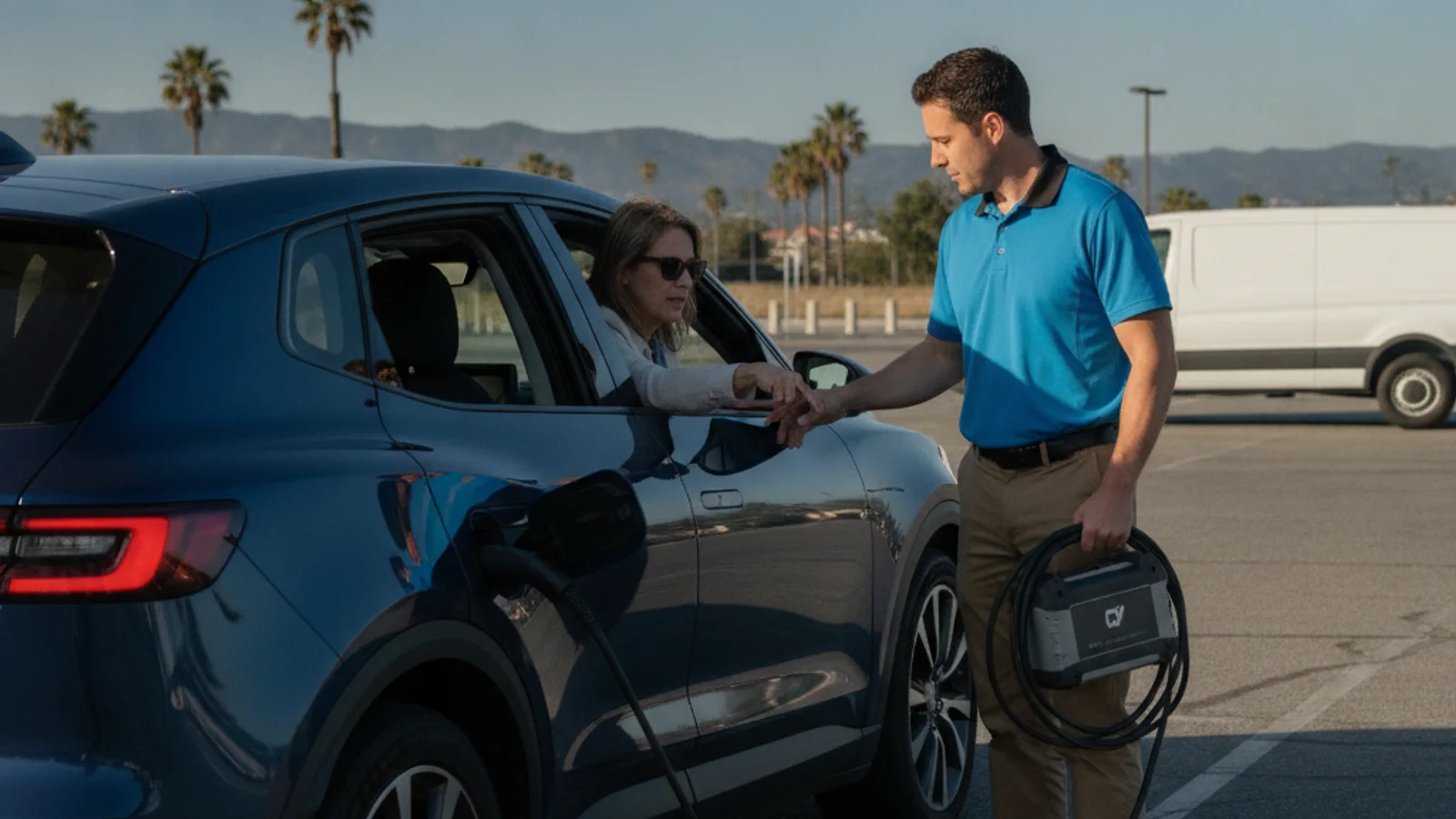
A Level 2 charge fits a confirmed empty traction pack. The pros we send bring a 240-volt source to the car. Teslas take a native NACS plug. Other EVs use a CCS or J1772 adapter. Typical charging time adds about 10 to 20 miles in 15 to 30 minutes. That window is charging time, never an arrival time.
A jump or 12-volt replacement fits a dead low-voltage system, when the maker allows it. Some cars hide posts behind a bumper cover. Some use the frunk. Don’t copy a clip filmed on a different brand. Confirm the steps in the manual and with the operator. Tesla 12-volt battery jump covers Tesla low-voltage jobs. Jump-starting an EV in desert heat covers the safety side.
A tow fits when you can’t tell which battery failed. It also fits when the car sits somewhere unsafe. It fits when the maker wants a shop. Tesla roadside doesn’t charge on site. It tows to a Supercharger or a service center. Ford tows to the nearest charger, home, or dealer within 50 miles. If you don’t know which battery failed, say that. Guessing costs you the wrong truck.
After you’re rolling, the Phoenix-area EV charging hub is the local map. APS and SRP split much of the Valley block by block. Confirm your own address. Mesa Municipal Electric covers about 5.5 square miles around downtown Mesa. ED3 serves Maricopa and much of northern Pinal. ED2 serves Casa Grande, Coolidge, and Florence. No EV-specific program turned up on ED2’s site.
Call when you can’t classify the warning
Call when the EV won’t power on or won’t charge. Call if you can’t place the warning on your own. Give the matched operator the vehicle and the exact wording. They sort a charge, a 12-volt job, or a tow from there. Call (602) 932-0920 and we’ll connect you with a local EV rescue operator.