The EV is dark on a Phoenix curb, and the only card in the console is State Farm. You need to know whether that roadside add-on pays for a charge, a jump, or only a tow. State Farm’s published Emergency Road Service pages do not clearly list mobile EV charging, so treat a charge as unconfirmed until an agent says it is covered.
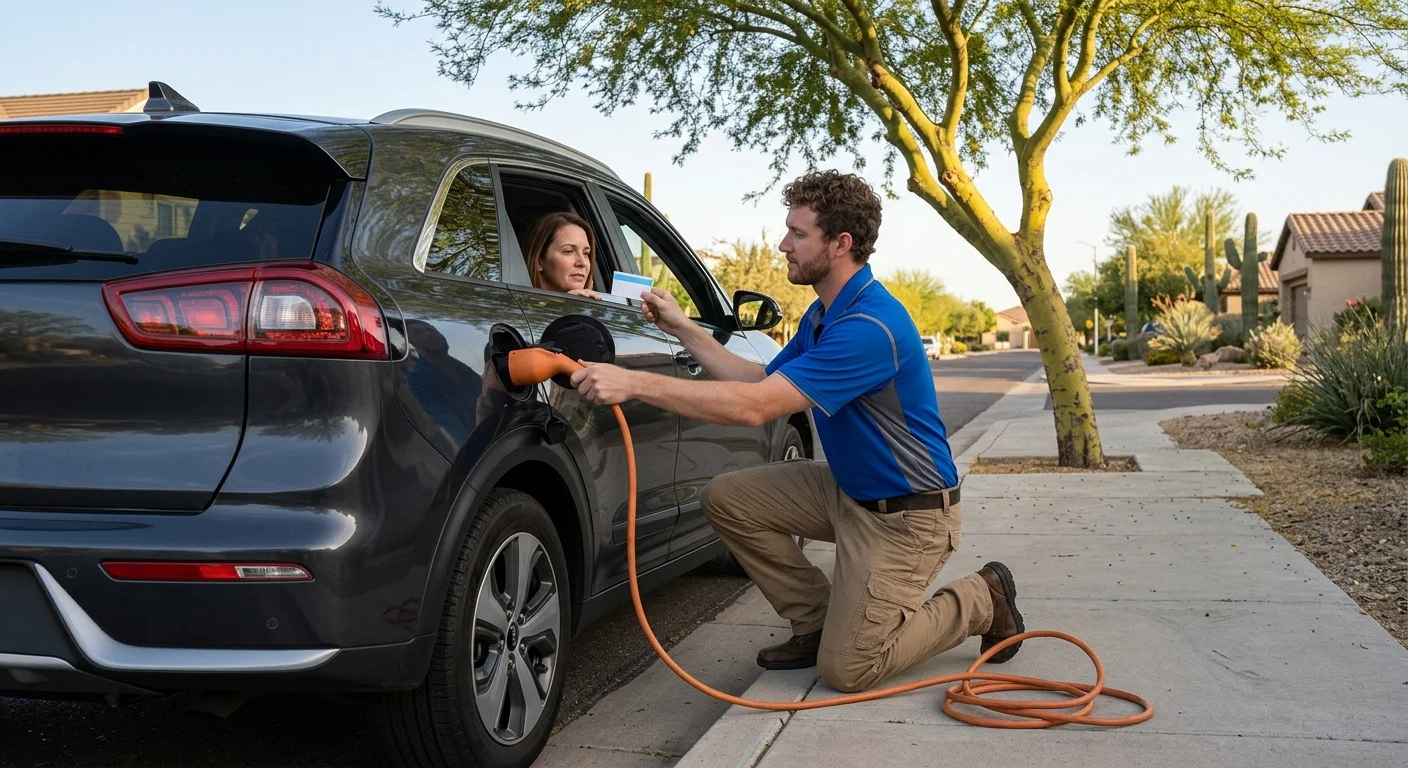
What State Farm roadside typically covers for EVs
State Farm sells Emergency Road Service as an optional add-on on many auto policies. Consumer pages for that add-on describe towing, a battery jump, a tire change, lockout help, and fuel delivery. Fuel delivery is written for gasoline and diesel. A truck that plugs into your charge port and puts miles back into the pack is not clearly named.
That gap is the problem for an EV driver. A gas car that ran dry gets a few gallons and leaves. An EV at 0% needs energy at the port, or a flatbed ride to a working charger. Those are different jobs. Only the tow sits clearly in the usual insurance roadside script.
State Farm also sponsors the ADOT Incident Response Unit on Phoenix-area freeways. That sponsorship has been in place since 2020. The unit works 5am to 8pm on weekdays. It is a 14-member crew. ADOT reports 10,400-plus responses since October 2019. The published list is crash and debris cleanup, tire changes, and help for stranded motorists. There is no EV-specific mention.
Arizona DPS Roadside Motorist Assistance runs statewide. It changes tires, provides gasoline or diesel, jump-starts dead batteries, adds water, and calls tows. DPS materials name gasoline and diesel. They say nothing about EV charging or an empty pack. Hours and specific corridors are not published.
Put those three sources next to each other and the pattern holds. Jump, tire, tow, gas. Not a mobile charge. Allstate roadside for dead EVs, Geico in Phoenix, and USAA follow that same published shape. If you hold a State Farm card, plan for a jump or a tow until someone on the recorded line says otherwise.
Arizona had about 141,800 battery EVs and 33,900 plug-in hybrids as of 2025, about 175,700 plug-ins in all. Plenty of those drivers carry State Farm. The documents we could check still read like a gas-car list.
Factory programs sit in a different pile. Tesla roadside is requested in the Tesla app. Tesla says assistance for a depleted battery is available, and that it is not a financially covered service, warranty or not. Tesla typically arranges transport to the nearest Supercharger or service center. Ford will take an out-of-charge Ford EV to a public charger, home, or a preferred Ford dealer within 50 miles of the breakdown. AAA offers mobile EV charging in select markets through a pilot, at no extra charge to members. None of those rules are State Farm rules. Do not mix them on the call.
The U.S. Department of Energy keeps a plain overview of how EVs charge. Use that to brief the agent: you need either a low-voltage jump or energy into the traction pack. Those are not the same request.
Jump, tow, and charging: what to ask on the call
A dead EV in the Valley is usually one of two calls. The first is a low-voltage lockout. The screens are dark. The doors may not open. The traction pack can still hold range. The second is an empty pack. The car still talks to you. The range is 0%. You need energy, or a ride to a charger. State Farm’s “battery service” language is built for the first call. It is a poor fit for the second.
Ask these questions before anyone hooks a cable or a winch.
Does my Emergency Road Service cover a jump on an EV low-voltage battery, not just a gas-car starter? If the pack is empty, will you dispatch a mobile charger, or only a tow? If it is a tow, is the destination a public charger that is actually working, or a body shop with no plug? Who picks that destination, you or the driver? What towing mileage sits on my endorsement? A single published free-tow figure for every Arizona State Farm auto policy could not be confirmed. The number lives on your card and your declarations page. Ask for it out loud.
Also ask who pays the vendor. Some carriers pay the contractor. Some tell you to pay and submit a receipt. Do not assume reimbursement after the fact. Get the claim or service number, the agent’s name, and a yes or no on mobile charging, in writing if the chat or app will save it.
If a tow is the answer, say flatbed. An EV’s drive wheels should not roll on the pavement for a long pull. Loop 202 South Mountain is a freeway, not a parking lot. I-10 through Tolleson, I-17 toward Anthem, and Loop 101 through the West Valley are the same. Arizona Revised Statutes 28-871 says you may not stop on the traveled part of a highway outside a business or residence district if it is practical to get off it. A vehicle disabled so badly it cannot be moved is exempt. When you are stopped you must leave room for other traffic and be visible 200 feet in each direction.
Arizona has no toll roads. Loop 202 South Mountain is free. Texts about unpaid Arizona tolls are scams. That does not help you if you are sitting in a live lane. Get the car out of traffic first, then sort the coverage.
A low-voltage jump is its own procedure. On the current Model Y, Tesla describes jump posts reached after the hood is open. The wires behind the tow-eye cover only release the hood latches. They cannot charge the low-voltage battery, and they must be disconnected once the hood unlatches. Procedures differ by model. A gas-car jumper who only knows the tow-eye pins can make this worse. Tell the dispatcher it is an EV, and name the model.
Phoenix heat lockouts a policy may not solve
Phoenix averages about 111 days a year at or above 100F, and about 21 at or above 110F. July highs average near 107F. August sits near 105F. Overnight summer lows still land in the mid-80s. That heat hits two different batteries, and a roadside policy written for a starter motor often only sees one of them.
Recurrent reports EVs can lose 20 to 30% of range above about 95F, with loss near 31% at 100F, from 345,622 trips by 300 Phoenix-area EVs. AAA’s 2026 study found about a 10% efficiency drop and an 8.5% range loss at 95F versus 75F. Cabin cooling is a real draw. NREL reports climate-control loads can cut EV range in a meaningful way. A drive from Mesa to Scottsdale that looked fine at 7am can be a different car at 4pm on the Loop 101 Price stretch, or climbing I-17 toward Anthem.
The other failure is the small battery that runs computers, locks, and contactors. Battery Council International work, via Battery University, found starter batteries last about 47 months in hot climates versus 59 in cool ones. AAA calls heat the number-one cause of battery failure. In Phoenix that small pack is living in a cabin that cooks in a strip-mall lot in Chandler, a Sun City driveway, or the Terminal 4 garage at Sky Harbor. A 12-volt death can lock the car even when the traction pack still has miles.
A State Farm jump, if the add-on covers battery service on your EV, may wake the 12-volt system. It does not refill an empty pack. It also does not fix a 12-volt that dies again after the jump, which is common here once the heat has cooked the pack. If the car is in the Terminal 3 or Terminal 4 garage, Level 2 charging is confirmed on site. That does not help if the car will not unlock or roll to those stalls.
ADOT’s Incident Response Unit can find you on a Phoenix freeway during its weekday window. It can change a tire. It is not a mobile charger. After 8pm on weekdays, and on weekends, that unit is not on the published schedule. DPS roadside, if it arrives, is still a gas-and-jump service. Heat lockouts and empty packs both look like “the car died” to a dispatcher. You have to name which battery failed.
How a local mobile charge is quoted by operators
Charge Pro PHX is a referral service. It matches you with independent local operators. It does not own trucks, set prices, or run the call. The operator quotes and bills you. The brand does not.
A typical rescue charge, from the operator’s Level 2 gear, is 10 to 20 miles of range in 15 to 30 minutes of charging. That is charging time, not arrival. The U.S. Department of Energy notes a Level 2 unit can range from 2.9 to 19.2 kW. Most residential Level 2 chargers operate at up to 30 amps, delivering 7.2 kW. Roadside trucks vary. The quote depends on where you sit, which port you have (J1772, NACS, or CCS), how empty the pack is, and the heat.
Charging power drops in high ambient heat. Field measurement of DC fast chargers in extreme heat found offered power declining by up to 35 to 40 kW once rectifier temperature approached 55C, with efficiency dropping about 5 to 8 percent. The car’s battery management system also asks for lower current when thermal headroom is gone. A summer stall on SR-347, I-10 south toward Casa Grande, or I-8 west toward Gila Bend is a slower charge than a February stall in Tempe. Operators price the job they can actually finish.
How that quote is built in this metro is spelled out in how Phoenix mobile EV charging is quoted. For the service itself, see mobile EV charging. If you still have a few miles and a charger you can reach, that is a different call than a car that will not roll. Emergency EV roadside assistance is the match when you need a local operator for a lockout, an empty pack, or a decision between a charge and a tow.
Pay the operator for the work they do. Then take that invoice to State Farm if you want to ask about reimbursement. Do not tell the operator that insurance will cover it unless an agent already said yes, on your policy, for this event. Mobile charging is not clearly listed on State Farm’s roadside pages. A verbal “we’ll see” is not a payment.
If the honest answer is a tow, say so early. A charge, not a tow, is the better outcome when the car can take energy on the spot and you only need enough range to reach home or a public plug. A freeway shoulder on I-17, with traffic at your back, can still force a flatbed. ARS 28-775, the Move Over law, is why people should give that truck a lane. Fines run $275, then $500, then $1,000 for repeats within five years. That protects the operator. It does not pay the bill.
Confirm State Farm’s current EV policy before you pay
Open the State Farm app or call the roadside number on your card before a contractor plugs in, if you can do that safely. Read the Emergency Road Service line on your declarations page. Ask whether mobile EV charging is covered on this policy, in Arizona, for this vehicle, today. Ask whether a low-voltage jump is covered. Ask the tow mileage. Ask who pays the vendor.
If the agent cannot find EV charging in the coverage, that is your answer. It could not be confirmed from the public materials we checked either. You can still hire an independent operator and pay them directly. You can still accept a covered tow to a charger, if towing is on the add-on and the destination is a live plug, not a locked lot.
Do not wait in a live lane while you argue coverage. Get off the traveled roadway when it is practical. On I-10, I-17, Loop 101, Loop 202, and US-60, that is the first job. Then sort the card. State Farm is the insurer. The operator is the person with the truck. Charge Pro PHX only makes the introduction.
If you already know the pack is empty and State Farm will only tow, say the nearest working charger out loud. Sky Harbor has Level 2 in the Terminal 3 garage, the Terminal 4 garage, and at the 24th St. station. That helps if you died in airport parking. It does not help on the Beeline toward Payson or on the I-17 climb past Sunset Point, where the grade is posted at 6% and the charger map thins out. Name the road. Name the battery. Then get the yes or no in a form you can keep.
When to call us
Coverage wording varies by insurer. Compare the public roadside descriptions in our Liberty Mutual dead-EV guide and American Family dead-EV guide, then confirm the answer against your own policy before dispatch.
Call when the car is dark, the pack is empty, or State Farm has already said a mobile charge is not on the policy and you still need energy on the spot. Call us at (602) 932-0920 and we’ll connect you with a local EV rescue operator.