The Progressive card is in the cup holder. The EV on a Tempe side street will not wake. That is either a heat-killed 12-volt or an empty pack, and those two calls do not get the same truck.
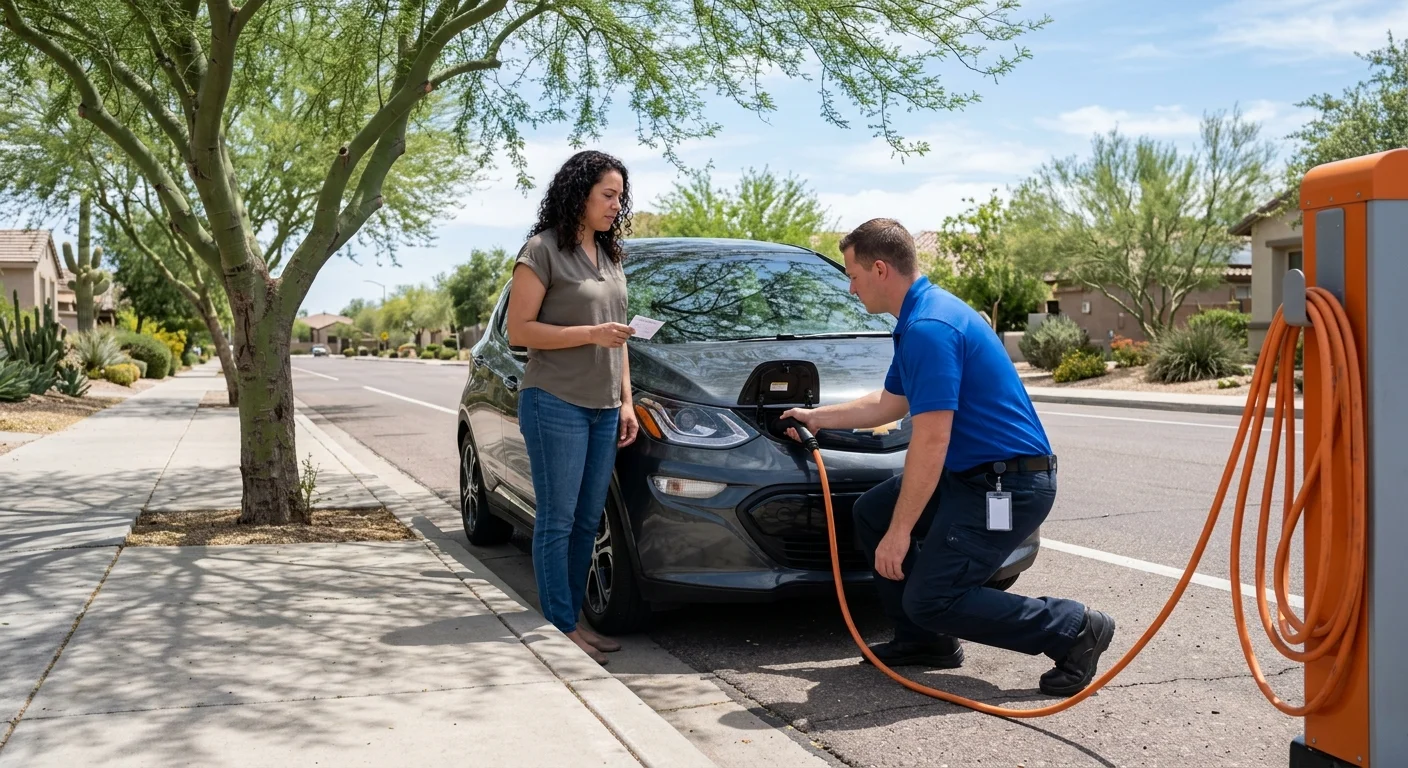
What Progressive roadside typically covers for EVs
Progressive roadside is a policy add-on on many auto policies. It is not a separate EV rescue product we can quote from here. Public Progressive materials available for this page do not clearly list mobile EV charging as a covered roadside service. That EV charging benefit could not be confirmed. Treat any blog that lists Progressive mile caps, trip limits, or charging fees as unverified until Progressive says it on your policy.
Classic roadside menus were written for gas cars. A jump, a gallon of fuel, a spare tire, and a tow still show up in that language. An EV in Phoenix often needs none of those in the gas-car sense. Fuel delivery does nothing for a traction pack at zero. A 12-volt jump can wake a locked car that still has miles in the pack. A tow can move you. A charge at the curb is a different job, and Progressive’s current documents do not clearly say they pay for it.
Other carriers in this cluster raise the same gap. Allstate roadside for a dead EV, Geico in Phoenix, and USAA in Phoenix all come down to the same ask: jump, tow, or charge, and who pays. Factory programs are clearer in the records we can cite. Tesla will arrange help for a depleted pack, but that help is not a financially covered service. Tesla typically sets transport to the nearest Supercharger or service center. Ford Roadside Assistance takes an out-of-charge Ford EV to the nearest public charger, home, or a preferred Ford dealer within 50 miles. AAA runs a mobile EV charging pilot in select markets. Progressive is the national name still missing a clear public EV charge line.
State trucks will not close that gap either. Arizona DPS Roadside Motorist Assistance changes tires, provides gasoline or diesel, jump-starts dead batteries, adds water, and calls tows. Published DPS materials say nothing about EV charging or an out-of-charge pack. ADOT’s Incident Response Unit works Phoenix-area freeways from 5am to 8pm on weekdays. It clears crashes and debris, changes tires, and helps stranded motorists. It also has no EV-specific mention. A Progressive dispatch and a freeway patrol can both leave you still needing emergency EV roadside assistance from an independent operator.
Read your declarations page before you assume anything. If roadside is listed, get Progressive to name the covered tasks for this VIN. If it is not listed, you are hiring help on your own dime.
Jump, tow, and charging: what to ask on the call
Say the failure in plain words. “The car is dark and the doors will not open” is a low-voltage lockout. “The dash still wakes and the range reads zero” is an empty pack. Mix those up and Progressive may send a jump to a car that needs miles, or a tow to a car that only needs a 12-volt wake-up.
Ask these, in this order, and write the answers down.
Is roadside even on this vehicle. A Snapshot discount or a liability-only policy is not proof. Have them read the endorsement.
Do you dispatch a jump, a tow, or a mobile charger. If they say “roadside,” push for the actual task. Roadside assistance for EV drivers fails when the word stays generic.
If they send a jump, confirm it is for the 12-volt or low-voltage battery, not a guess at the traction pack. A gas-car booster pack on the wrong posts can make a bad night worse. Tesla’s current Model Y manual, as one example, puts jump posts under the hood after a specific hood-release path. Other models differ. Tell the dispatcher the make, model, and year.
If they send a tow, ask how far and to where. Progressive’s published tow distance for this page could not be confirmed. Get the mile limit on the recorded call. Ask whether the destination is the nearest public charger, a dealer, or home. A tow from I-10 in Tolleson to a random west-side lot is a different bill than a short pull to a working DC stall. Arizona sets no statewide tow-rate cap. Cities and counties may set local maximums. Confirm who pays the wrecker before the hook goes on.
If they will not charge on site, ask who pays a mobile EV charging operator. Get a yes, a no, or a claim number. “We’ll figure it out later” is how drivers eat the invoice.
Progressive’s public app page lists roadside assistance as a request path, with location used to place the call. That is a button, not proof that EV charging is covered. Use the app if it is on your phone. Still make them say the covered task out loud. The number on your insurance card is the Progressive line. Ours is only the referral line at the bottom of this page.
Stay off the traveled lane while you wait, if you can move. ARS 28-871 says you may not stop on the traveled part of a highway outside a business or residence district when it is practical to get off it. A disabled vehicle that cannot be moved is exempt. Leave room for traffic and stay visible. Arizona’s Move Over law, ARS 28-775, requires other drivers to change lanes or slow for a stopped vehicle with warning lights. Fines run $275, then $500, then $1,000 for repeats within five years. Put hazards on. Do not stand in a Loop 101 lane to argue coverage.
Phoenix heat lockouts a policy may not solve
Phoenix averages about 111 days a year at or above 100F, and about 21 at or above 110F. July highs average near 107F. August sits near 105F. Overnight summer lows still hang in the mid-80s. That climate creates two stranded-EV calls that look identical from the sidewalk.
The first is a 12-volt, or low-voltage, lockout. Cabin electronics, door latches, and the “ready” sequence all lean on that small battery. Battery Council International work, via Battery University, found starter batteries last about 47 months in hot climates versus 59 in cool ones. AAA calls heat the number-one cause of battery failure. A Progressive jump, if they will send one, might belong on this call. The traction pack can still hold tens of miles. The car simply will not wake.
The second is a true empty pack. Recurrent looked at 345,622 trips by 300 Phoenix-area EVs and reported 20 to 30 percent range loss above about 95F, with loss near 31 percent at 100F. AAA’s 2026 study found about a 10 percent efficiency drop and an 8.5 percent range loss at 95F versus 75F. Cabin cooling is a real draw. The U.S. Department of Energy’s electric vehicle pages are the clean overview of how charging and range actually work. A jump does not put those miles back. Only a charge or a tow to a charger does.
The Valley is not one pattern. East Valley commutes on US-60 through Mesa and the Superstition grade cook the pack on the way home. West Valley runs on I-10 through Avondale and Tolleson sit in radiant heat off the pavement. North of Anthem, I-17 starts to climb. Drivers on that northbound climb report roughly 481 Wh/mi going up versus 293 coming down, about 40 percent more energy uphill, and the nav often underestimates it. That is a driver report, not a lab measurement. Plan as if the estimate is short. A Scottsdale errand around Camelback and a Gila Bend run on I-8 are not the same remaining-range problem.
If you are already in a Sky Harbor garage, the facts change again. Level 2 charging is confirmed in the Terminal 3 garage, the Terminal 4 garage, and at the 24th St. station. Asking Progressive for a tow out of a garage that already has plugs can be the wrong move. Asking for a jump in that same garage can still be right if the 12-volt has dropped and the charge port will not wake.
A policy that “covers roadside” can still leave both of those Phoenix failures unsolved. The lockout needs the correct low-voltage procedure. The empty pack needs energy. Confirm which failure you have before you accept the truck they send.
How a local mobile charge is quoted by operators
Charge Pro PHX is a referral service. We match you with an independent local operator. We do not own the truck, set the price, or run the charge. The operator quotes you, bills you, and does the work. Progressive may or may not reimburse that invoice. That is a Progressive question, not a rate we publish.
What we can say about the job itself is narrow and sourced. A typical rescue charge is 10 to 20 miles of range in 15 to 30 minutes of Level 2 charging. That is charging time on scene, not a promise about when anyone arrives. A Level 2 unit can range from 2.9 to 19.2 kW. Most residential Level 2 chargers operate at up to 30 amps, delivering 7.2 kW. Roadside trucks are not all built to that same number. The operator should tell you the connector they carry (J1772, NACS, or CCS) and whether your inlet needs an adapter. Rivian’s J1772 AC adapter, for one documented case, is for AC only and must not be used on a DC charger.
The quote moves with the map. A stall on a Chandler cul-de-sac is a different setup than a shoulder on Loop 202, a dark car in an El Mirage driveway, or a delivery van that died at Sky Harbor. Heat cuts offered charging power. Field measurement of DC fast chargers in extreme heat found offered power falling by up to 35 to 40 kW once rectifier temperature approached 55C, with charge time stretching from 86 minutes in winter to 169 minutes under extreme summer conditions. The car’s own battery management system also asks for less current when it is hot. A Phoenix August quote that assumes winter speed is the wrong quote.
Ask the operator to price the miles you need to reach a working public stall, not a full pack. Ten to twenty miles is often enough to roll to a charger in the core, the East Valley, or along I-10. It may not be enough on the I-17 climb or out SR-347, where ADOT still lists a public charging gap. Get the destination in the quote. Get Progressive’s coverage answer in writing or on a recorded line before you tell the operator that insurance is paying.
For the way Phoenix operators actually build that number, how a Phoenix mobile EV charge is quoted walks through the same math without turning it into a brand price list.
Confirm Progressive’s current EV policy before you pay
Does insurance cover mobile EV charging. For Progressive, that specific benefit could not be confirmed from the public roadside materials used for this page. Do not pay a contractor on a guess. Call Progressive, open the app request, or both, and ask this sentence: “Is mobile EV charging a covered roadside service on this policy, for this vehicle, at this location.” Then ask them to put the answer on the claim or dispatch notes.
If they say yes, get the cap. Dollar caps, trip caps, and destination rules were not verified here, so the only safe number is the one they speak on your call. If they say no, you can still hire an independent operator and pay that operator directly. The referral is separate from the insurance file.
If they offer only a tow, confirm the destination before the winch moves. Nearest open charger is the usual EV-smart ask. Home only helps if you have working Level 2 there and enough remaining battery to accept a load after the 12-volt is up. A dealer trip can be right for a failed pack and wrong for a car that only needs 15 minutes of Level 2.
Pull the physical card and the declarations page while you still have phone battery. Screenshot the coverage list. If roadside is missing, adding it after you are already dark on a Mesa curb will not retroactively pay this stop. Progressive’s current EV wording can change. Recheck it when you renew, not when the cluster is black.
Keep the two failures separate on every call. Heat lockout. Empty pack. Jump, tow, or charge. Who pays. Those four lines are the whole file.
When to call us
Call when Progressive will not send a charger, when the 12-volt jump still leaves you with an empty pack, or when you are sitting off I-10, I-17, or a Valley arterial and need miles rather than a wrecker. Call us at (602) 932-0920 and we’ll connect you with a local EV rescue operator.