An EV can jump start a gas car from its 12-volt battery. It can’t feed that jump from the traction pack. In Phoenix heat that small battery is already tired. Clip the cables anyway and you may strand both cars.
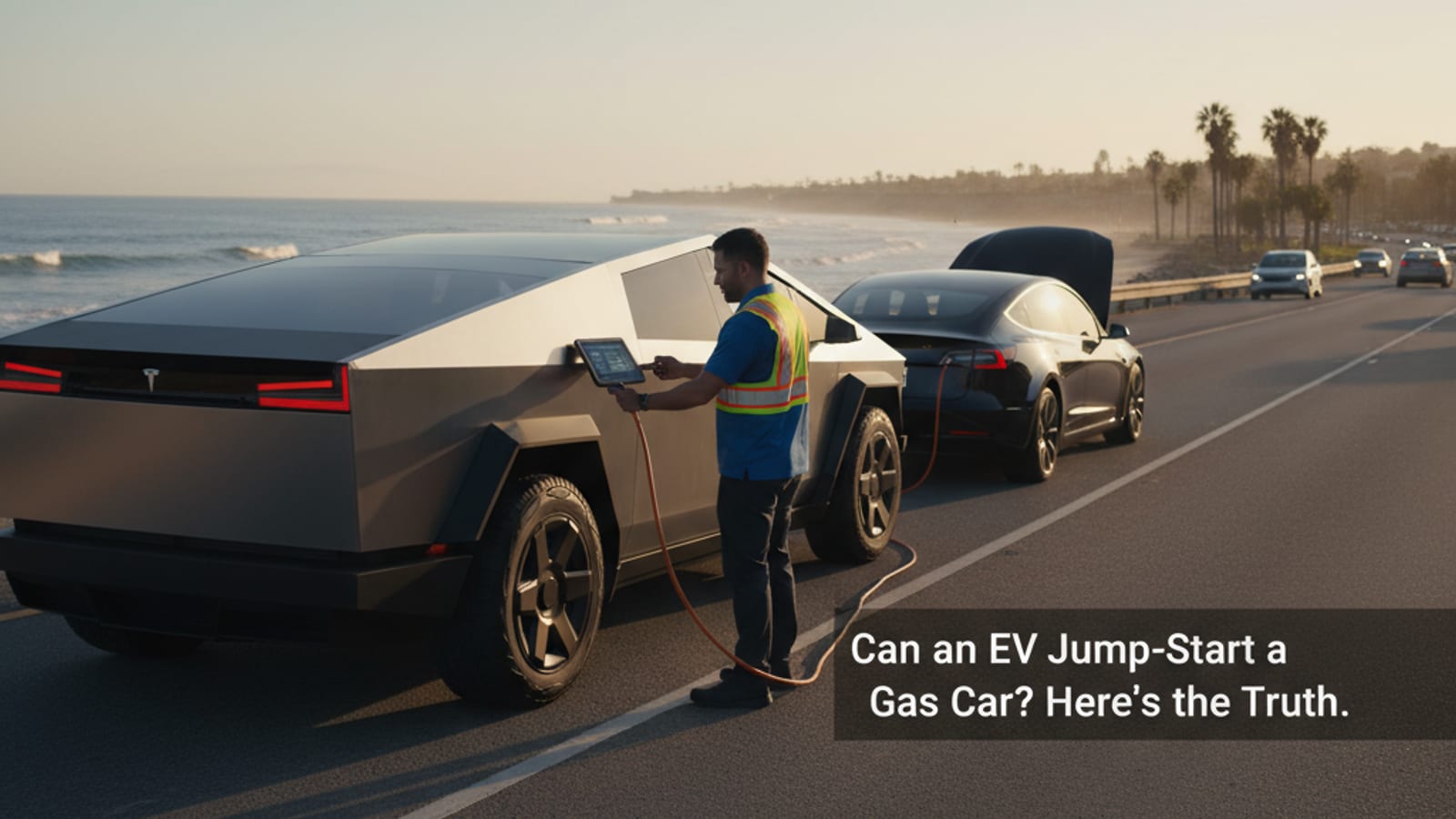
The high-voltage pack that moves the wheels stays out of this. The jump is only a 12-volt-to-12-volt loan. That’s true on I-10, Loop 101, and a Sky Harbor garage ramp. It’s true in Mesa, Tempe, and Scottsdale lots too.
The 12-volt does the work, not the pack
Every EV still carries a small 12-volt battery. It wakes the computers, door handles, and screens. It closes the contactor that connects the traction pack. It doesn’t crank a gas car’s starter motor. A gas car’s 12-volt does that job with a short, heavy surge.
Jumper cables only tie those two small batteries together. Your EV isn’t a portable power plant in that moment. It’s sharing a surge it wasn’t sized to give. Many newer Teslas use a lithium 12-volt, not lead-acid. Lithium units trip protection faster when a starter yanks hard.
Valley heat makes a weak donor weaker
Phoenix averages about 111 days a year at or above 100F. About 21 of those days hit 110F or more. Those are NOAA 1991-2020 normals via NWS Phoenix. July highs average near 107F, and August sits near 105F. Overnight summer lows hang in the mid-80s, so the 12-volt never cools.
Battery Council International work, via Battery University, found a hard split. Starter batteries last about 47 months in hot climates. They last about 59 months in cool ones. A battery might last five years in a cooler climate. Here it can fail in two or three. AAA calls heat the number-one cause of battery failure. That’s the dead gas car in front of you. It can also be the EV you’re about to drain.
Sentry Mode keeps drawing while you park. Cabin Overheat Protection does the same in a hot cabin. A car left in the Terminal 3 garage at Phoenix Sky Harbor comes back cooked.
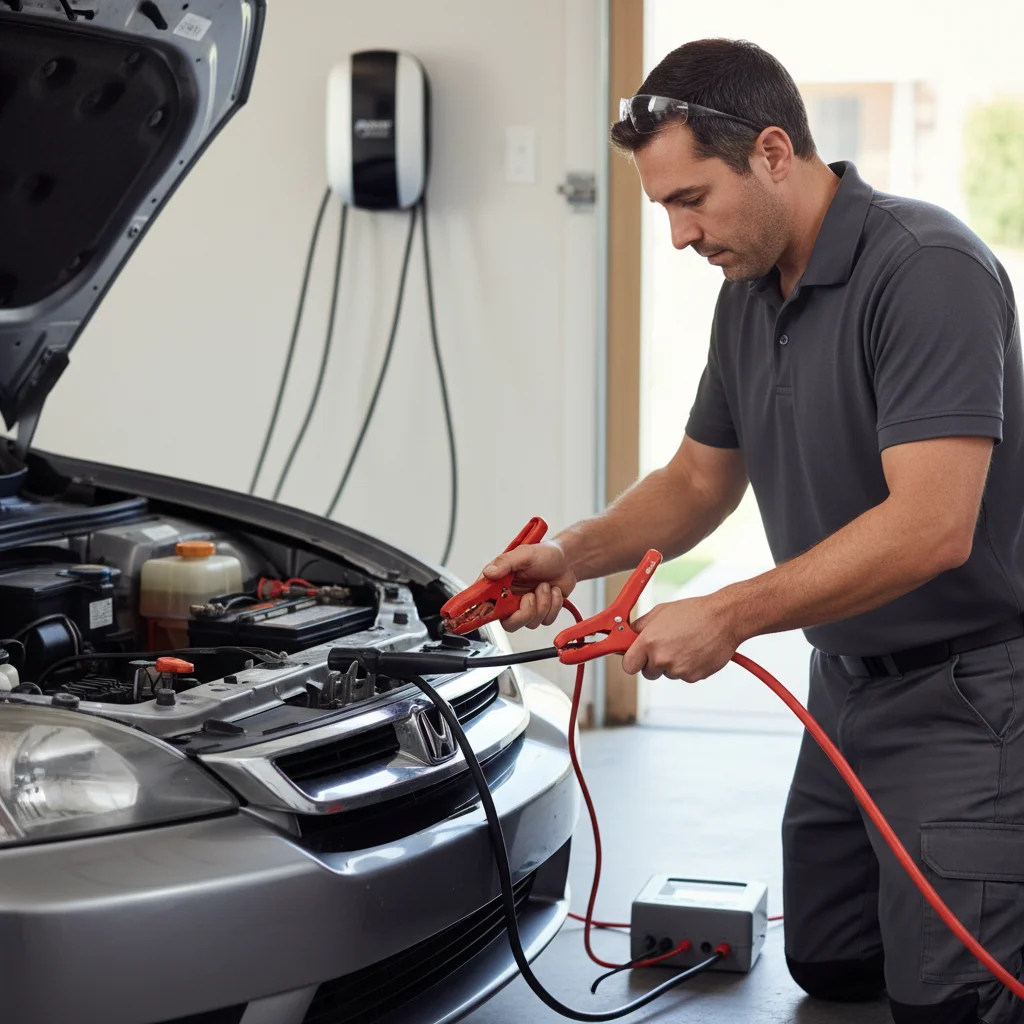
What a starter surge does to an EV
A gas starter wants a short, heavy gulp of current. Your EV’s 12-volt is built for accessories and control boards. Drain it too far and your EV won’t wake. That happens even with a full traction pack. The DC-DC converter recharges the 12-volt while the car is on or charging. A dead 12-volt leaves the doors, screens, and contactor dark.
A sloppy hookup can spike the low-voltage side. That can stress the DC-DC converter and the battery management gear. Tesla’s support pages generally tell owners not to jump other cars from a Tesla. Confirm the current wording on tesla.com/support before you try. NHTSA publishes jump-start safety steps for any vehicle. The safer move is still to skip the jump.
Arizona will jump the gas car for you
Arizona DPS Roadside Motorist Assistance will change a tire. It’ll bring gasoline or diesel, and it’ll jump a dead 12-volt. Its published materials say nothing about EV charging or an empty pack. ADOT’s Incident Response Unit works Phoenix-area freeways from 5am to 8pm on weekdays. It clears debris, changes tires, and helps stranded drivers. It also doesn’t advertise an on-site EV charge.
If the gas car died, start with that state help. If your EV dies after the jump, those programs won’t refill the pack. Independent operators we connect you with bring a 240V Level 2 source. They typically add 10 to 20 miles of range. That takes 15 to 30 minutes of charging, not an arrival time. They can jump or replace a dead 12-volt on site.
If the jump already killed your EV
Get off the traveled lanes if you can. ARS 28-871 covers disabled vehicles on a highway. Don’t stop on the traveled part if you can get clear. A vehicle that can’t move is exempt. Stay visible 200 feet in each direction. Arizona’s Move Over law is ARS 28-775. Other drivers must change lanes or slow for warning lights.
Don’t keep cycling the cables after a failed jump. If the EV’s 12-volt collapsed, more jumping won’t save either car. A Tesla 12-volt jump from a mobile operator is the on-site path. When Tesla 12-volt batteries fail in desert heat walks that failure. Can a roadside jump wake an EV covers the other direction. How to jump start an electric car in desert heat covers the safer sequence.
Skip your EV and help the gas car another way
Call DPS, a motor club, or a shop for the gas car. Keep your EV in ready mode if you wait nearby. Don’t add Sentry Mode as a second drain. Read why jumping a gas car from a Tesla is a bad idea.
Charge Pro PHX is a referral line. It matches stranded EV drivers with independent local mobile rescue operators. It doesn’t do the work, own trucks, or set prices. The operator quotes you before starting and bills you directly. If the jump already killed your 12-volt, call (602) 932-0920. We’ll connect you with a pro who can jump or replace it on site.
We serve the Phoenix area, including Phoenix and the rest of the Valley. Confirm the current advice in your owner’s manual, Tesla’s support page, and azdps.gov before you clip anything.
Can an EV jump start a gas car at all?
Yes, it can, through the 12-volt only. The traction pack stays out of the circuit. Heat makes that small battery a poor donor.
Will this damage my Tesla or other EV?
It can drain or stress the 12-volt and the low-voltage electronics. Tesla generally advises against jumping other cars. Check tesla.com/support for the current wording.
Who should jump the gas car instead?
Arizona DPS Roadside Motorist Assistance advertises battery jumps for gasoline and diesel vehicles. A motor club or shop jump is the other path. Keep the EV out of that job.