Arizona DPS will jump a 12-volt battery. It won’t add traction miles on the freeway. If your EV won’t start, that split is the whole answer.
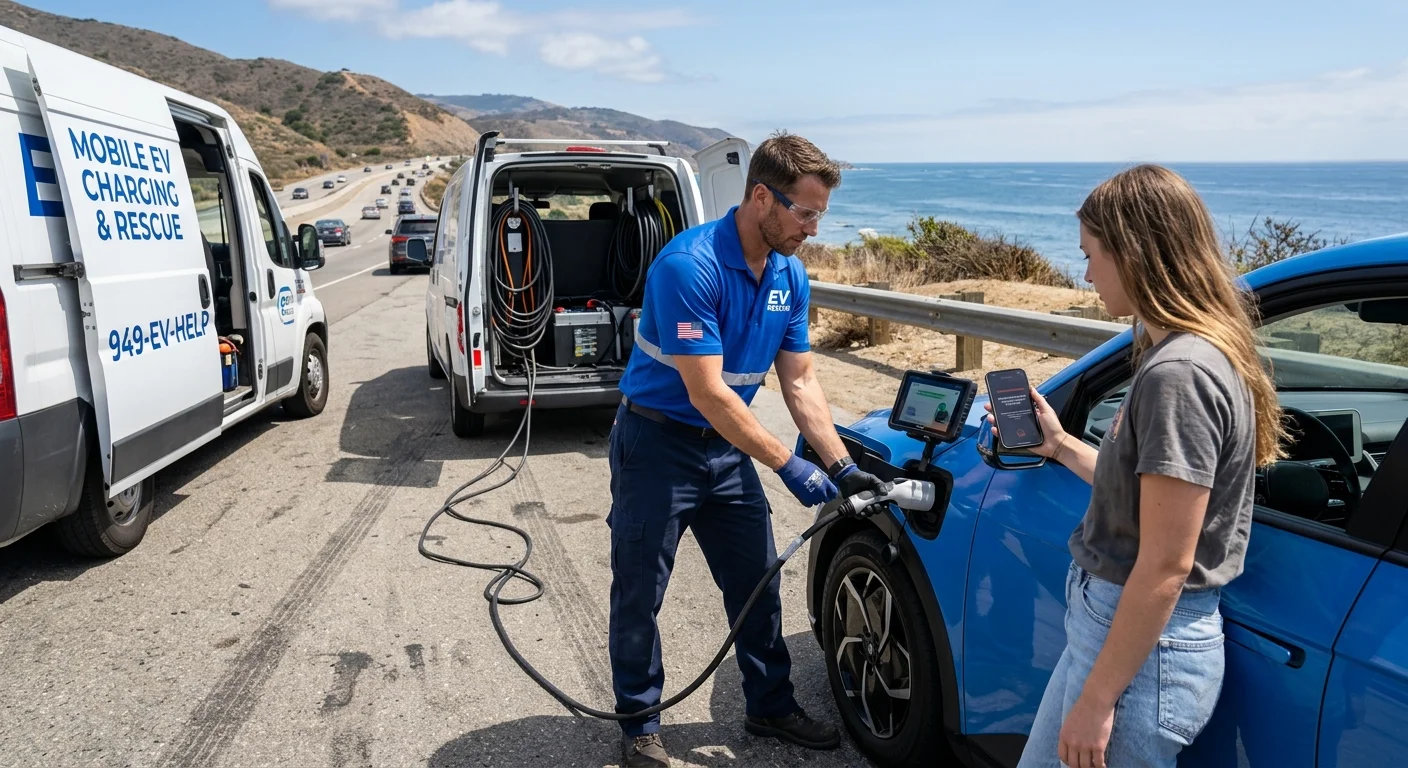
DPS can jump a 12-volt. It can’t fill the pack
The search is “can you jump start an EV.” Arizona’s public vans already have a published answer.
Arizona DPS Roadside Motorist Assistance runs statewide for disabled motorists. Crews change tires and bring gasoline or diesel. They jump-start dead batteries, add water, and call tows. In 2018 the program helped 75,235 motorists statewide. Its published pages name gasoline and diesel only. They say nothing about charging an electric car.
ADOT’s Incident Response Unit covers Phoenix-area freeways on weekdays. Published hours are 5am to 8pm on weekdays. It clears crashes, changes tires, and helps stranded motorists. No EV charge is on that published list.
A 12-volt jump wakes locks, screens, and high-voltage contactors. It doesn’t put miles into the traction pack. If the car still showed range, then went dark, a jump may fit. If you watched the percentage hit zero, cables won’t help. You need mobile EV charging or a tow.
For the tire-and-gas side of those vans, see Tesla flat tire coverage, and the Arizona motorist help gap.
Heat is why Valley cars fail this way
Phoenix averages about 111 days a year at or above 100F. July highs average near 107F in the Valley.
Heat is the number-one cause of battery failure, per AAA. Battery Council International work, via Battery University, tracked starter batteries in hot climates. Those batteries last about 47 months in heat. A battery good for five years elsewhere can fail in two or three here.
In an EV, the small 12-volt runs the door handles, the screens, and the contactor. That contactor is what connects the traction battery. A dead 12-volt strands you even with a full pack. The DC-DC converter only recharges it while the car is on or charging. Tesla features like Sentry Mode and Cabin Overheat Protection draw power while parked.
Sky Harbor makes that split concrete after a trip. Level 2 charging is confirmed in the Terminal 3 garage. It’s also in the Terminal 4 garage and at the 24th Street station. A week in a hot garage can still leave a dead 12-volt. That’s a jump job, not a pack job. Read what happens when an EV’s 12-volt dies in desert heat.
An empty traction pack looks different on the dash. You watched the percentage fall while you drove. AAA’s 2026 study found about a 10% efficiency drop at 95F versus 75F.
I-17 north toward Anthem, New River, and Black Canyon City climbs hard. ADOT posts a 6% maximum grade on northern I-17. The Beeline toward Payson posts a 7% grade into Slate Creek Canyon. US-60 east toward Apache Junction and Gold Canyon climbs as well. Those grades chew traction miles on the way up.
A Surprise or Goodyear commute on Loop 101 Agua Fria is a heat-and-AC drain. An Anthem or New River run on I-17 is a grade drain. Both of those trips can empty the pack. Neither is a reason to ask DPS for miles.
Two batteries. Only one takes jumper cables
Every current EV still has a small 12-volt battery. Tesla, Rivian, Ford, Hyundai, Kia, and Chevy all do. Jump points and chemistry aren’t identical across those cars. A newer Tesla lithium 12-volt isn’t an older lead-acid unit.
The traction pack is the big battery under the floor. Superchargers and public DC fast chargers refill that one. A roadside jump doesn’t touch that pack. Tesla roadside won’t charge you on site. It tows to the nearest Supercharger or service center.
Don’t lean on the word “dead” when you call. Drivers use it for a black screen, a refuse-to-drive, or a zero-percent pack. Those are different jobs for the operator.
For model-specific clamp points, use the current owner’s manual. Our guide to jumping an EV in desert heat is extra reading. It doesn’t replace the pages written for your VIN. The matched operator handles clamps on scene.
Name the freeway, the lot, and the access
The Phoenix area isn’t one place with one stall pattern. A stall on I-10 through central Phoenix isn’t a stall on Loop 101 Agua Fria. US-60 is Grand Avenue to the northwest and the Superstition Freeway east of Mesa.
A car in a Tempe apartment garage after an ASU day is an access problem. A car on the shoulder of Loop 202 is a Move Over problem. ARS 28-871 limits stopping on the traveled part of a highway. A vehicle disabled so badly it can’t be moved is exempt. You must be visible 200 feet in each direction.
ARS 28-775 is Arizona’s Move Over law. Approaching a stopped vehicle with flashing lights, move over a lane if you can. If you can’t move over, slow down. That’s why an operator working a shoulder needs other drivers to shift.
Arizona has no toll roads and no toll express lanes. Texts about unpaid Arizona tolls are scams.
Gated driveways in Paradise Valley the town aren’t a Sky Harbor stall. A lot at Chase Field after a night game is often a 12-volt story. Phoenix Raceway sits in Avondale, not Phoenix, despite the name.
Maricopa the city is in Pinal County, not Maricopa County. Salt River Pima-Maricopa and Gila River land have their own police. Say the road, the lot, the gate, and the nation if you’re on tribal land.
Report the last screen, not a guess
Give the last charge number the car showed. Read every warning message word for word. If the screen is black, say the screen is black. Don’t relabel it as a dead battery.
Then describe the start attempt in plain facts. Say whether the display still lights up. Say whether the car will enter Drive.
Share the full make, model, and year. “Tesla” or “electric Hyundai” isn’t enough detail. The operator needs the exact vehicle first. That’s before they choose a 12-volt jump or a charge.
Mention visible damage, smoke, heat, water, or a recent collision. After monsoon water in a charge port, a jump may not belong in the response.
If the traction pack looks empty, say it’s an out-of-charge EV. Asking only for a “jump” can send the wrong truck. That’s when out-of-charge recovery is the clearer request.
When a jump is the wrong ask
A jump isn’t a charge for the traction pack. An empty pack is the clearest reason to skip cables. Loop 101 in summer AC can empty the pack without covering miles. A crawl on I-10 does the same. Sitting with climate on is a standstill drain, not a 12-volt death.
Access can change the decision too. A low-clearance garage isn’t an open driveway. A gated lot or tight garage stall can limit which operator can take it.
Tesla, Rivian, and Hyundai/Kia factory scripts often end in a tow. Rivian and Hyundai/Kia owners have documented trouble getting a dead EV towed. Ask for a tow by name if that’s the path you want.
Charge Pro PHX doesn’t choose the procedure or perform the work. The independent operator evaluates the situation and explains the next step.
How we connect you, and what we don’t do
Charge Pro PHX is a referral line. We match stranded EV drivers with independent local mobile rescue operators. We hold no trade license and own no trucks. We employ no technicians and set no prices. We promise no arrival time.
The pros we connect you with are licensed and insured. The operator quotes you before starting. The operator bills you directly for the visit.
Operators bring a 240V Level 2 source to the car. Teslas use a native NACS plug. Other brands use a CCS or J1772 adapter. Charging typically adds about 10 to 20 miles of range. That happens in 15 to 30 minutes of charging. That window is charging time, never an arrival time. Operators also jump or replace a dead 12-volt on site. They handle Tesla and every major EV brand.
When you call, have the model, warning, last charge, and pin ready. We pass the request to an operator who can review the job. You’ll contract with that operator. Confirm the work and the quote before you approve anything.
Start with EV roadside assistance if you’re not sure which service fits. We serve every city in the county.
Call (602) 932-0920 when the car won’t wake. We’ll connect you with a local operator who reviews the vehicle first.