A CCS car can reach zero near ASU or a Tempe freeway interchange. The next step depends on its location, connector, warning messages, and whether the main pack or low-voltage battery caused the stop.
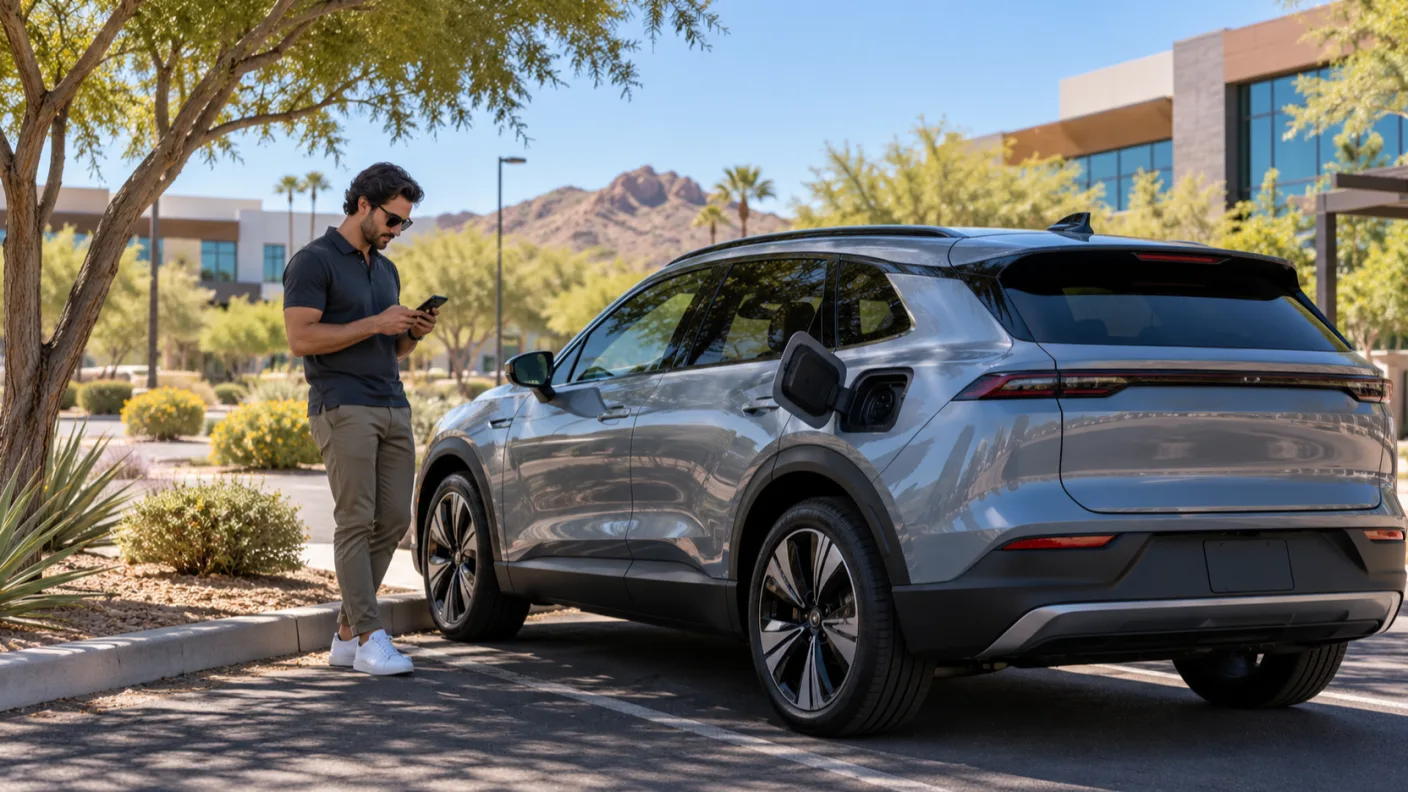
Why CCS and J1772 cars stall in Tempe
Tempe packs campus traffic, apartments, surface lots, and several major roads into a compact city. I-10, Loop 202 Red Mountain, US-60, and SR-143 all cross or border the local driving pattern. A missed charging stop can become a roadside problem quickly.
Heat also changes the range calculation. Phoenix averages about 111 days each year at or above 100°F. AAA’s 2026 study found about an 8.5% range loss at 95°F compared with 75°F. Cabin cooling also draws energy, according to the U.S. Department of Energy.
That doesn’t mean every stopped EV has an empty main battery. A car that won’t unlock, wake, shift, or release its charge port may have a low-voltage problem. A car that remains responsive but shows no usable driving range points toward a depleted propulsion pack. Warning messages and dashboard behavior help separate those situations.
Connector language can create more confusion. J1772 is used for AC charging. A CCS inlet contains that J1772 portion and adds separate pins for DC fast charging. A CCS DC adapter doesn’t automatically solve an AC compatibility problem.
Check the owner’s manual before connecting outside equipment. Procedures vary by manufacturer, model, and year. Our Non-Tesla EV Rescue service connects drivers with independent local operators who can assess the information provided and quote the appropriate option.
ASU lots, Mill Avenue, and the 202 and I-10 gaps
A stalled EV near Arizona State University creates a different problem from one stopped beside I-10. Campus garages, apartment lots, and busy Mill Avenue blocks can restrict access. The operator needs the exact entrance, level, row, and stall number, not only a dropped map pin.
Tempe’s housing also differs from newer East Valley suburbs. Census data shows 41.2% of its housing was built before 1980. That matters when a driver expected overnight charging at an older apartment or rental property but found no usable connection. It doesn’t prove a building has outdated wiring or public charging. Confirm the property’s actual equipment with its manager.
Road position changes the rescue plan. Arizona law says drivers should get off the traveled highway when practical. A vehicle too disabled to move has an exemption, but it must leave room for traffic and remain visible from both directions. Police can order an obstructing vehicle removed.
If you’re already in a safe parking space, leave the car there while gathering details. Don’t push it through active traffic or attempt an improvised tow. If you’re exposed to moving vehicles, prioritize personal safety and contact emergency services.
Drivers stopped on a Tempe freeway should also review our broader guide to EV roadside assistance in Tempe. It covers roadside decisions beyond the CCS-specific charging problem addressed here.
Superchargers that still leave CCS cars hunting
A nearby pin labeled “Supercharger” doesn’t prove your non-Tesla EV can use it. Access can depend on the vehicle, charging site, adapter, network rules, and current stall status. Those details can change, so confirm them in the vehicle maker’s manual and the charging network’s current app.
No verified source in our approved research establishes that every Tempe Supercharger accepts every CCS car. It also doesn’t confirm which local site has the correct hardware for a specific model. Treat an unverified charging pin as an option to check, not a destination you can trust blindly.
The connector itself matters. J1772 and J3400, also called NACS, support AC charging. CCS adds dedicated DC pins below the J1772 section. An adapter designed for one charging direction or power type may not work for another. Manufacturer approval matters because the port shape alone doesn’t establish compatibility.
Before moving toward any station, check four items:
- The connector shown for the individual stall
- Your vehicle’s supported AC and DC connections
- Whether a manufacturer-approved adapter is required
- Current access, price, and live availability in the network app
A station can still be occupied, inaccessible, offline, or incompatible when you arrive. If the remaining range won’t safely cover another attempt, stop hunting from one map pin to another. Our comparison of public CCS and Tesla Superchargers in Phoenix explains the connector split. The Phoenix-area non-Tesla rescue guide covers the same decision across the wider metro.
Factory help versus a matched local operator
Start by checking the roadside benefit attached to your vehicle, insurance policy, or membership. Coverage and dispatch options differ. Ask whether the provider can bring compatible mobile charging, address a low-voltage battery, or only arrange a tow.
Ford publishes a specific out-of-charge policy for its EVs. Its roadside program can tow an eligible Ford EV to a nearby public charger, the owner’s home, or a preferred Ford dealer within the program’s stated limits. Coverage terms depend on the vehicle and eligibility, so confirm them directly before relying on that option.
AAA says its mobile EV charging pilot uses Level 2 equipment in select markets. The published material doesn’t establish that the service is available for every Tempe request. Drivers should ask AAA whether their membership, location, and vehicle qualify at that moment.
Other insurers may also distinguish between charging and towing. American Family says its optional Emergency Roadside Service may provide a mobile charge or tow to a qualified EV facility. Liberty Mutual’s public roadside list mentions towing and dead-battery jumps, but it doesn’t promise mobile EV charging. Check your own policy and current dispatch options.
A matched local operator can be useful when factory or policy help doesn’t fit the situation. Charge Pro PHX is a referral service. We don’t perform charging, own rescue vehicles, set prices, or promise arrival times. The independent operator quotes and bills the driver directly.
The goal of mobile EV charging is often enough energy to reach a suitable charging point. A typical rescue charge can add roughly 10 to 20 miles of range during 15 to 30 minutes of Level 2 charging. That is charging time, not an arrival estimate.
What to have ready when you request a match
Good details prevent the wrong equipment from reaching a constrained Tempe location. Start with the vehicle’s year, make, model, and connector type. Don’t report only “CCS car.” Some model years use different ports or require different approved adapters.
Describe what the car is doing now. Note whether the doors unlock, screens wake, hazard lights work, and the vehicle shifts. Share the displayed range, battery percentage, and exact warning text. A photo of the dashboard can help preserve a message that disappears later.
Location needs similar precision. Provide the street address or map pin, then add access details. Near ASU, include the garage name, entrance, floor, row, and stall. Around Mill Avenue, mention whether the car is in a private lot, metered space, loading area, or street lane. Near Loop 202 or I-10, provide the direction of travel, closest exit, and whether the vehicle is fully outside traffic.
Also tell the operator about clearance limits, gates, validation rules, and property access. Don’t claim permission that hasn’t been granted. Ask the property manager or parking staff when access is controlled.
Finally, state the outcome you need. That may be a low-voltage assessment, compatible mobile charging, or transport to a suitable charger. Mention any adapter already in the car, but don’t assume it works for the requested connection. The operator should confirm compatibility and quote the work directly before service begins.
When to call us
Request a match when your non-Tesla EV can’t safely reach a compatible charger, or factory roadside options don’t fit the Tempe location. Call us at (602) 932-0920 and we’ll connect you with a local EV rescue operator.