An electric car stranded near Queen Valley needs the right kind of help. First get away from moving traffic, then determine whether the main pack is empty or the low-voltage system has failed.
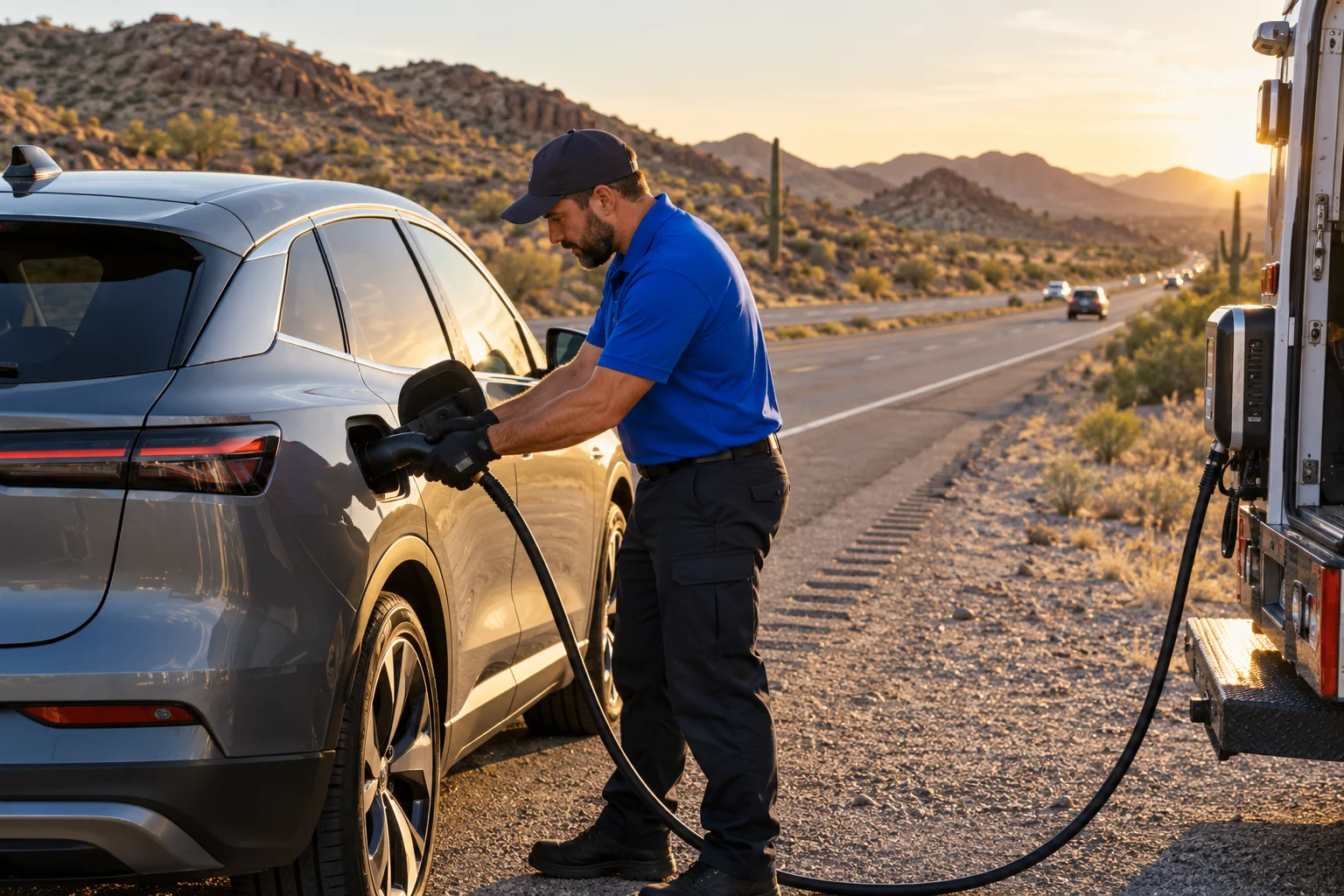
Move away from traffic before checking the car
Treat traffic exposure as the first problem. Battery diagnosis can wait until you and your passengers are in the safest available position.
If the car still moves, get completely off the traveled roadway where practical. Don’t stop in an active lane to preserve the last fraction of displayed range. Choose a stable place away from traffic when the surroundings allow it.
Arizona law supports that basic decision. ARS 28-871 says drivers outside business or residential districts can’t stop on the traveled highway when it’s practical to pull off. A vehicle too disabled to move is exempt. It still must leave room for traffic and be visible from both directions.
If the car stops in a live lane, don’t attempt roadside troubleshooting beside traffic. Contact emergency services and follow their directions. Tell them the vehicle is disabled, whether it blocks a lane, and whether anyone is in immediate danger.
Once you’re safely off the road, note which direction you were traveling. Look for Queen Valley Road, a visible US-60 marker, or another fixed reference. Don’t walk along US-60 searching for a charger.
Arizona’s Move Over law, ARS 28-775, tells approaching drivers to change lanes when safely possible around stopped vehicles displaying warning lights. Otherwise, they must slow down. That law doesn’t remove the danger of standing beside a disabled car.
Conditions can also change during Arizona’s monsoon season, which runs from June 15 through September 30. Dust walls can reduce visibility to nearly zero. If dust or heavy rain arrives, prioritize personal safety and official instructions over inspecting the vehicle.
Our broader guide for drivers stranded on US-60 covers the corridor. Near Queen Valley, however, the immediate decision is narrower: identify the failure, report your exact position, and choose charging or towing.
Confirm an empty pack versus a low-voltage failure
“Dead EV” can describe two different failures. An empty high-voltage pack needs charging or transport. A low-voltage failure may leave the main battery with energy while the displays, locks, contactors, or controls won’t operate normally.
Start with what the vehicle actually shows. Record the displayed battery percentage, remaining-range warning, warning messages, and the last screen you saw. If the car powers on, don’t repeatedly cycle it while guessing. Take a photo of the warnings for the operator.
A vehicle that warned about critically low range before slowing or stopping points toward an empty traction pack. A car that suddenly becomes dark, won’t unlock normally, or won’t enter drive may have a low-voltage problem. Those signs aren’t a final diagnosis. Give the symptoms to the operator and let them choose the correct equipment.
Don’t use another EV as an improvised jump source. Tesla’s current Model Y manual specifically says a Model Y can’t jump-start another vehicle because damage may result. Procedures also differ across brands, models, and model years.
Current Model Y instructions show why model-specific guidance matters. The wires behind the tow-eye cover release the hood latches. They don’t charge the low-voltage battery. Tesla directs owners to separate jump posts after the hood opens.
Check the current owner’s manual before touching terminals, covers, or tow points. Tell the operator the exact year, make, model, connector type, and whether the charge port opens. Also report whether the vehicle can enter tow or transport mode.
If you’re still unsure, our guide to choosing a charge, jump, or tow explains the basic split. Charge Pro PHX can connect drivers with an independent operator, but it doesn’t diagnose or work on the vehicle itself.
Describe your location near Queen Valley and US-60
“Near Queen Valley” isn’t enough for a useful roadside request. The operator needs a location that distinguishes US-60 from Queen Valley Road and identifies your direction of travel.
Open your phone’s map while you’re still inside a safe location. Copy the coordinates or share a dropped pin if the phone permits it. Then give a plain-language description. State whether you’re on US-60 or Queen Valley Road, your direction, and the nearest visible route marker or fixed landmark.
Don’t guess at mileage or name a business you can’t see. A precise pin with an honest location note is better than an invented distance. If the map keeps moving the pin, mention that uncertainty.
Include these details in the first message:
- Your map pin or displayed coordinates
- US-60 or Queen Valley Road
- Your direction of travel
- Whether the vehicle is fully off the roadway
- The year, make, and model
- The displayed charge and warning messages
- Whether the car powers on or enters drive
- Whether the charge port is accessible
- Your connector and any approved adapter you carry
Signal coverage at a particular Queen Valley roadside location hasn’t been confirmed. Don’t depend on an assumed connection. If service is available, send the pin and screenshots before the connection changes. If it isn’t, follow your vehicle maker’s offline guidance and seek emergency help when traffic exposure creates immediate danger.
Queen Valley sits beyond the more developed US-60 stretch east of Gold Canyon. That makes location wording especially important. A request meant for Queen Valley shouldn’t be routed as a generic Phoenix or Mesa call.
For nearby context, see our local guides to EV roadside help in Gold Canyon and EV roadside help in Apache Junction. Those pages don’t establish charger availability near your current pin. They help describe the surrounding US-60 service area.
Compare a mobile charge with a tow
A mobile charge makes sense when the high-voltage pack is simply empty, the vehicle accepts charging, and a compatible operator can reach the location safely. A tow is usually the better request when charging won’t solve the failure or roadside access is unsafe.
A typical rescue charge can add 10 to 20 miles of range through 15 to 30 minutes of Level 2 charging. That’s charging time, not an arrival estimate. It also isn’t a promise that every vehicle, operator, or roadside location will produce the same result.
The goal is usually enough energy to reach a verified charging stop. A mobile session isn’t meant to fill the battery. Learn more about mobile EV charging and how an operator may evaluate the vehicle and location.
Ask for a tow when the vehicle won’t accept a charge, the connector isn’t compatible, the charge port is damaged or inaccessible, or the car shows a fault that charging won’t clear. Towing may also be necessary when the vehicle can’t be serviced safely where it stopped.
Tell the towing provider that the vehicle is electric. Give the exact model and describe its condition. The operator needs to confirm the correct loading method and the vehicle’s current transport instructions. Don’t assume every tow setup suits every EV.
Pricing near Queen Valley couldn’t be confirmed from an approved public source. Charge Pro PHX doesn’t set the price. The independent operator quotes and bills the driver directly. Ask what the quote covers before accepting service, including charging, transport, mileage, or any other operator-set item.
Arrival times also aren’t confirmed. They depend on the operator, vehicle, location, traffic, and equipment. We don’t publish or promise an ETA.
If the symptoms point to an empty pack, start with out-of-charge EV recovery. Share enough detail for the matched operator to decide whether charging or towing is appropriate.
Verify the next charging stop before moving
Don’t accept a small roadside charge until you know where it should take you. A station name on an old map doesn’t prove that a compatible, working port is available now.
No specific public charger near Queen Valley has been confirmed for this page. Prices, access rules, connector types, hours, and live operating status also remain unconfirmed. Check the charging network’s app, PlugShare, and your vehicle’s navigation before relying on a stop.
Verify five things:
- The station appears in the current network listing.
- Your vehicle can use the connector.
- Any required adapter is approved for that use.
- The location is accessible when you expect to arrive.
- Recent status information shows a usable stall.
Treat community reports as helpful context, not a guarantee. A charger can become occupied or unavailable after the last check. Call the property or network when access remains unclear.
Compatibility deserves special care. J1772 and J3400, also called NACS, can be used for AC charging. CCS adds separate DC pins to the J1772 portion of the vehicle inlet. Owning a DC adapter doesn’t automatically establish AC compatibility.
Heat can also change the plan. Phoenix averages about 111 days each year at or above 100°F. AAA’s 2026 study found about an 8.5% range loss at 95°F compared with 75°F. Cabin cooling also draws energy, so leave a buffer rather than planning around the exact displayed arrival range.
The U.S. Department of Transportation’s rural EV charging page provides broader planning information. It doesn’t confirm live conditions near Queen Valley.
Before the operator leaves, recheck the destination in the vehicle and network app. If no suitable charging stop can be verified, discuss towing instead of attempting the next leg with an uncertain plan.
When to call us
Call when your EV is safely off the road near Queen Valley but can’t reach a verified charger. We’ll gather the vehicle, location, and failure details, then connect you with an independent local EV rescue operator.
Call us at (602) 932-0920 and we’ll connect you with a local EV rescue operator.