EV roadside assistance in Gold Canyon means a mobile charge or a 12-volt jump. The community sits on US-60 east of Apache Junction, where the Superstition climb begins. Charge Pro PHX matches you with an independent local operator. That operator comes to the car, quotes you, and bills you directly.
Where Gold Canyon sits on the Superstition Freeway
Gold Canyon is a Pinal County community of 13,107 people, per the 2020-2024 ACS. Census land area is 28.7 square miles across ZIPs 85118 and 85119. It sits at the eastern foot of the Superstition Mountains, past Apache Junction. Gold Canyon Golf Resort is the name most visitors know. Neighborhoods include the townsite, Mountainbrook Village, and Superstition Mountain Golf.
Only 2.1% of housing here was built before 1980. That’s new Pinal belt stock. Home Level 2 charging is common in places like this. The stranding calls still happen on US-60 and the golf-course roads. You’re not in a downtown garage. You’re on a desert foothill corridor.
US-60 through here is the Superstition Freeway. Don’t mix it up with Grand Avenue in the northwest Valley. Same route number, different road. Gold Canyon’s charging and rescue page is the hub for this community.
Why the climb toward Superior spends extra miles
The grade is already on you when you leave Apache Junction. Apache Junction sits near 1,700 feet, and Superior sits near 2,890. Top-of-the-World is near 4,530 feet, with Globe near 3,510 after the drop. Treat those elevations as approximate, not survey-grade.
Highway climbs spend more energy than a flat East Valley commute. Cabin cooling stacks on that in summer. Phoenix averages about 111 days a year at or above 100F. July highs average near 107F, and August near 105F. Overnight summer lows still sit in the mid-80s. Gold Canyon runs that desert heat up into the Superstition foothills.
Recurrent looked at 345,622 trips from 300 Phoenix-area EVs. Range loss ran 20 to 30 percent above about 95F. Loss was near 31 percent at 100F. AAA’s 2026 study found about a 10% efficiency drop at 95F versus 75F. Range loss in that study was about 8.5%. That’s better than AAA’s 2019 figure of 17%. It still isn’t a rounding error on a grade.
NREL reports climate-control loads can cut range in a real way. Never treat remaining-miles as a promise on this corridor. The display was built for mixed driving, not a long Superstition pull.
Don’t use SR-88 as a backup. The Apache Trail is partly closed after 2026 monsoon damage. US-60 is the through route. ADOT’s National Electric Vehicle Infrastructure plan includes parts of US-60, with construction underway in 2026. Confirm what’s actually open in your charging app before you roll.
Two ways a Gold Canyon EV dies
From the curb, both failures look identical. The car won’t ready, handles may freeze, and the screen stays dark.
A heat-worn 12-volt fits the local call pattern. The community skews older, with golf and retirement traffic. Heat is hard on the small battery. Battery Council International work, via Battery University, tracked starter-battery life in heat. Those batteries last about 47 months in hot climates. In cool climates it’s about 59 months. A battery good for five years elsewhere can fail in two or three here. AAA calls heat the number-one cause of battery failure. AAA recommends AGM batteries for hot areas.
In an EV, the 12-volt runs the handles, screens, and contactor. The contactor is what connects the high-voltage pack. The DC-DC converter recharges it only while the car is on or charging. Tesla Sentry Mode and Cabin Overheat Protection keep drawing while you sit. Heat plus Sentry Mode can flatten the 12-volt in a golf-resort lot.
The operator can jump or replace that 12-volt on site. That’s a different job from feeding the traction battery. If the big pack is empty, you need kilowatt-hours in the car. Tesla roadside won’t charge you on the shoulder. Tesla tows to a Supercharger or service center and bills for it. Ford’s published policy tows you to a charger, home, or dealer within 50 miles. Rivian and Hyundai/Kia owners should specifically request a tow if that’s the path. Independent operators handle out-of-charge recovery on the spot instead.
If you’re already stopped on US-60
Get out of the traveled lanes if the car can still roll. ARS 28-871 says get off the traveled lanes when you can. That rule applies outside a business or residence district. A vehicle disabled so badly it can’t move is exempt. Leave room for traffic to pass, and stay visible 200 feet each way. Hazards on, if the 12-volt can still run them.
ARS 28-775 is the Move Over law. Drivers approaching a stopped vehicle with warning lights must change lanes if they can. If they can’t, they have to slow down. You still don’t control the truck in the left lane. Stay as far right as the shoulder allows.
Arizona has no toll roads and no toll express lanes, per ADOT. SB 1340, effective January 1, 2024, bars new tolls without a new legislative vote. Texts about unpaid Arizona tolls are scams. US-60 here is a regular freeway.
Under ARS 28-872, police may order a disabled or obstructing vehicle removed. Owners pay reasonable tow and storage before release, and ADOT mails notice. Don’t sit in a live lane waiting for a miracle.
Monsoon season runs June 15 to September 30. Haboobs can drop visibility to near zero, and flash floods follow. ARS 28-910 can bill you if you drive around a barricade into floodwater. Don’t drive into that water.
What DPS and ADOT will do, and what they won’t
Arizona does run free motorist help, and DPS Roadside Motorist Assistance is statewide. Crews change tires, bring gasoline or diesel, jump-start batteries, add water, and call tows. In 2018 the program assisted 75,235 motorists statewide. Hours and specific corridors aren’t published. The published materials name gasoline and diesel. They say nothing about charging an empty EV.
ADOT’s Incident Response Unit covers Phoenix-area freeways from 5am to 8pm weekdays. It’s a 14-member unit, sponsored by State Farm since 2020. It has logged 10,400-plus responses since October 2019. It clears crashes and debris, changes tires, and helps stranded motorists. No EV-specific mention appears in its published materials.
A tire change or a gas-style jump may still come from those crews. An on-site EV charge isn’t what they advertise. That’s the job EV roadside assistance is for.
What a mobile operator actually does
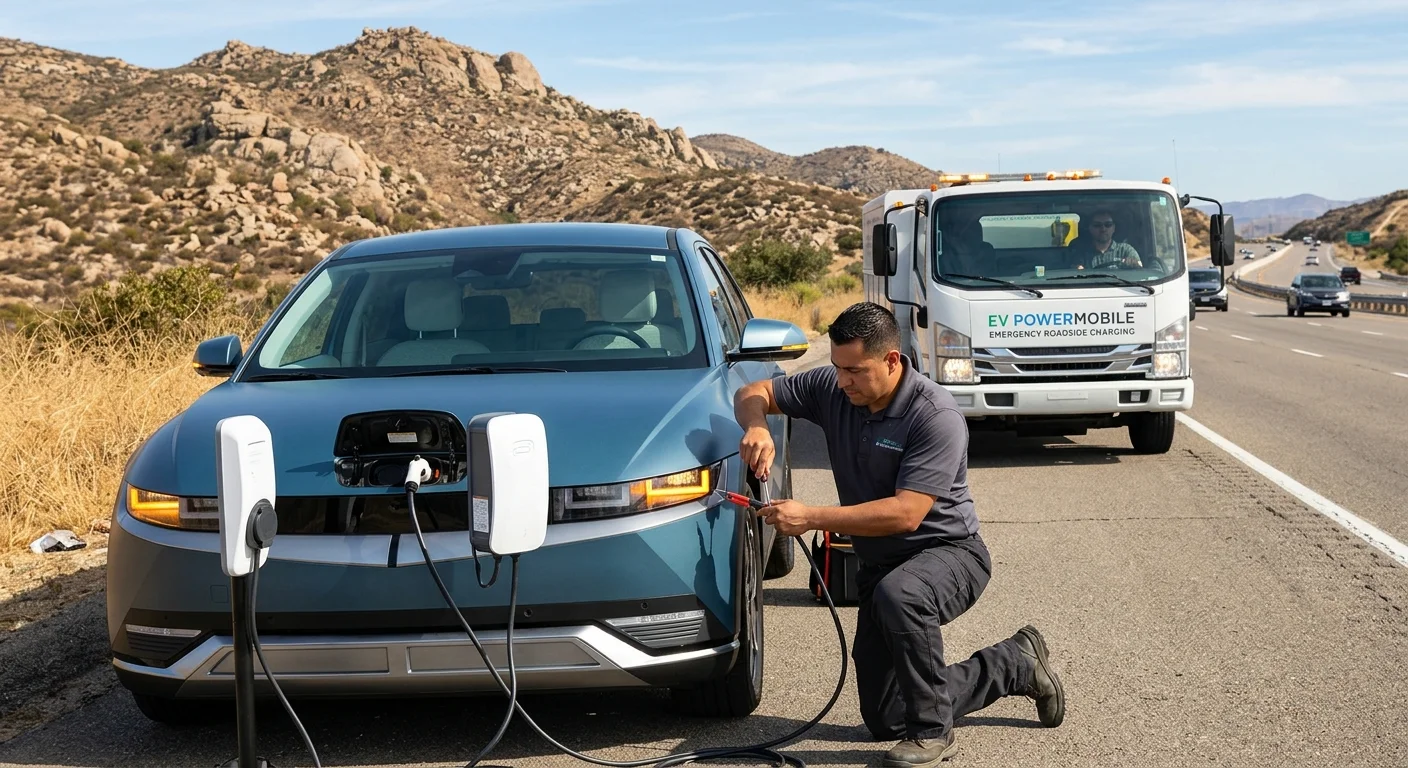
The operators we connect you with bring a 240V Level 2 source. Teslas take a native NACS plug. CCS or J1772 adapters cover the other major brands. A typical session adds 10 to 20 miles of range. That’s 15 to 30 minutes of charging time. It’s charging time, never an arrival time. The operator quotes before any cable goes in. You pay that operator, not Charge Pro PHX.
Charge Pro PHX doesn’t own trucks, a yard, or a fleet. It doesn’t employ technicians or hold a trade license. It doesn’t set prices or publish hours. The pros we connect you with are licensed and insured. The matcher only connects the call.
Tell the matcher your make, connector, and whether the car will even unlock. A locked Tesla after a 12-volt death is a different setup. An empty pack with working handles is another. Tesla, Rivian, Ford, Hyundai, Kia, and Chevy are all in scope. So are the other major EV brands.
Charge the car, or put it on a flatbed
A mobile charge keeps the EV on its own wheels. You skip a no-power flatbed hookup. Towing a dead EV has extra steps. Wheels may need to stay off the pavement. A car with no 12-volt can be awkward to release from park. Enough range to reach a charger you already trust is often cleaner.
A tow is still the right call when the high-voltage system is faulted. It’s also right when the pack won’t accept charge. Don’t keep plugging in if the car reports pack damage. That’s a shop job, not a roadside charge. Arizona sets no statewide cap on private-property tow rates. Cities and counties may set local maximums under ARS 9-499.05 and ARS 11-251.04. Confirm the quote before anyone hooks the car.
Apache Junction, San Tan Valley, and the rest of the belt
Apache Junction is the last larger stop before the foothills. Mobile EV rescue in Apache Junction covers that eastbound US-60 approach. San Tan Valley sits southwest on the inland Pinal commute. Casa Grande and Maricopa sit farther south. This page is for Gold Canyon itself, plus the climb that starts at its door. If you’re on the freeway shoulder west of Gold Canyon, use the Superstition Freeway guide.
When the warning is already red
Call when the car won’t ready and you’re done cycling the screens. Call when the estimate is collapsing on the grade. Call if you won’t make the next stop you trust. Call when the 12-volt has locked the handles. Don’t stand in a live lane hoping the display comes back.
Charge Pro PHX matches Gold Canyon drivers with independent mobile rescue operators. Ask for the quote first. Call (602) 932-0920. We’ll connect you with a local operator who quotes before starting.