A non-Tesla EV with an empty pack needs connector-specific help. In Chandler, the right response depends on the car, its inlet, and where it stopped.
Why non-Tesla EVs get stranded in Chandler
An EV can reach a Chandler parking lot with less range than expected. The driver may then find a blocked, unavailable, or incompatible charging stall. A charging session can also fail after the cable is connected.
Phoenix heat adds another concern. AAA’s 2026 study found about an 8.5% range loss at 95°F compared with 75°F. Recurrent reported larger losses among Phoenix-area EVs above roughly 95°F. Air conditioning also draws energy, according to the National Renewable Energy Laboratory.
Those findings don’t predict one car’s remaining range. Vehicle condition, speed, climate settings, and battery temperature all matter. The dashboard estimate can change as those conditions change.
A workplace lot creates its own problem. A car may sit through a workday without gaining the expected charge. The driver often discovers the shortfall when preparing to leave. That’s different from a moving breakdown, but connector compatibility still controls the next step.
A non-Tesla badge doesn’t identify the charging inlet. Model year and market configuration matter. Some vehicles use a CCS inlet, while others use different hardware. An adapter may support one charging method but not another.
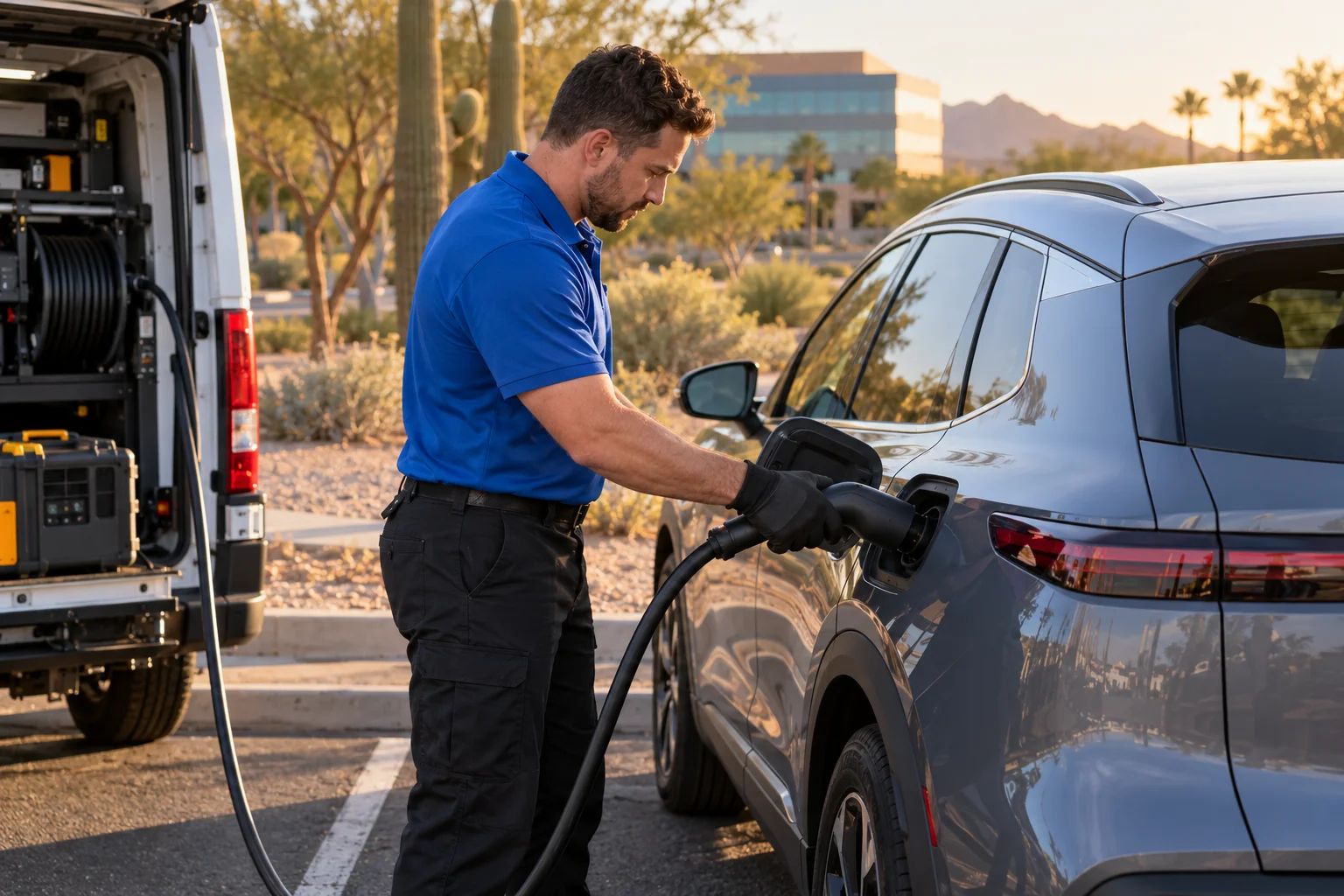
Our Non-Tesla EV Rescue service connects drivers with independent local operators. Charge Pro PHX doesn’t perform the charging, own rescue equipment, set prices, or promise an arrival time. The operator assesses the vehicle and quotes the driver directly.
Loop 101, Loop 202, and workplace charging gaps
Your exact location changes what kind of help is practical. A stalled car beside Loop 101 Price isn’t the same as a parked car near Price Road. A vehicle near Loop 202 Santan also needs a precise direction of travel and nearby exit.
If the car can still move, don’t make a risky last-mile attempt. Follow the vehicle’s warnings and current owner’s manual. When stopped on a highway, Arizona law says drivers must get off the traveled roadway when practical. A vehicle that can’t move is treated differently, but traffic still needs room to pass.
Share whether the car is:
- On a freeway shoulder
- Near an entrance or exit ramp
- Inside a workplace parking lot
- In a gated garage or restricted lot
- Connected to a charger that won’t start
- Completely unresponsive
A parking-lot rescue may require access details. Give the business name only if it appears at the location. Include the lot entrance, building side, floor, gate instructions, and parking space. Don’t assume a map pin shows the correct driveway.
For a freeway stop, call emergency services if there’s an immediate danger. ADOT’s Incident Response Unit helps stranded motorists on Phoenix-area freeways, but its published services don’t mention EV charging. Arizona DPS Roadside Motorist Assistance also doesn’t list out-of-charge EV service.
Our guide to EV roadside assistance in Chandler covers broader roadside situations. This page stays focused on non-Tesla charging compatibility. Drivers who need a local charging option can also review mobile EV charging.
Confirm the car’s connector before requesting help
“CCS car” isn’t enough information for an operator. The operator needs the vehicle’s make, model, model year, inlet type, and current condition. Check the owner’s manual or the manufacturer’s current support material before describing compatibility.
The U.S. Department of Energy explains the basic connector distinction. J1772 and J3400, also called NACS, can be used for AC charging. A CCS inlet includes the J1772 portion for AC and adds separate pins for DC fast charging.
That distinction matters during rescue. A CCS DC adapter doesn’t automatically establish AC compatibility. Likewise, an adapter designed for AC charging shouldn’t be treated as a DC adapter.
Don’t tell an operator that the car “takes any CCS plug.” Connector shape is only part of the answer. The operator must assess the vehicle, charging method, equipment, and any approved adapter. Manufacturer instructions can also differ by model year.
Take a clear photo of the open inlet if it’s safe. Include the entire port and any labels around it. Also photograph any adapter you expect to use. An adapter’s brand name alone doesn’t prove that it supports the proposed charging method.
If you’re comparing public charging options, read our guide to CCS and Tesla Supercharger differences. Don’t assume a Supercharger accepts your car because the connector appears suitable. Check the vehicle manufacturer’s guidance and the charging network’s app before traveling there.
Live charger status couldn’t be confirmed for this article. Check the network app or PlugShare for access, connector details, price, and current stall reports.
Factory roadside help versus a local operator match
Start by checking the roadside program attached to your vehicle. Open the manufacturer’s current app, manual, or support page. Confirm whether your specific vehicle remains eligible and whether an empty pack leads to charging or towing.
Coverage isn’t identical across manufacturers. Ford’s published EV roadside terms, for example, describe towing an out-of-charge Ford EV. The destination and mileage rules depend on the breakdown location and coverage terms. That Ford policy shouldn’t be applied to another brand.
Insurance roadside coverage also varies. A policy may list towing and battery jumps without promising mobile EV charging. Confirm the current dispatch options with the insurer before relying on the policy.
A local operator match is another path. Charge Pro PHX refers the driver to an independent operator who can evaluate the request. The operator decides whether the available equipment fits the vehicle and location. The operator also provides any price, timing, or service terms directly.
Ask these questions before accepting service:
- What charging method does the operator propose?
- Does the equipment match this exact vehicle and model year?
- Is an adapter required?
- Who supplies and approves that adapter?
- Is charging possible at this location?
- Would towing be the safer or workable option?
- What will the operator charge?
Don’t accept a connector guess based only on “non-Tesla.” If the operator can’t confirm compatibility, consult the manufacturer’s current manual or support channel. A tow may be required when charging can’t be completed where the vehicle stopped.
Our broader Phoenix-area non-Tesla rescue guide explains how these choices vary across the metro.
What to share when the pack is empty
Good details help an operator evaluate the job without guessing. Start with the vehicle’s full identification. Give the make, model, model year, and the inlet type shown in the manual.
Then describe what the vehicle is doing. “Empty pack” and “car won’t start” aren’t always the same problem. Report the exact dashboard message. Say whether displays, locks, lights, and the charge-port door still work.
A dead low-voltage battery can leave an EV unable to wake up, even when the high-voltage pack isn’t empty. Procedures vary by vehicle. Don’t apply instructions from another model. Use the current manual for the exact year and configuration.
Share these details with the operator:
- The displayed state of charge
- The exact warning text
- Whether the car is in Park
- Whether the charge port opens
- Whether a cable is stuck
- Whether the displays and locks respond
- The connector or inlet shown in the manual
- Any adapter present with the vehicle
- Photos of the inlet, adapter, and warning screen
- Your exact Chandler location and access instructions
Also explain the surroundings. Mention moving traffic, a narrow shoulder, parking-garage clearance, gates, or property restrictions. Don’t stand in traffic to inspect the inlet or take photos.
A typical rescue charge can add 10 to 20 miles of range during 15 to 30 minutes of Level 2 charging. That’s charging time, not an arrival estimate. Actual results depend on the car and charging conditions.
Don’t promise yourself that this range will reach a particular charger. Verify the destination, route, live charger status, and remaining range first. If the proposed destination can’t be confirmed, discuss towing with the operator.
When to call us
Call when a non-Tesla EV can’t reach charging and connector compatibility needs review. We’ll refer you to an independent local operator who can assess mobile charging or towing.
Call us at (602) 932-0920 and we’ll connect you with a local EV rescue operator.