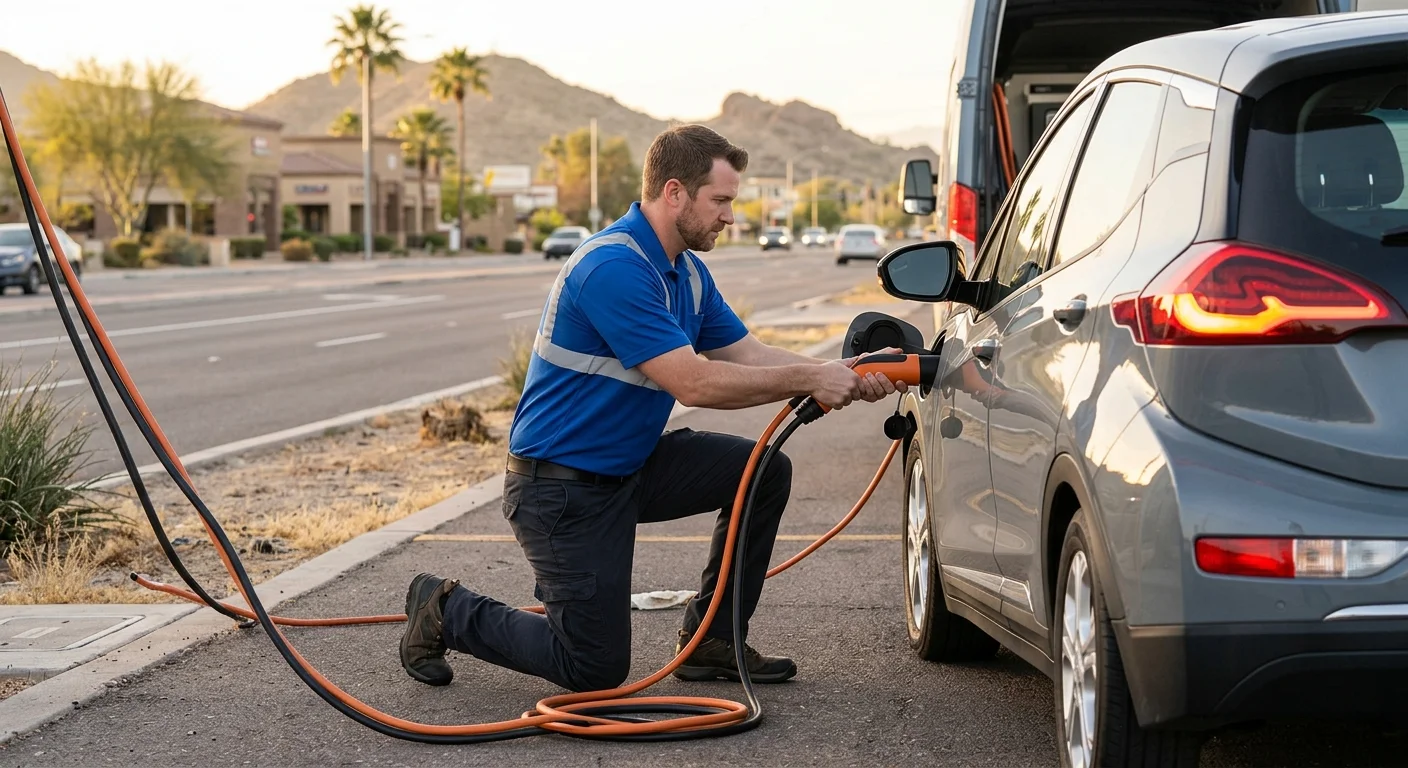
Your Mesa EV stops in a lot or on a curb with the range number at zero. The nearest working public plug is farther than the car can roll. Charge Pro PHX matches you with an independent local operator who can bring a mobile charge to that stall.
Where Mesa EVs actually stall
Mesa is the East Valley’s largest city, 511,764 people in the Census ACS 2020-2024 5-year count. Gilbert, Chandler, and Glendale each sit between 250,000 and 280,000. The stall map follows that size. It is arterial lots, HOA guest parking, Gateway airport pavement, and the long commercial strips on Southern, Baseline, Main, and Power.
Downtown Mesa is its own electrical island. Mesa Municipal Electric serves about 5.5 square miles around downtown (over 18,000 customers) with an Electric Vehicle Time-of-Use rate (E1EV). SRP serves much of the rest of the city. That split does not change a car that has already stopped.
Heat is what turns a thin buffer into a Mesa stall. Phoenix averages about 111 days a year at or above 100F, with July highs near 107F and August near 105F. Recurrent reports EVs can lose 20 to 30% of range above about 95F, with loss near 31% at 100F, from 345,622 trips by 300 Phoenix-area EVs. A morning run from Dobson to Power can look safe. The afternoon return, cabin cooling on, can leave you in a Superstition-area lot with a zero on the dash.
East Mesa HOA and apartment parking is a common scene: no home Level 2, a guest stall, and a public charger that is occupied or dark. Street parking around Main and Country Club sits closer to downtown options, but only if the car can still creep. Phoenix-Mesa Gateway’s Hourly, Daily, and Ray Road Economy lots are another stall surface when a planned plug is down.
If the car cannot move, the match is mobile EV charging. Chandler already has this stall pattern on mobile EV charging when you stall in Chandler. For a wider Mesa roadside picture, use EV roadside assistance in Mesa. This page stays with the stopped car and the charge that gets it to a working plug.
US-60, Loop 202 Red Mountain, and Superstition lots
US-60, the Superstition Freeway, is Mesa’s east-west spine. It runs from the Tempe line through the Fiesta area, along the south edge of downtown, past Superstition Springs, and on toward Apache Junction. Loop 202 Red Mountain Freeway is the north Mesa belt, river side, toward the 101 and Scottsdale. Superstition lots are the retail pads, theater parking, and big-box fields along that US-60 run, plus the commercial pavement off Power near the 202/60 stack.
A stall on those freeways is not the same job as a stall in a Superstition lot. On the traveled lanes, ARS 28-871 says you may not stop or park on the traveled part of a highway outside a business or residence district if it is practical to get off it. A vehicle disabled so badly it cannot be moved is exempt. When you are stopped you must leave room for other traffic to pass and be visible 200 feet in each direction. Drivers coming up on your hazards fall under ARS 28-775 Move Over: change a lane if they safely can, otherwise slow down. Fines run $275, then $500, then $1,000 for repeats within five years.
ADOT’s Incident Response Unit covers Phoenix-area freeways, 5am to 8pm weekdays. The unit clears crashes and debris, changes tires, and helps stranded motorists. Published materials do not mention EV charging. Arizona DPS Roadside Motorist Assistance is statewide. It changes tires, provides gasoline or diesel, jump-starts dead batteries, adds water, and calls tows. It says nothing about EV charging or an empty pack.
A US-60 or Red Mountain stall is first a get-clear problem. If you can creep onto a shoulder, an on-ramp cutout, or a frontage lot, do that. Arizona has no toll roads, so you are not boxed into a paid lane. HOV occupancy rules still apply during weekday rush hours. As of September 30, 2025, alternative-fuel and energy-efficient-plate vehicles no longer get solo HOV access.
A Superstition lot stall is already off the traveled way. That is the cleaner mobile-charge setup. There is room for the operator’s vehicle, no Move Over traffic at your bumper, and a short roll to a working public plug once you have 10 to 20 miles. Corridor notes for that freeway live on Mesa US-60 EV rescue. Keep this page for the stalled car itself.
Public charger failed versus the pack hit zero
Two Mesa stalls look the same from the sidewalk. They are not the same job.
The charger never started
You still have some indicated miles. The plug never woke, the session died at a random percent, or every stall in the row is occupied. You may be able to limp to another Mesa site. You may not. The U.S. Department of Energy’s electric vehicle pages are a clean primer on AC versus DC. J1772 and J3400 (NACS) are used for AC charging. A CCS vehicle inlet includes the J1772 portion for AC and adds separate DC pins for fast charging, so a CCS DC adapter alone does not establish AC compatibility. Bring the adapter you actually own, not the one you meant to buy.
The pack is actually empty
The car will not roll. Out-of-charge recovery and a mobile Level 2 session are the on-site path. The typical rescue charge published for this brand is 10 to 20 miles of range in 15 to 30 minutes of Level 2 charging. That clock is charging time. It is not an arrival window, and Charge Pro PHX does not promise one. Most residential Level 2 gear, per the DOE AFDC, operates at up to 30 amps, about 7.2 kW. Level 2 as a class can range from 2.9 to 19.2 kW. A mobile operator quotes the unit they actually bring.
Summer Mesa adds thermal drag. Charging power drops in high ambient heat. The vehicle’s battery management system requests lower current when thermal headroom is limited. Field measurement of DC fast chargers in extreme heat found offered power declining by up to 35 to 40 kW once rectifier temperature approached 55C. Do not map those DC numbers onto a mobile Level 2 truck. Expect a slower session in July than in January.
A third look-alike is a dead 12-volt. The screens are dark. The traction pack may still hold energy. A charge lead will not wake that car. Say so when you call. Do not treat every dark Tesla, Mach-E, or Ioniq 5 as an empty pack.
If the car can still move a mile, a working public stall is often the simpler end of the night. If it cannot, the operator comes to the pin.
How a mobile charge is quoted by local operators
Charge Pro PHX does not set a price. The matched operator quotes you and bills you. That is the model.
What they are pricing is the stall in front of them. Location comes first. A Superstition Springs lot is a different setup than a US-60 shoulder west of Power, which is different again from a downtown street stall inside the municipal-electric pocket. Connector comes second: J1772 or NACS, and whether an adapter is in the car. Remaining energy comes third. A pack at a few percent that can still accept charge is a shorter session than a pack at true zero that needs a wake sequence. Miles you need come fourth. The published typical rescue is 10 to 20 miles, enough to reach home or the next working station, not a full pack.
Heat and access show up in the quote because they show up in the work. July on black Mesa asphalt is a derated session. A car nose-in against a cart corral may need a different lead than a pull-through. None of that is a brand fee, a discount, or a free estimate from Charge Pro PHX. Ask the operator what they will charge before they plug in.
AAA offers mobile EV charging in select markets through a pilot that deploys trucks with Level 2 mobile chargers, enough range to reach home or the nearest station, at no additional charge to members. Mesa is not confirmed here as one of those markets. Check AAA directly if you hold that membership. Tesla’s roadside policy says assistance for a depleted battery is available but is not a financially covered service, regardless of warranty status. Tesla typically arranges transport to the nearest Supercharger or service center. Ford Roadside Assistance takes an out-of-charge Ford EV to the nearest public charger, home, or a preferred dealer within 50 miles. Those programs are other phones on your list. They are not this match.
No dollar figure on this page is an operator’s Mesa rate. If someone quotes you a number, it is theirs.
What the matched operator needs from you
The operator cannot guess the stall. Send a pin, not a landmark. Superstition Springs is a mall. The south lot, third aisle, silver Ioniq, hazards on, is a findable car. Add the cross streets if you are on Southern, Power, Val Vista, Alma School, Dobson, or Country Club.
They need make, model, and year, because charge ports and wake procedures differ. They need the connector on the car. They need whether the car still talks: indicated miles, a working app, a charge port that unlatches. They need whether this is an empty pack or a dark 12-volt. They need whether you can stay with the vehicle. A Mesa HOA lot after dark is a different wait than a US-60 shoulder in afternoon sun.
If you are on a freeway, say so in the first sentence. ARS 28-871 still wants you off the traveled way when it is practical. Hazards on. Room for traffic. Visible 200 feet each way. Do not stand in the lane. ADOT Incident Response and DPS roadside can help with a tire, fuel, or a tow. They are not a mobile EV charger. The U.S. Department of Transportation’s rural EV charging notes are a reminder that public plugs thin out as you leave the Valley core. East Mesa toward the Superstition run is where that thinning starts to matter.
Have the operator quote the session before the lead goes in. Ask how many miles they plan to put on, in what charging time, on what connector. Typical published rescue charging is 10 to 20 miles in 15 to 30 minutes of Level 2. Your car and that afternoon’s heat will move the real number.
Charge Pro PHX does not own the truck, the charger, or the quote. The brand is the match. The independent operator is the person who pulls up.
When to call us
Call when the Mesa car has already stopped and you need range, not a tow across the East Valley. A lot stall, a curb stall, or a shoulder you have already cleared is the moment for a mobile charge match. Call us at (602) 932-0920 and we’ll connect you with a local EV rescue operator.