You’re sitting on a Phoenix arterial with the range number falling, and the phrase you type is roadside assistance EV charging near me. You want miles added at the car, not a pin on a public stall map. Charge Pro PHX refers that call to an independent local operator who quotes you, bills you, and brings the charge.
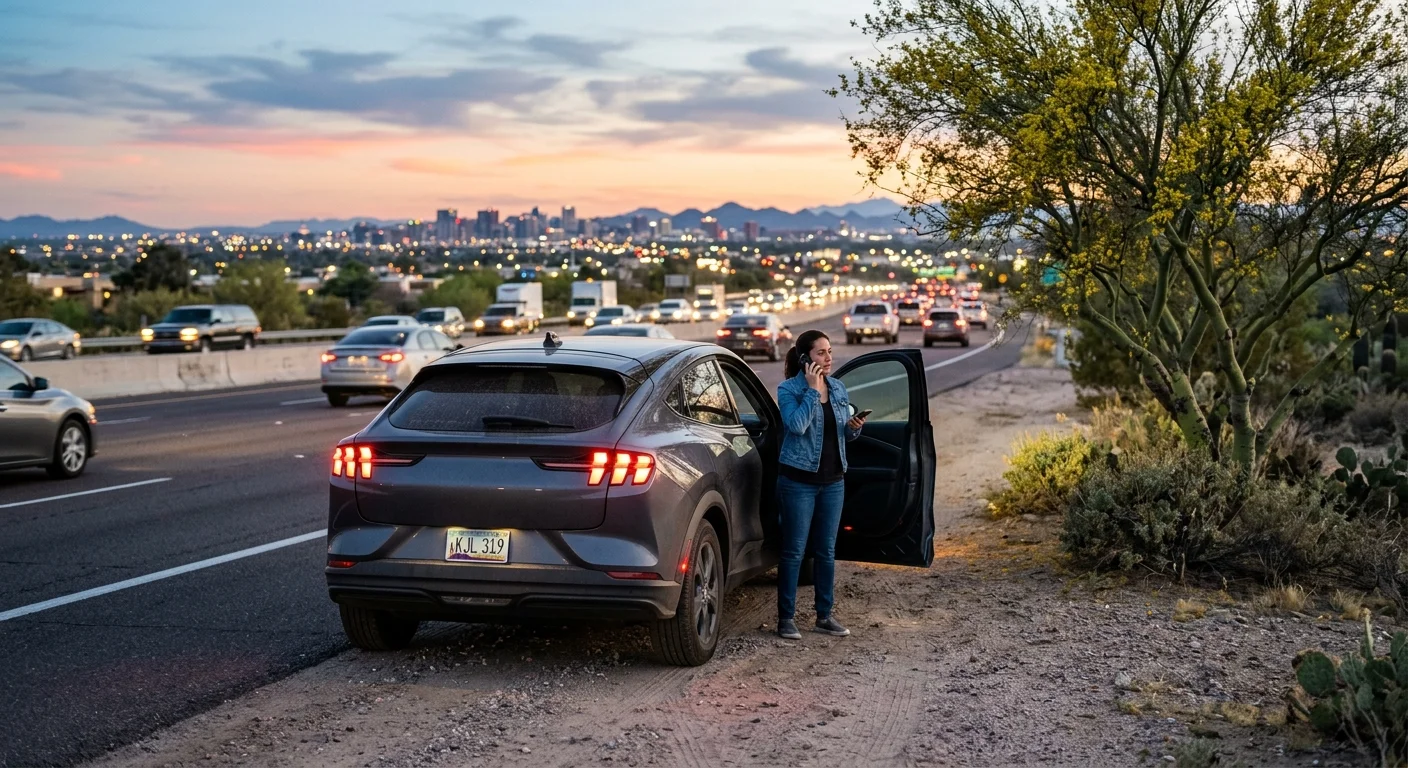
What that search actually means on Valley roads
That query is a request for miles at the bumper, in this metro, on this heat.
Phoenix Core stalls show up on I-10, I-17, and the Loop 202 South Mountain stretch. That freeway is free. Arizona has no toll roads. Heat still eats range. Recurrent reports EVs can lose 20 to 30 percent of range above about 95F, with loss near 31 percent at 100F, from 345,622 trips by 300 Phoenix-area EVs. Phoenix averages about 111 days a year at or above 100F. July highs sit near 107F. AAA’s 2026 study found about a 10 percent efficiency drop and an 8.5 percent range loss at 95F versus 75F. Cabin cooling is part of that. The U.S. Department of Energy lays out how climate control changes what an EV can do on a hot day.
If you are on the traveled lanes, ARS 28-871 says get off when it is practical. A vehicle disabled so badly it cannot move is exempt. Leave room for traffic and stay visible 200 feet each way. Other drivers must move over or slow under ARS 28-775. Fines run $275, then $500, then $1,000 for repeats within five years.
East Valley calls often sit on US-60 through Mesa or Loop 101 Price through Chandler and Gilbert. SRP serves much of Mesa. APS shares Chandler, Gilbert, Tempe, and Scottsdale with SRP. West Valley calls cluster on Loop 101 Agua Fria, Loop 303, and Grand Avenue through Glendale, Surprise, Goodyear, and Buckeye. APS serves Surprise, Goodyear, and Buckeye. Newer housing out there means more home Level 2. That home plug does not help a pack that already hit zero on the 303.
Public stalls along I-10 and I-17 are growing under ADOT’s NEVI plan. That plan is for fixed sites, at least every 50 miles on designated corridors. It is not a truck at your door. Arizona DPS Roadside Motorist Assistance lists gasoline, diesel, jumps, tires, water, and tows. It does not mention EV charging. ADOT’s Incident Response Unit works Phoenix-area freeways 5am to 8pm weekdays. It clears crashes and debris, changes tires, and helps stranded motorists. No EV-specific mention. Those crews can make a shoulder safer. They cannot add traction miles.
So the search is not “where is a stall.” It is “who can add range where I am sitting.”
Jump, tow, or a charge brought to the car
Drivers who type ev roadside assistance near me often want any help that understands an EV. This page is narrower. You want the subset that can add miles.
Three different failures get mixed together on a hot Valley shoulder. A dark car with a silent dash is often the low-voltage battery, not an empty traction pack. A car that still boots, shows zero miles, and will not roll is out of charge. A car in a live lane, in a flood, or with a flat that will not hold air may need a flatbed. Mixing those three is how people wait for the wrong truck.
A jump does not put range in the pack. It may wake the computers so the car can accept a charge or move a short distance. Tesla’s current Model Y manual describes a lithium-ion low-voltage battery and a jump-post procedure after the hood is open. Battery type and steps vary by model and year. Confirm the type in the vehicle information and use the current manual. Tesla also states that a Model Y cannot jump another vehicle.
A tow moves the problem. Ford Roadside Assistance takes an out-of-charge Ford EV to the nearest public charger, the owner’s home, or a preferred Ford dealer within 50 miles of the breakdown. Beyond 50 miles it tows to the nearest charge station or Ford EV-certified dealer. Tesla’s roadside policy says assistance for a depleted battery is available but is not a financially covered service, regardless of warranty status. Tesla typically arranges transport to the nearest Supercharger or service center. That is a ride to a stall, not a charge on the curb.
A mobile charge is the third path. An independent operator brings Level 2 power to the port. A typical rescue charge is 10 to 20 miles of range in 15 to 30 minutes of Level 2 charging. That window is plug time, not travel time. The goal is enough miles to reach home or a working public stall, not a full pack. For how charge, jump, and tow fit together as a decision, use the EV roadside assistance Phoenix guide. For the service that actually sends a charger to the car, see mobile EV charging. Broader emergency EV roadside assistance still covers the cases where a jump or a flatbed is the honest match.
Roadside assistance can charge an electric car when the unit that shows up is a charger. Many factory, club, and freeway trucks are not that unit. Ask what they will plug in before you wait.
Why factory and insurer trucks often skip charging
Factory apps, insurer add-ons, and freeway patrols were built around gas-car jobs: a tire, a jump, a few gallons, a tow. An empty EV pack does not fit those boxes.
Tesla roadside is requested in the app under Roadside. For a depleted pack, Tesla’s published policy is transport, and it is not a financially covered service. Ford’s published EV roadside path is a tow to a charger, home, or dealer inside that 50-mile window. Neither policy, as verified, is “we plug in on the shoulder in Phoenix.”
AAA offers mobile EV charging in select markets through a pilot. Trucks with Level 2 mobile chargers give enough range to reach home or the nearest station, at no additional charge to members in those markets. Phoenix is not named in the materials we can verify. Treat Valley coverage as unconfirmed. Call AAA and ask, before you sit in the heat, whether your membership will send a charger in Maricopa County. If the answer is a tow, that is the answer.
Insurer roadside is the same pattern. Policies talk about towing and jumps. A mobile EV charge is rarely spelled out. If the card in your wallet does not clearly list EV charging, say so on the call and ask before you pay. We could not confirm a Phoenix EV-charging benefit on the club and insurer pages that name gasoline, diesel, and tows.
DPS Roadside Motorist Assistance was originally funded by the Maricopa Association of Governments. In 2018 it assisted 75,235 motorists statewide. That is a real freeway safety program. It still lists gasoline and diesel. It does not list a charge. ADOT’s Incident Response Unit is a 14-member crew on Phoenix-area freeways, 5am to 8pm weekdays, sponsored by State Farm since 2020, with 10,400-plus responses since October 2019. Useful on I-10 and I-17. Not a charger.
None of that means those numbers are useless. A DPS or ADOT truck can get you off a live lane. A factory tow can move a car that cannot accept a charge. The gap is the job you searched: a plug at the bumper. Local EV roadside assistance operators who carry mobile charging fill that gap. Charge Pro PHX does not roll a truck. We connect you with an operator who does.
How local operators quote a mobile charge
Charge Pro PHX sets no price. The operator quotes. The operator bills you. Ask for that number before anyone plugs in, and pay the person who did the work.
What they are quoting is a rescue session, not a full charge. Typical work is 10 to 20 miles of range in 15 to 30 minutes of Level 2 charging. A Level 2 unit can range from 2.9 to 19.2 kW. Most residential Level 2 chargers operate at up to 30 amps, delivering 7.2 kW. Rescue gear varies. Do not assume DC fast power on a shoulder. Heat also cuts charge rate. Field measurement of DC fast chargers in extreme heat found offered power declining by up to 35 to 40 kW once rectifier temperature approached 55C, with charging duration rising from 86 minutes in winter to 169 minutes under extreme summer conditions. The car’s battery management system also requests lower current when thermal headroom is limited. A July stop on US-60 in Mesa or on Loop 303 in Surprise will often take the long end of that 15 to 30 minute plug window.
Location changes the quote because the Valley is wide. Phoenix Core jobs around Sky Harbor, downtown, and Camelback sit inside dense traffic and tight shoulders. East Valley jobs in Gilbert, Chandler, and Mesa may be a parking-lot stall at a grocery, which is easier to work than a live freeway. West Valley jobs in Goodyear, Buckeye, and Surprise can be farther from the operator’s usual loop. The operator names those facts. We do not invent a fee on top.
There is no statewide tow-rate cap in Arizona, and there is no published statewide cap on mobile EV charging either. Cities and counties may set tow maximums locally. That does not give you a Charge Pro PHX rate, because we do not sell the charge. If a club or insurer says the visit is included, get that in plain words before the operator arrives. If they will only tow, you are shopping a different job.
For how matching works when you search by map pin, that is a separate page: mobile EV charging near me in the Phoenix area. This page is the roadside version of the same need. You are already stopped. You want a quote for miles at the car.
What to send so the match is the right connector
A wrong connector wastes the visit. Say the port before anyone drives.
J1772 and J3400 (NACS) are used for AC charging. A CCS vehicle inlet includes the J1772 portion for AC and adds separate DC pins for fast charging, so a CCS DC adapter alone does not establish AC compatibility. Rivian’s J1772 AC Adapter gives NACS-port vehicles access to J1772 Level 2 chargers. It is a Rivian-approved part for AC chargers only and must not be used with a DC charger. Tesla ports and adapters differ by model and year. Send make, model, and year. Send whether the port is NACS, J1772, or CCS. Send whether you have the car’s own adapter in the trunk.
Then send the failure, in one line. “Pack at zero, dash still on” is a charge job. “Car is dark, doors awkward, no dash” is often low-voltage, and a charger may not wake it. “On the shoulder of I-10 west of the Deck Park Tunnel, hazards on, off the traveled lane” is a location an operator can actually find. “Near Phoenix” is not. Use a cross street, a lot name, or a freeway mile. Sky Harbor jobs should name Terminal 3, Terminal 4, or East Economy, because those garages are different buildings. East Valley jobs should name Mesa, Gilbert, or Chandler, not “the 60.” West Valley jobs should name Glendale, Surprise, Goodyear, or Buckeye, not “the West Valley.”
Add remaining indicated range, even if it is a dash or a turtle. Add whether the car will accept a plug. Add whether you are already on a public stall that failed. A dead stall is a different problem than an empty pack on a curb. If the honest next step is a working DC stall a few miles away, read EV rapid charger near me or roadside while you wait on the quote. That page is the stall-versus-truck choice. This page is the truck.
Where can you charge an EV for free in Phoenix. We do not have a verified list of free public stalls to publish. Utility EV rates from APS, SRP, Mesa Municipal Electric, and ED3 are home and workplace plans, not a free plug on the street. This search is not a hunt for a complimentary kiosk. It is a hunt for enough miles to leave the shoulder.
Send the connector, the failure, and the pin. The operator quotes from that. We make the match. You take the quote or you don’t.
When to call us
Call when the pack is empty on a Phoenix Core, East Valley, or West Valley road and you want a charge brought to the car, not a default tow to the next stall. Call when the club, the factory app, or a freeway patrol cannot confirm they will plug in. Call us at (602) 932-0920 and we’ll connect you with a local EV rescue operator.