Use a verified rapid charger if your EV can still reach it. If it can’t, stop somewhere safe and get a truck to the car. Arizona DPS Roadside Motorist Assistance helps stranded motorists statewide. ADOT’s Incident Response Unit works Phoenix-area freeways on weekdays. Neither program advertises bringing an EV a charge.
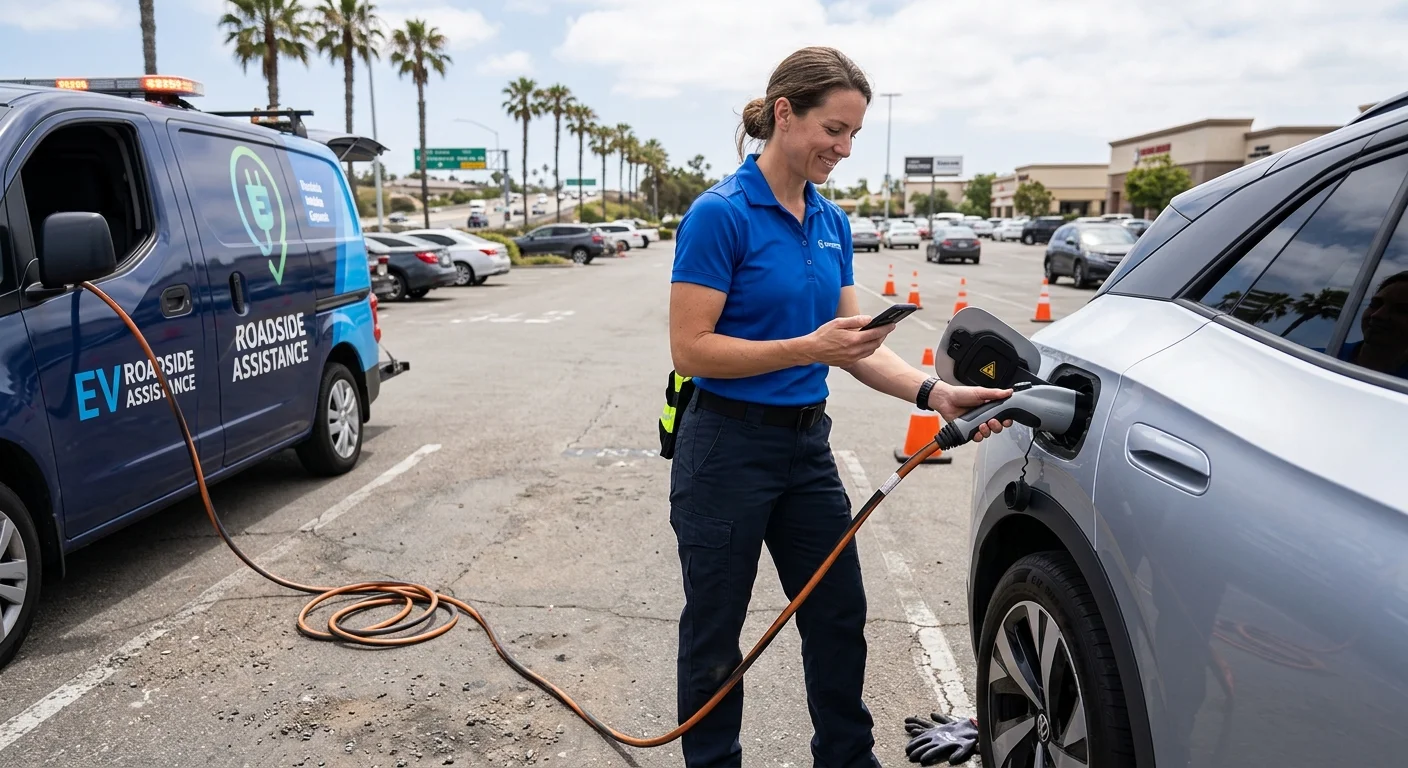
Arizona’s free help stops short of an EV charge
Arizona runs two free motorist programs across this metro. DPS Roadside Motorist Assistance is statewide, originally funded by the Maricopa Association of Governments. Crews change tires, add gasoline or diesel, and call tows. They also jump-start dead 12-volt batteries and add water. In 2018 the program assisted 75,235 motorists statewide. Published materials name gasoline and diesel. They say nothing about charging an empty pack.
ADOT’s Incident Response Unit works Phoenix-area freeways. Published hours are 5am to 8pm weekdays. It’s a 14-member unit sponsored by State Farm since 2020. ADOT reports more than 10,400 responses since October 2019. It still doesn’t advertise an on-site EV charge.
Independent mobile operators fill that gap. Charge Pro PHX is a referral line. We match stranded EV drivers with local operators. We hold no trade license, own no trucks, and employ no technicians. The operator quotes you before starting and bills you directly.
Confirm the stall before you spend the last miles
A map pin is a lead, not a confirmation. Access rules, plugs, and live status change. Start with the station operator’s own app or site. Then compare it with your car’s navigation.
The DOE charging guide names CCS, CHAdeMO, and J3400 as DC fast plugs. Your car may not accept every connector. An adapter doesn’t make every stall compatible. Follow your manufacturer’s port guidance.
Before you spend remaining range, confirm these points:
- The connector matches your vehicle.
- The network reports the stall as available.
- You can enter the property when you arrive.
- The charger isn’t limited to customers, residents, or employees.
- Your car still predicts enough energy for the full approach.
- You see the current session price in the operator’s app.
Live status is a signal, not a hold. Another driver can take the stall first. A charger can show online while the cable or reader fails. Save more than one compatible option. Charging apps to check before you’re stuck walk through that check.
Read the Valley approach, not the pin
Straight-line distance doesn’t tell you if you’ll make it. Central Phoenix, the East Valley, and the West Valley use different roads. Loop 101 is Agua Fria on the west. It’s Pima on the northeast and Price on the southeast. Loop 202 is Red Mountain, Santan, and South Mountain. US-60 is Grand Avenue northwest and the Superstition Freeway east.
Downtown Phoenix pins need extra care. Chase Field and Mortgage Matchup Center sit in garage country. A stall inside a structure can sit several ramps from the street.
East Valley pins around Mesa, Gilbert, Chandler, and Tempe need a side check. They can sit on opposite sides of Loop 202 or US-60. Check which side you’re already on. West Valley pins off Loop 101 Agua Fria have the same issue from Glendale, AZ.
Freeway searches need the exit, not the bird’s-eye pin. From I-10, I-17, Loop 101, or Loop 202, walk the merge in your nav. Arizona has no toll roads, per ADOT. HOV occupancy rules still apply on weekday rush hours. Solo HOV access for alt-fuel plates ended September 30, 2025.
Northbound I-17 toward Anthem and Black Canyon City climbs. ADOT posts a 6% maximum grade on northern I-17. If you’re already low, pick a stall you can enter and leave. Don’t pick the first listing that says fast.
Heat eats the buffer you think you have. Phoenix averages about 111 days at or above 100F, per NOAA normals via NWS Phoenix. AAA’s 2026 study found about an 8.5% range loss at 95F versus 75F. Recurrent reported 20 to 30% loss above about 95F. That set included trips from 300 Phoenix-area EVs. Treat the dash number as an estimate.
When a verified rapid charger is still the right move
Stay with a public DC fast stall when the car still drives. You also need a confirmed compatible station and a real buffer. Tesla Superchargers are DC fast for Tesla cars. CCS and J3400 cover most other brands.
Check the car first, including reduced-power warnings or a locked port. Those can mean a public stall won’t help. Read the exact dashboard message. Verify at least one stall through the network’s own listing. Pick a second option on a different property if you can. Don’t hop between uncertain pins with almost no energy left.
Phoenix Sky Harbor is a different problem than a freeway hunt. Confirmed charging there is Level 2, not DC fast. It’s in the Terminal 3 garage and the Terminal 4 garage. There’s also charging at the 24th St. station. EVPassport installed that charging in 2022. A car left a week in a hot garage often won’t wake. The traction pack can still be full while the 12-volt is dead. That’s a 12-volt job, not a rapid-charger search.
If the route leaves no buffer, stop chasing a farther pin. Move off the traveled lanes if the car can still roll. ARS 28-871 limits stopping on the traveled part of a highway. That applies outside a business or residence district. A vehicle disabled so badly it can’t move is exempt. Leave room for traffic and stay visible 200 feet each way.
ARS 28-775 is Arizona’s Move Over law. Approaching a stopped vehicle with warning lights, move over a lane if you can. Otherwise slow down. An operator working a shoulder needs that space.
When a truck to the car makes more sense
A mobile charge fits when the car is parked safely. The traction battery is empty, and an operator can feed it on site. Independent operators typically bring a 240V Level 2 source. Tesla cars take a native NACS plug. CCS or J1772 adapters cover most other brands. The usual goal is 10 to 20 miles of range. That takes 15 to 30 minutes of charging. That’s charging time, never an arrival time.
Charge Pro PHX connects you through mobile EV charging. We don’t perform the charge. We don’t promise what a given truck carries. The operator confirms compatibility, quotes you, and bills you.
Before you request a truck, gather this:
- Year, make, and model.
- The exact dashboard message.
- Pack percentage, if the screen still shows it.
- Your visible connector.
- A precise pin, not just Phoenix or the 101.
- Gates, garage height, or property access limits.
- Whether the car can shift, steer, and unlock.
On I-10 west of the Stack is useful. Downtown inside a garage is not. Name the freeway, direction, and nearest exit. Loop 101 needs Agua Fria, Pima, or Price. US-60 needs Grand Avenue or Superstition.
Mobile charging may not fit if the car won’t accept power. It also fails if the port is damaged. A dead 12-volt can lock you out. An unsafe shoulder can rule a truck out too. Describe symptoms, and don’t guess the cause. How a mobile EV charging truck actually helps you covers what operators typically carry. If you need recovery rather than a top-off, start with out-of-charge recovery.
When a tow is the better call
A tow fits when charging won’t solve the stop. That includes a car that won’t accept power or a port that won’t open. A serious fault or collision damage points the same way. So does a car stopped in a dangerous place.
A dark screen doesn’t prove the traction pack is empty. The 12-volt runs handles, screens, and the contactor that connects the main pack. Heat shortens 12-volt life. AAA calls heat the number-one cause of battery failure. Tesla Sentry Mode and Cabin Overheat Protection draw parked power.
Tesla’s own roadside path is a tow to a Supercharger or service center. It doesn’t charge you on site. Share symptoms, not a guessed service. If a tow is recommended, follow the maker’s loading rules. What towing a dead EV in the Phoenix area actually involves walks through that checklist.
Private-property tows follow ARS 9-499.05 in cities and ARS 11-251.04 in counties. Arizona sets no statewide tow-rate cap. Confirm the destination and the quote before you agree. Charge Pro PHX doesn’t tow, set prices, or warrant the job. Read when you need a charge, not a tow for that split.
Call when the map can’t finish the job
Call when you can’t safely reach a confirmed rapid charger. We’ll connect you with an independent local operator. For a wider walkthrough, see EV roadside rescue for Phoenix drivers.
Call (602) 932-0920 and we’ll connect you with a local EV rescue operator.