Arizona’s free motorist programs will change a tire. They’ll bring gasoline. They’ll jump a 12-volt. They won’t bring an EV a charge. Roadside assistance for EV trouble on Valley roads starts with that split. A referral operator is who shows up with a 240-volt Level 2 source. Then they plug into the car.
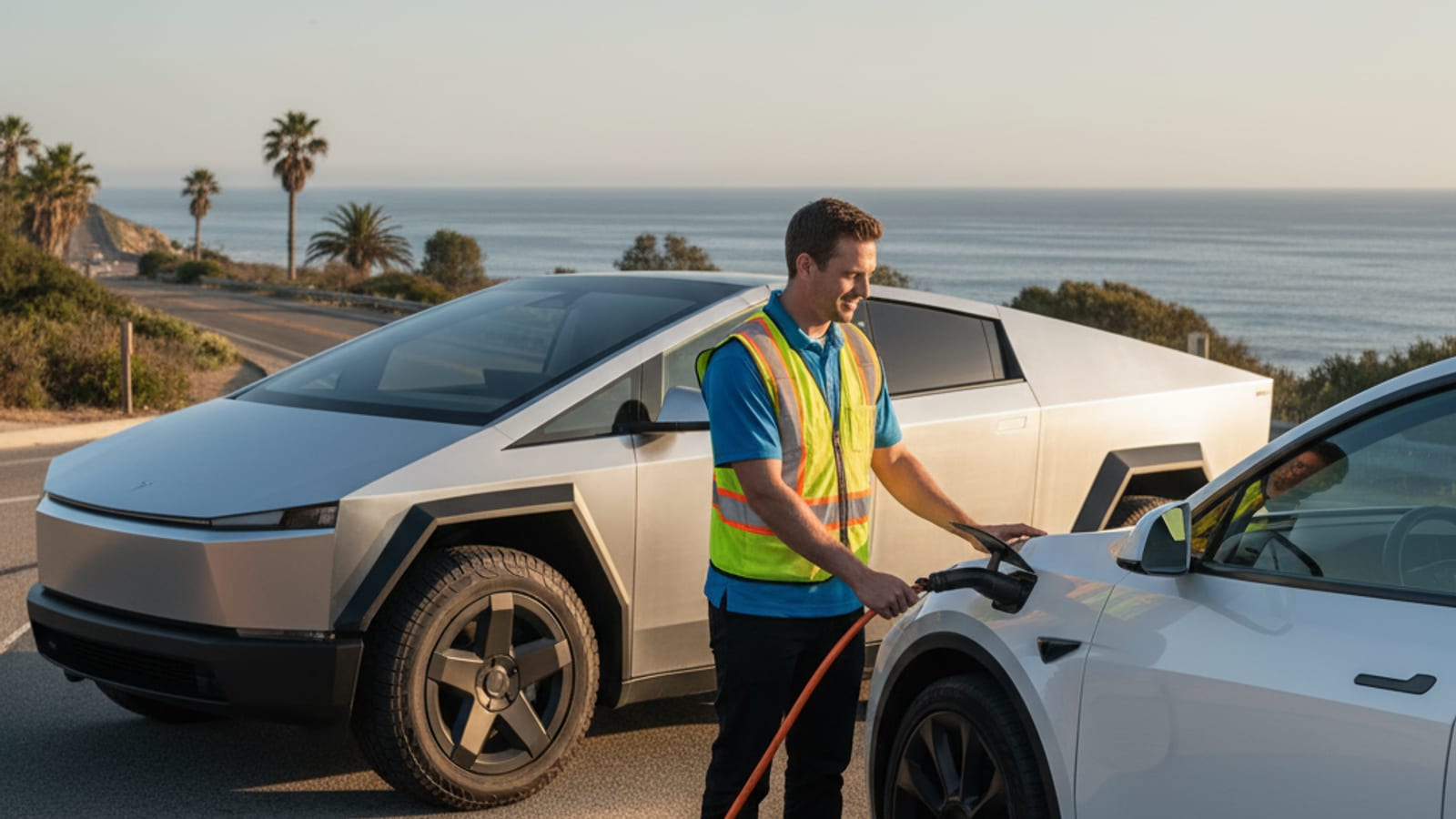
Arizona’s two motorist programs, and what they skip
The Phoenix area isn’t a place that leaves you without any help. Arizona runs two free programs on these roads. Both are built for gas-car problems. Neither one publishes EV charging as a service.
DPS roadside motorist assistance
Arizona DPS runs Roadside Motorist Assistance statewide. The Maricopa Association of Governments originally funded it. The published menu matches a conventional breakdown. Crews change tires. They provide gasoline or diesel. They jump-start dead batteries. They add water. They call a tow. In 2018 the program assisted 75,235 motorists statewide. Its materials name gasoline and diesel. They don’t mention charging an empty EV. They don’t mention a car that hit zero. Hours and specific corridors aren’t published on the DPS pages reviewed for this piece. If you need that program, confirm current coverage with Arizona DPS.
ADOT incident response on Valley freeways
ADOT’s Incident Response Unit covers Phoenix-area freeways. Published hours are 5am to 8pm on weekdays. The unit has 14 members. State Farm has sponsored it since 2020. ADOT reports 10,400-plus responses since October 2019. They clear crashes and debris. They change tires. They help stranded motorists. No EV-specific mention appears in the published write-up. A Model Y at 0% on Loop 101 may still get tire help. That unit isn’t advertised as the truck that adds range.
A Tesla flat tire and an Arizona DPS stop aren’t the same job. Rubber and gasoline are state work. An empty traction pack isn’t.
Charge, jump, or tow: pick the right call
Most EV stalls in this metro fall into three buckets. Mixing them up wastes a tow. It can also leave you waiting for the wrong truck.
The pack is empty
You drove until the car stopped. Climate control, grades, and heat all eat range. Phoenix averages about 111 days at or above 100F. About 21 days hit 110F or more. July highs average near 107F. August sits near 105F. AAA’s 2026 study found about a 10% efficiency drop at 95F versus 75F. Range fell about 8.5% in that test. Recurrent looked at 345,622 trips from 300 Phoenix-area EVs. It reported 20 to 30% range loss above about 95F. Loss sat near 31% at 100F.
None of that names a missing charger on a given road. It means the same commute can use more energy than your nav promised. Phoenix and Sky Harbor sit near 1,135 ft. Northbound I-17 climbs toward Anthem at about 1,860 ft. Sunset Point rest area is about 3,410 ft. ADOT posts a 6% maximum grade on northern I-17. The Beeline, SR-87, posts a 7% grade into Slate Creek Canyon toward Payson. US-60 east climbs the Superstition Freeway through Apache Junction toward Superior and Globe. Those grades are why a charge call is often the right one.
A mobile operator brings a 240-volt Level 2 source to the bumper. Teslas take a native NACS plug. Other brands take a CCS or J1772 adapter. Typical charging time adds about 10 to 20 miles in 15 to 30 minutes. That’s charging time. It isn’t a promise of when someone arrives. The operator quotes you before work starts. They bill you directly. We don’t set that price. We match you with the independent pro.
See how a mobile EV charging truck helps for the equipment picture. For the recovery itself, use mobile EV charging.
The 12-volt is dead
This one fools people. The traction pack can still be full. The car still won’t wake. Door handles, screens, and the main-battery contactor all run on the small 12-volt. A DC-DC converter only recharges it while the car is on or charging. Tesla features like Sentry Mode and Cabin Overheat Protection draw power while parked. Sky Harbor is a classic version of this. You leave the car in a Terminal 3 or Terminal 4 garage for a week. You come back to a brick. Level 2 charging is confirmed in the Terminal 3 garage, the Terminal 4 garage, and at the 24th St. station. None of that restarts a 12-volt that already died in the heat.
Battery Council International work, via Battery University, put hot-climate starter-battery life near 47 months. Cool climates sat near 59 months. A battery that lasts five years elsewhere can fail in two or three here. AAA calls heat the number-one cause of battery failure. It recommends AGM batteries for hot areas. An on-site jump, or a 12-volt replacement, is the job. It isn’t a Level 2 charge. DPS may jump a dead battery. Confirm whether they’ll work on your EV before you wait. Independent operators who do EV work can jump or replace that 12-volt on site.
If you’re sorting the two failures, read charge it, jump it, or wait for a tow.
You need a flatbed
Some stalls aren’t energy problems. A puncture on a heavy EV. A charge port that won’t release. A software lock. A car that still won’t move after a jump. Then the honest answer is a flatbed. Arizona doesn’t set a statewide tow-rate cap. Cities and counties may set local maximums. Private-property tows need the owner’s written authorization or a police request. Under ARS 28-872, police may order a disabled or obstructing vehicle removed. Owners pay reasonable tow and storage costs before release. We don’t tow. The operators we connect you with focus on charge and 12-volt work. If a flatbed is the right tool, that’s a separate call.
Factory programs often default to a tow anyway. Tesla doesn’t charge on site. It tows to a Supercharger or service center. Ford tows to the nearest charger, home, or dealer within 50 miles. Rivian and Hyundai/Kia owners have reported trouble getting a dead EV towed. Confirm the plan before you accept the hook.
What a referral rescue is, and isn’t
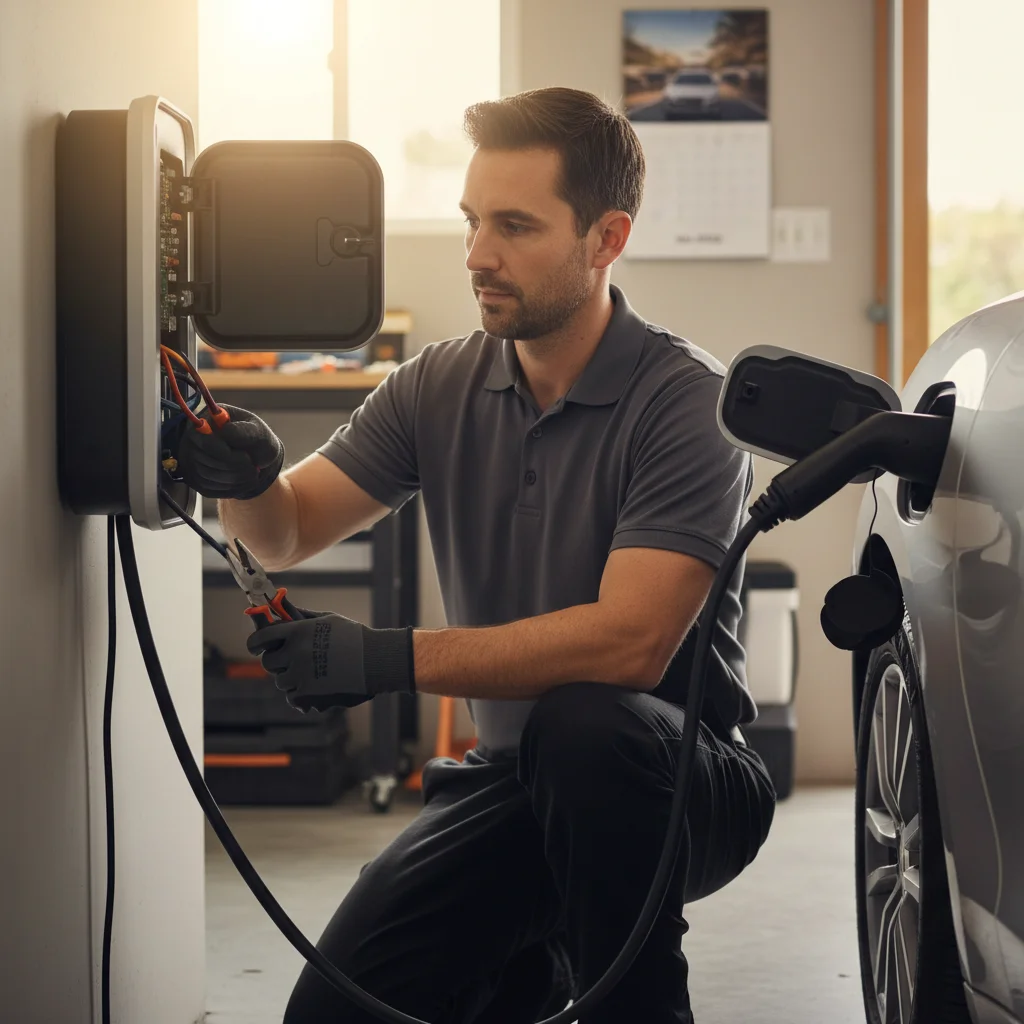
Charge Pro PHX is a referral line for the Phoenix area. We match stranded EV drivers with independent local mobile rescue operators. We don’t hold a trade license. We don’t own trucks. We don’t employ technicians. We don’t publish hours or arrival times. The pro you get quotes before starting. They bill you. The pros we connect you with are licensed and insured.
What those operators actually do is narrow, and that’s the point.
- They bring 240-volt Level 2 power to the car.
- They plug NACS, or they adapt CCS or J1772.
- They jump or replace a dead 12-volt on site.
- They handle Tesla and every major EV brand.
That’s EV roadside assistance in this metro. It isn’t a substitute for DPS on a spare tire. It isn’t a club’s gas can. When a club or insurer can’t charge you, a mobile EV operator can.
Shoulder rules that actually apply here
Arizona has no toll roads and no toll express lanes. ADOT confirms that. SB 1340 took effect January 1, 2024. It bars the state from adding them without a new legislative vote. Loop 202 South Mountain is free. Scam texts about unpaid Arizona tolls are scams. If you stall, the law that matters is about where the car sits.
ARS 28-871 covers where you may stop. Don’t sit on the traveled lanes outside a business or residence district if you can get off them. A vehicle disabled so badly it can’t be moved is exempt. When you’re stopped, leave room for traffic to pass. Be visible 200 feet in each direction. Hazard lights help. Get as far onto the shoulder as the car will still roll.
ARS 28-775 is the Move Over law. Drivers approaching a stopped vehicle with warning lights must move over a lane if they can do it safely. Otherwise they slow down. That rule exists because someone is working your car on the shoulder.
ARS 28-674 covers minor crashes. You must move the vehicle off the traveled roadway when it’s safe. You aren’t at fault merely for moving it. ADOT may require and assist removal when no serious injury is apparent.
Don’t walk the travel lanes. Stay with the car if the shoulder is a live freeway. That includes I-10 and I-17. It includes Loop 101 Agua Fria, Pima, and Price. US-60 is Grand Avenue on the northwest side. East of town it’s the Superstition Freeway. They’re different segments of the same route. The Stack is I-10, I-17, and US-60. Give the operator a milepost, an exit, and a direction. Westbound Loop 101 Agua Fria, before the I-10 stack, is usable. Somewhere in Phoenix isn’t.
HOV-lane occupancy rules still apply during weekday rush hours. Alternative-fuel plates lost solo HOV access on September 30, 2025. Don’t sit in that lane on the assumption the plate still helps.
Tribal land isn’t a Phoenix suburb. Salt River Pima-Maricopa sits between Scottsdale, Tempe, Mesa, and Fountain Hills. Gila River includes Sacaton and Casa Blanca, south of Chandler. Maricopa the city is in Pinal County, not Maricopa County. Those nations have their own government and police. If you stall there, say so when you call.
Paradise Valley the town isn’t the Paradise Valley urban village inside Phoenix. Sun City, San Tan Valley, and Anthem are CDPs with no city government. Name the place you can see on a sign.
Heat, parking, and stalls that look like an empty pack
A dead 12-volt after a ballgame or a flight is common. Mortgage Matchup Center downtown hosts the Suns and Mercury. Chase Field hosts the Diamondbacks. State Farm Stadium in Glendale AZ hosts the Cardinals. Phoenix Raceway is in Avondale, not Phoenix, despite the name. Sloan Park in Mesa cooks a parked car the same way. Tesla Sentry Mode doesn’t help that 12-volt.
Monsoon season runs June 15 to September 30. Haboobs can drop visibility to near zero. Flash floods follow. ARS 28-910 is the so-called Stupid Motorist Law. Drive around a barricade into floodwater and you can be billed for the emergency response. Don’t drive into water. Wait it out. SR-88, the Apache Trail, has had monsoon damage and partial closure by 2026. Don’t treat it as a through route.
Arizona doesn’t observe daylight saving time. When you report a stall in this metro, local time is Mountain Standard year round.
What factory roadside will and won’t do
Most makers include some roadside plan with a new EV. Coverage length varies. Confirm yours in the app or the owner’s packet. Tesla’s published pattern for a pack at zero is a tow. It isn’t a plug on the shoulder. That’s useful if you want the car at a Supercharger. It’s the wrong tool if you only need a short Level 2 session to finish the drive. Independent operators fill that on-site charge. They also handle CCS and J1772 cars.
Don’t assume a national club will charge the traction pack. Many still jump 12-volts and tow. Ask whether they can bring Level 2 to your pin. If the answer is no, you want a mobile EV operator.
Reduce the odds before you leave home
Arizona had about 141,800 battery EVs and 33,900 plug-in hybrids as of 2025, per DOE AFDC.
Home charging still prevents most empty-pack stalls. Newer Pinal and far-suburb housing makes a wall unit common. Sun City has 88.9% of housing built before 1980. The call from those streets is often a 12-volt that cooked in a driveway.
The Valley splits among APS, SRP, Mesa Municipal Electric, ED3, and ED2. Service can change block by block. Confirm your address with the utility. APS markets the R-EV rate as EV Overnight Charging, 11pm to 5am on weekdays. SRP’s Electric Vehicle Price Plan is closed to new enrollment as of a February 2025 board decision. Existing customers may stay through the November 2029 billing cycle. Mesa Municipal Electric offers E1EV around downtown Mesa. ED3 in Maricopa and northern Pinal offers EV TOU 2-10. Confirm current terms with the utility. Amounts aren’t something to guess from a blog.
EVs are exempt from Arizona emissions testing. Maricopa County is Area A. Hybrids aren’t exempt. Arizona has no annual safety inspection. Watch for slow door handles, flickering screens, and repeated 12-volt warnings after hot parks.
Named charging you can count on here includes Sky Harbor’s Terminal 3 garage, Terminal 4 garage, and the 24th St. station. Phoenix-Mesa Gateway’s official amenities list didn’t confirm on-site EV charging. Treat AZA charging as unconfirmed and check the airport before you park.
Keep tire pressure in spec. EVs are heavy. DPS can still be the right first call for a flat.
If you’re already stopped
Get off the traveled lane if the car will still roll. Hazards on. Stay visible, with room to pass.
Decide the failure. Screens dark and doors dead usually means 12-volt. A car that drove to 0% and rolled to a stop is an empty pack. A hissing tire is a tire.
Call the right program. Tire, gasoline, or a generic jump may be DPS. On a weekday freeway between 5am and 8pm, ADOT’s unit may be the one you see first. An empty EV needs a Level 2 operator. We match that call across the Phoenix area. That includes central Phoenix, Mesa, Tempe, Scottsdale, Gilbert, and Chandler. It includes Glendale AZ, Peoria AZ, Surprise, Goodyear, Buckeye, and the Pinal belt.
Stay in the car on a live freeway. Turn off cabin cooling if you’re holding a last sliver of pack for lights. Don’t stand behind the bumper in traffic.
Frequently asked questions
Does Arizona DPS or ADOT charge a stranded EV?
Not in anything they publish. DPS Roadside Motorist Assistance lists tires, gasoline or diesel, jumps, water, and tow calls. ADOT’s Incident Response Unit lists crash and debris work, tires, and stranded-motorist help on Phoenix-area freeways, weekdays 5am to 8pm. Neither program advertises bringing an EV a Level 2 charge. For an empty pack, a referral mobile operator is the service that plugs in.
If my EV won’t start, is a jump the right call?
Only if the 12-volt is the failure. A full traction pack won’t move the car when that small battery is dead. Heat shortens 12-volt life in this climate. A jump or an on-site replacement can wake the contactors. An empty high-voltage pack needs Level 2 charging instead. If you can’t tell which one you have, say so when you call. The operator can sort it at the car.
Will Tesla roadside plug me in on the shoulder?
Tesla’s published out-of-charge pattern is a tow to a Supercharger or service center. It isn’t on-site charging. Confirm your live dispatch in the Tesla app. If you need range added where you sit, that’s a local mobile operator with a 240-volt Level 2 source. It isn’t a factory tow.
Call Charge Pro PHX at (602) 932-0920. Ask for a Level 2 charge or a 12-volt jump match. The operator quotes you before they start.