You searched “mobile EV charging near me” and landed here. Here is how the matching works in the Phoenix area, what the operator does at the car, what it costs, and what to expect when you call.
What “mobile EV charging near me” actually means
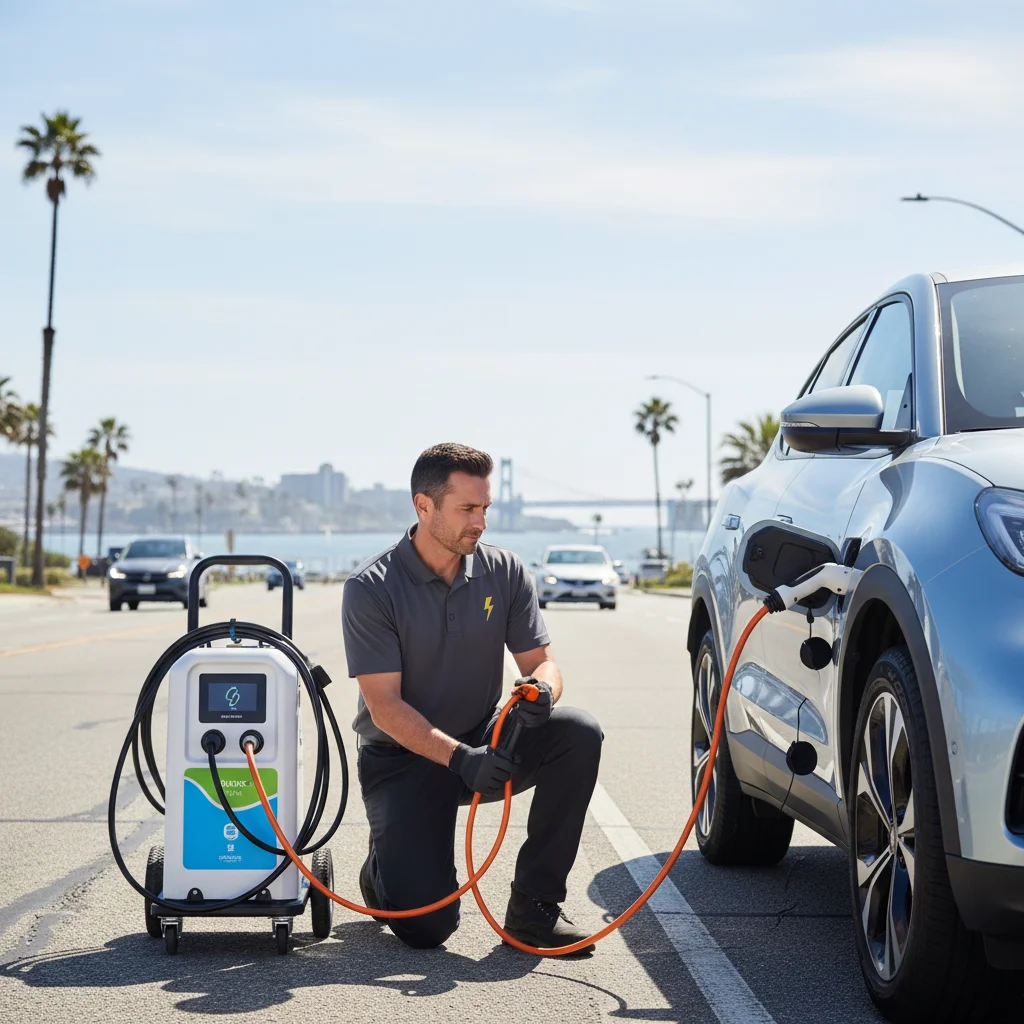
A mobile EV operator brings a portable 240-volt Level 2 source to where the car sits, plugs in with the right connector, and adds real miles while you wait. The truck carries a native NACS plug for Teslas and CCS or J1772 adapters for other major brands. The session is real Level 2 charging at the car, not a fast-charge detour or a battery swap.
A typical session adds about 10 to 20 miles of range in 15 to 30 minutes. That is charging time at the car, not an arrival time for the operator. The goal is enough range to reach a charger you already meant to use, or enough to make it home on a slow top-up.
How the matching works
Charge Pro PHX is a referral line. We match you with an independent local operator who has the right gear for your car. We do not own trucks, employ technicians, or set prices. The operator quotes before any work starts and bills you directly.
The match happens by location and connector. You tell us where you are (nearest cross street, exit number, or landmark), and we connect you with an operator who can reach you and who carries the right plug for your car. We do not promise an arrival time. The operator sets that with you after the job is confirmed.
We never publish an arrival time because we cannot guarantee one. Heat, traffic, dispatch load, and the operator’s distance from your location all affect timing, and a quoted arrival that the operator cannot keep is worse than no quote at all. The operator gives you a window after the job is confirmed.
What the operator brings
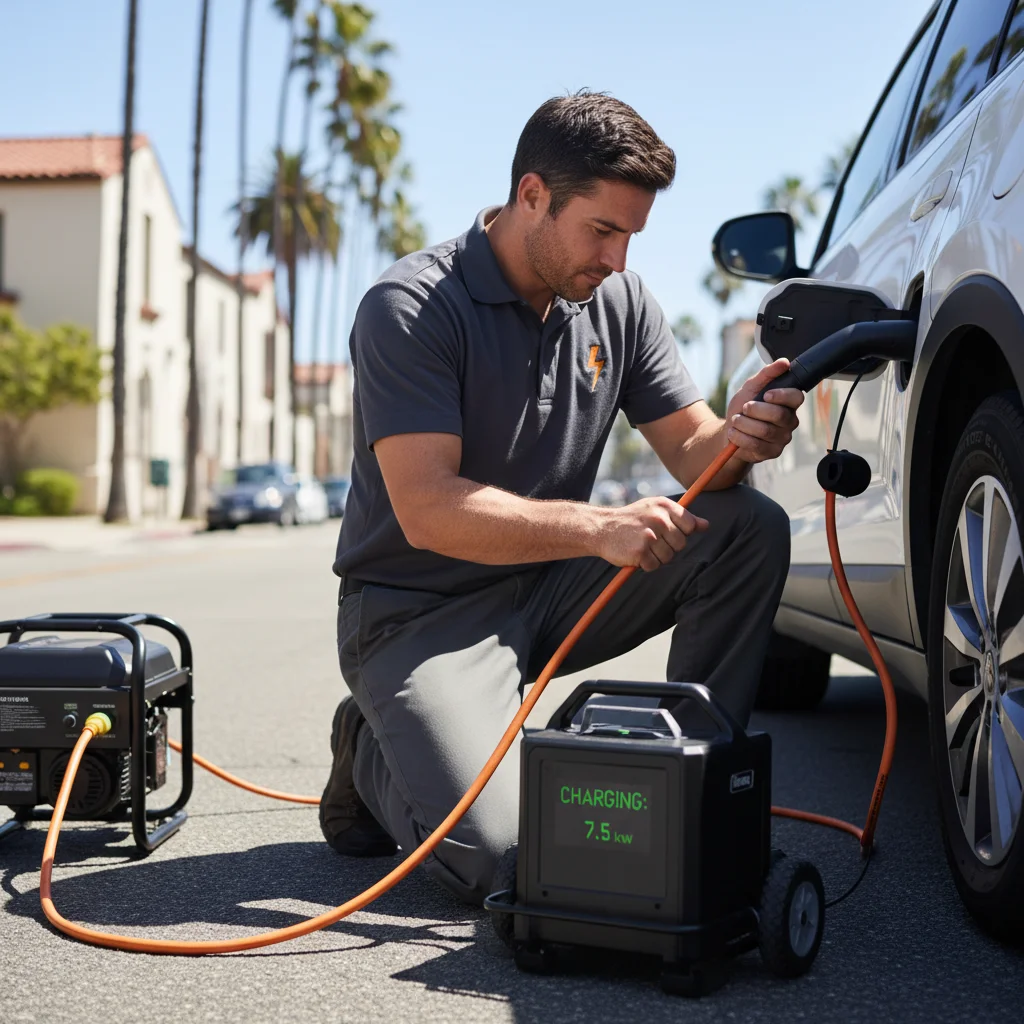
The truck carries a portable 240-volt Level 2 source, a generator, and the connectors for the major EV brands. The right connector for your car is on the truck before the operator rolls.
For Teslas: a native NACS plug. For CCS cars (most non-Tesla brands sold in the US since 2020): a CCS handle. For J1772 cars (older non-Teslas): a J1772 handle.
If you drive a Lucid Air, the truck carries a CCS handle (Lucid uses the CCS standard on North American cars). If you drive a Nissan Leaf, the truck carries a J1772 handle.
For a deeper look at what the trucks carry, see what Phoenix mobile EV rescue trucks actually have on board.
What it costs
The operator quotes a price before any work starts. The cost depends on several factors that move the price:
- How much range you need added. A few miles to reach a charger is one number. Twenty miles to make it across town is another.
- The dispatch distance. A call in central Phoenix is a quicker job than a call on the I-17 north of Anthem or in San Tan Valley.
- The time of day and the operator’s dispatch load. An evening rush-hour call costs more than a midday call because the operator is busy.
- The location. An office park with easy truck access is a quicker job than a tight apartment lot or a downtown parking garage.
We do not set prices. The operator does. The operator’s quote covers the visit, the Level 2 charge session at the car, and any additional mileage if you ask for it.
For a broader rundown on what a mobile visit adds, see roadside Level 2 charging for stranded drivers.
What to do before the operator arrives
Get the car as far off the travel lane as you can. Keep hazards on. ARS 28-871 says to leave the traveled part of a highway when you can. A vehicle that cannot be moved is exempt.
Have a location ready: nearest cross street, exit number, or landmark. The closer the pin, the faster an operator can find you.
If the 12-volt is dead and the doors are locked, do not force the door handles. Use the mechanical key from the fob as described in how a Tesla 12-volt rescue works (the principles apply to every modern EV with flush handles, not just Teslas).
When mobile charging is not the right call
A mobile Level 2 visit is the right move when the traction pack is empty but the car will wake and roll, and the next charger is further than your current range will go. It is not the right move when the traction battery has a physical fault, when the car will not wake after a 12-volt jump, when the charge port is damaged, or when the car is in a tight indoor space where a generator cannot run. In those cases, a tow is the right answer.
For the broader principle of when a tow beats a charge, see mobile EV charging vs a tow.
What to do right now
If your EV is out of charge in the Phoenix area right now, get the car as far off the travel lane as you can and keep hazards on. Have a location ready.
Call (602) 932-0920. The operator quotes before any work starts and bills you directly.
Frequently asked questions
How quickly can a mobile EV operator reach me in Phoenix?
The operator gives you a window after the job is confirmed. We do not publish an arrival time because heat, traffic, dispatch load, and the operator’s distance all affect timing.
How much does mobile EV charging cost in the Phoenix area?
The operator quotes the price before any work starts. The cost depends on how much range you need, the time of day, and the location. We do not set prices. The operator does.
Will Arizona DPS bring my EV a charge?
No. DPS Roadside Motorist Assistance changes tires, brings gasoline or diesel, jumps conventional batteries, and clears debris. It does not advertise bringing an EV a charge.
Does Charge Pro PHX cover the whole Phoenix area?
Yes. We match you with an operator who serves your area. The operator confirms whether they can reach you and at what price before any work starts.