Tesla roadside assistance hours in the Phoenix area couldn’t be confirmed from our approved sources. What we could confirm is simpler than the hours question. Tesla tows a dead car and doesn’t charge you on site. Arizona DPS and ADOT will change a tire or bring gasoline. They never advertise bringing an EV a charge.
Tesla roadside assistance hours you can actually check
We couldn’t confirm a current published schedule for Tesla roadside in Arizona. Don’t treat an old search result as proof that help is always on. Open the Tesla app tied to the stranded car. Read what it offers for this vehicle and this spot, right now.
Hours and coverage aren’t the same question. A request button can show up while your problem sits outside the terms. Roadside assistance is a label, not a promise. An empty pack may not qualify the way a flat tire does.
Phone numbers in random directories go stale fast. Start with Tesla’s current support materials and the app, then keep a local backup. Our guide to the Tesla roadside phone number walks through that check.
When you request help, pin more than a city name. Name the direction and the nearest exit, not just I-10. Note whether you’re on the shoulder or in a Sky Harbor garage. A lot by Chase Field needs the garage name and level too.
Tesla tows. It doesn’t charge the car on site.
Carmaker help for an empty Tesla is a tow. Tesla doesn’t send a charger to the car. It moves the vehicle to a Supercharger or a service center. That’s the pattern we could verify, and it isn’t an on-site charge.
That matters on Valley roads. A Model 3 on Loop 101 Agua Fria can still move. Tesla’s program is built around the tow, not that truck.
Don’t assume the tow is free. We couldn’t confirm that Tesla covers every request, location, or service without a bill. Read the terms shown for your VIN before you accept.
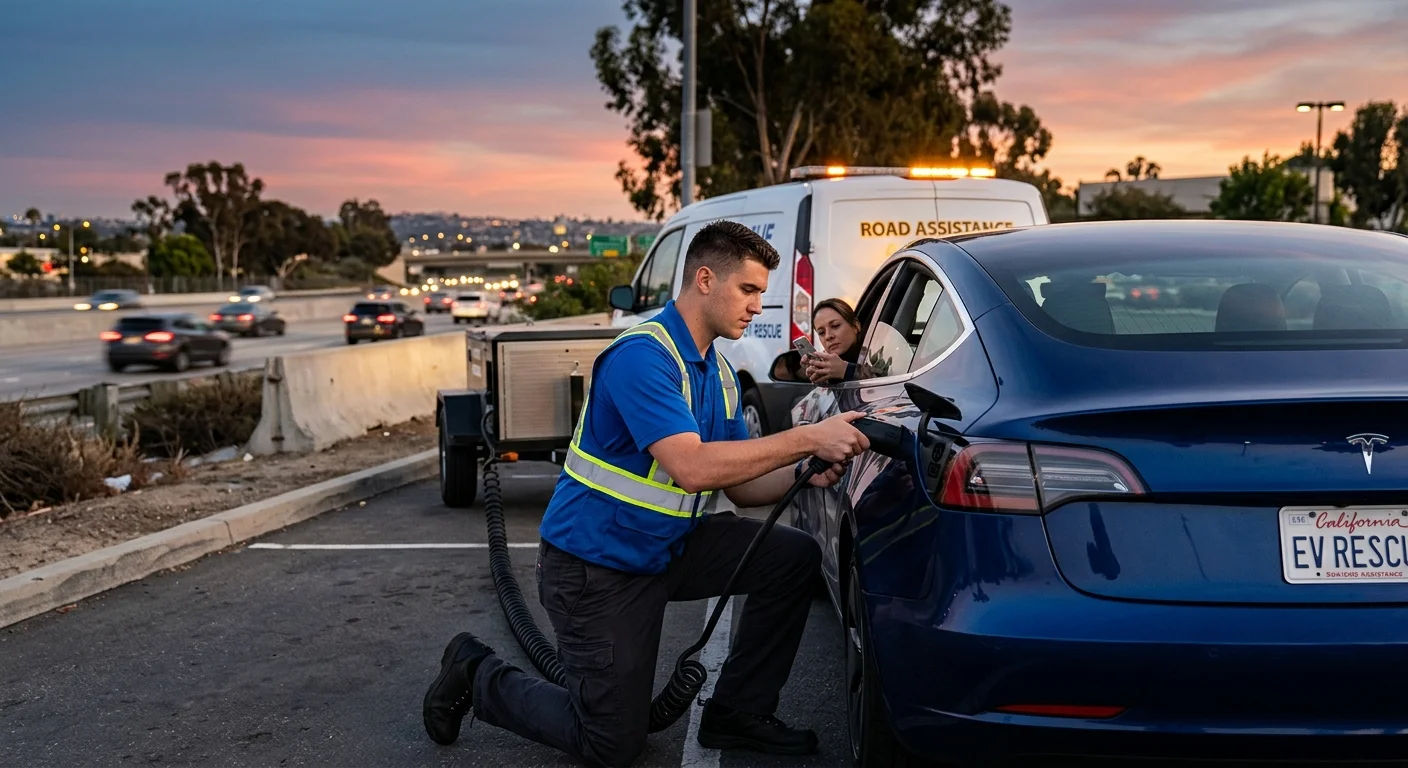
If the high-voltage pack is empty, you may want the car charged where it sits. A Tesla roadside rescue from an independent local operator is a different path. Charge Pro PHX only makes the match. The operator looks at the car, quotes you, and bills you directly.
A dead 12-volt is a different job from an empty pack. The small battery runs the screens, the door handles, and the contactor that connects the main pack. Phoenix averages about 111 days a year at or above 100F. That heat is hard on the 12-volt. A car that won’t wake after a week at Sky Harbor is often the 12-volt. Tell the dispatcher which problem you actually have.
DPS and ADOT help motorists. They don’t advertise charging an EV.
Arizona does run free motorist help, and two programs cover the metro. Neither one lists EV charging in its published materials.
Arizona DPS Roadside Motorist Assistance, or RMA, is statewide. It changes tires and brings gasoline or diesel. It jump-starts dead batteries, adds water, and calls tows. Its own pages name gasoline and diesel, not electricity. They say nothing about charging an EV on the shoulder. Hours and corridors for that program aren’t published.
ADOT’s Incident Response Unit works Phoenix-area freeways. Published hours are 5am to 8pm weekdays. It’s a 14-member unit, sponsored by State Farm since 2020. It clears crashes and debris, then changes tires for stranded motorists. No EV-specific mention appears on ADOT’s materials.
If you’re out of charge on I-17 toward Anthem, the state truck may set cones. It may call a tow on the Superstition Freeway through Mesa too. That truck isn’t advertised as a mobile charger. Independent operators fill that roadside charging job.
For a tire-only stop, Tesla’s coverage and DPS can overlap. Our comparison of Tesla flat tire help and Arizona DPS separates those jobs. An empty pack isn’t a tire job.
How to request Tesla help from the Valley
Open the Tesla app connected to the stranded vehicle. Look for the current Roadside or support area. If a request option appears, read every condition on the screen, then submit.
Have a location string ready before you tap. Use the roadway, the direction, the nearest signed exit, and a landmark you can see. On Loop 101, say Agua Fria, Pima, or Price. Those are different legs. US-60 is Grand Avenue on the northwest side. It’s the Superstition Freeway on the east. They aren’t the same stop for a dispatcher. Downtown, a garage name and level at Mortgage Matchup Center beats a street number.
Describe the car in plain words, not a guess. Say whether the screens are on, whether it shifts, and what message is showing. Mention a flat, smoke, heat damage, or a blocked lane. Don’t open electrical covers beside moving traffic.
Screenshot the request and any confirmation. Save the provider name and the terms on the screen. If the request vanishes, go back to Tesla’s current support channel. Don’t keep dialing an old number from an unsourced list. Our Tesla roadside app or phone guide covers what to prepare for either route.
If the Tesla is sitting in a bad spot
Treat live traffic danger as an emergency, not a coverage question. If the car is in a travel lane, call 911. Call 911 if someone is at immediate risk, then follow the responders.
Arizona’s ARS 28-871 covers where you may stop on a highway. You may not sit on the traveled lanes if you can get off them. That rule applies outside a business or residence district. A vehicle disabled so badly it can’t move is exempt. When you’re stopped, leave room for traffic to pass and stay visible.
If you can move the car without adding risk, get it out of the lane. Don’t push, charge, or inspect a Tesla from a live freeway lane. That includes I-10, I-17, Loop 202, and the Stack interchange.
Turn on the hazard lights if they still work. Share the travel direction, shoulder side, nearest exit, and any mile marker.
Arizona’s Move Over law is ARS 28-775. It tells other drivers to change lanes or slow down when they see warning lights. You still shouldn’t stand in the travel lane waiting for that to happen.
Once the scene is stable, pick the right kind of help. A tow and a mobile EV charge are different trucks. If you ran empty on I-10 in the heat, use our out of charge on I-10 checklist. Don’t do electrical work on the shoulder yourself.
When an independent operator is the better match
Call a local operator when Tesla’s app has no useful path. Call when the terms don’t cover an on-site charge. Call when you want the car powered where it sits. Confirm the service, the quote, and who collects payment before anyone starts.
Charge Pro PHX is a referral line for the Phoenix area. We connect you with independent local mobile rescue operators. The pros we connect you with are licensed and insured. We don’t hold a trade license, own trucks, or employ technicians. We don’t set prices or promise an arrival time. The operator quotes you before starting and bills you directly.
Tell them the Tesla model, the warning on the screen, and the exact spot. Say whether the car is in a lot, a garage, or on a shoulder. They decide if the job matches their 240-volt Level 2 gear. Charging time, not travel time, is typically 15 to 30 minutes. That often adds about 10 to 20 miles of range.
Read our on-site charge or a Tesla tow guide for that comparison. That page is about the choice, not a wait time. Before you accept, ask who is coming and what the quote covers. Keep the agreement the operator gives you.
When to call us
Call when your Tesla is stranded in the Phoenix area. You need a match with a mobile EV operator. We don’t promise availability or an arrival window. The operator confirms the work and the terms.
Call (602) 932-0920 and we’ll connect you with a local EV rescue operator.