A Tesla charge on a Phoenix heat day lasts the miles heat leaves you. Cabin cooling and grades take their share too. That’s not a catalog number. AAA’s 2026 test at 95F shows a real desert cut. Recurrent’s Phoenix-area trips show the same pattern. Check the estimate on your screen first. Don’t treat a published range as today’s limit.
Daily charge and pack life are different questions
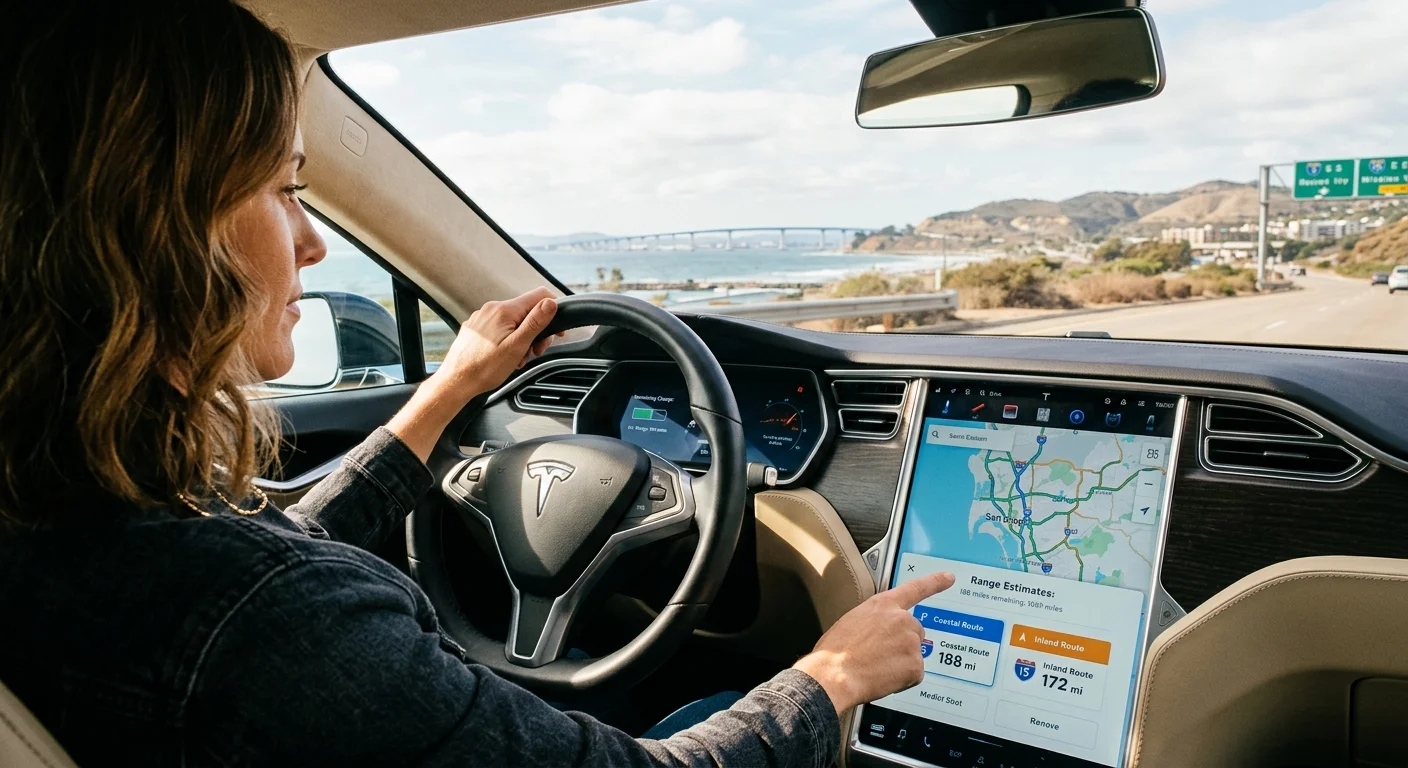
Searchers type “how long does tesla battery last in a day” and mix two clocks. One clock is today’s remaining drive. The other is how many years the traction pack stays useful. Today’s answer lives on the car’s display. Compare that estimate with the full route home, plus every extra stop. A forum range for another Model Y doesn’t override your screen.
Pack life is an ownership question on a longer timeline. Geotab tracked cars in climates above 27C for more than 35% of days. Those packs degrade about 0.4% per year faster than in mild climates. See how long Tesla batteries last in Phoenix heat. A weak day of remaining miles doesn’t prove the pack is worn out.
What the desert studies actually measured
AAA’s 2026 study compared 95F with 75F. It found about a 10% efficiency drop and an 8.5% range loss. A 250-mile car did just under 230 miles in that test. That’s better than AAA’s 2019 finding of 17% range loss. It’s still a cut you feel on a July commute.
Recurrent looked at real trips, not a lab loop. Its dataset included 345,622 trips by 300 Phoenix-area EVs. Recurrent reports EVs can lose 20 to 30% of range above about 95F. Loss sat near 31% at 100F.
Phoenix averages about 111 days a year at or above 100F. About 21 days hit 110F or more, per NOAA 1991-2020 normals via NWS Phoenix. July highs average near 107F. Overnight summer lows stay in the mid-80s. NREL reports cabin cooling is among the biggest climate-control draws. On a 107F afternoon that load isn’t optional.
Those study figures aren’t a promise for your Tesla. Tesla’s own site wasn’t available to confirm a factory daily-range claim.
Start with the model, the percent, and the screen
Write down the Tesla model, battery percent, and estimated distance before you leave. Recheck the display after you add a destination or a major reroute. Treat that estimate as a planning input, not a contract.
Then compare the estimate with the whole day. Count the outbound trip, errands, and the return. Count the last miles to a charger you can actually use. A commute ending at a home Level 2 stall is one kind of day. A night at Chase Field with garage parking after is another.
The U.S. Department of Energy’s verified guidance says Level 2 residential charging uses 240-volt power. It adds about 25 miles of range per charging hour for a midsize EV. Level 1 at 120 volts adds about five miles per hour. Actual speed varies with battery size, state of charge, and temperature.
If the displayed estimate is already tight, change the plan while you still can. Add a charging stop the car can reach, or skip the extra stop.
Heat spends charge even when you’re parked
Cabin Overheat Protection and Sentry Mode draw power while the car sits. Battery Council International work, via Battery University, timed starter batteries in heat. They last about 47 months in hot climates versus 59 in cool ones. AAA calls heat the number-one cause of battery failure. In an EV, a dead 12-volt can strand you with a full traction pack. It runs the screens, door handles, and the contactor for the main battery. A DC-DC converter only recharges it while the car is on or charging.
Phoenix Sky Harbor is a common version of that stall. Level 2 charging is confirmed in the Terminal 3 garage. It’s also in the Terminal 4 garage and at the 24th St. station. A car left a week in a hot garage can return with a drained 12-volt. See how Phoenix heat changes EV battery care.
Overnight charging still sets the day’s starting percent. APS markets the R-EV residential EV rate plan. It’s sold as EV Overnight Charging from 11pm to 5am on weekdays. SRP’s Electric Vehicle Price Plan closed to new enrollment after a February 2025 board decision. Existing customers may stay through the November 2029 billing cycle. APS and SRP split many Valley cities block by block.
Valley roads are not one flat commute
Phoenix sits near 1,135 feet. Northbound I-17 is a different energy problem. North of the city, Anthem sits near 1,860 feet and Sunset Point rest area near 3,410. ADOT posts a 6% maximum grade on the northern I-17. Forum drivers on that climb have reported roughly 481 Wh/mi going up. Coming down sat near 293 Wh/mi, about 40% more energy uphill.
SR-87, the Beeline toward Payson, posts a 7% grade into Slate Creek Canyon. US-60 east climbs through Apache Junction near 1,700 feet toward Superior near 2,890. Loop 101 splits into Agua Fria west, Pima northeast, and Price southeast. US-60 is Grand Avenue northwest and the Superstition Freeway east. Arizona has no toll roads.
Write destinations in order, and include the return. A displayed estimate that looks fine for Scottsdale can shrink later. A Tempe stop plus a Mesa run home will do that. Don’t invent a fixed mile penalty for traffic or heat. No verified local figure supports a universal adjustment beyond the studies above. If the low-battery warning is already on, see our Tesla low battery warning guide. For a car that’s already empty, use the Tesla out-of-charge checklist.
Act while a charger is still in reach
Low charge is easier to handle before the estimate collapses. Stop adding destinations and pick a compatible stall the car can still reach. Confirm it through the network that runs it. Don’t assume arriving in the general area is enough. Count the last streets and the garage entrance.
If you’re already very low, write down the road and direction. Note the nearest exit, parking level, or a named landmark. Don’t stop in a travel lane just to make the description easier. ARS 28-871 covers highway stops outside a business or residence district. You may not stop on the traveled part if you can get off it. A vehicle disabled so badly it can’t move is exempt. Leave room for traffic and stay visible 200 feet in each direction. ARS 28-775 is the Move Over law. Other drivers should change lanes or slow for warning lights.
Arizona DPS Roadside Motorist Assistance will change a tire or bring gasoline. ADOT’s Incident Response Unit works Phoenix-area freeways 5am to 8pm weekdays. Neither program advertises bringing an EV a charge. Use our EV running low in Phoenix heat sequence at this stage.
Public charging, a mobile operator, or a tow
The right next step depends on the car and the spot. If usable charge remains, ordinary charging may be the simplest path. That only works when a compatible stall is still reachable.
If you can’t reach a stall, ask about a mobile 240-volt charge. Operators we match you with bring a Level 2 source to the car. They use a native NACS plug, or a CCS or J1772 adapter. They typically add 10 to 20 miles of range. That takes 15 to 30 minutes of charging. That’s charging time, never an arrival time. Our out-of-charge recovery page explains how we connect stranded drivers with those operators.
A tow may be better when a mobile charge isn’t suitable. Tesla factory roadside tows to a Supercharger or service center. It doesn’t charge on site. A Tesla that won’t wake may be a 12-volt problem, not an empty pack. The Tesla roadside rescue page outlines the referral path.
Before you authorize work, ask the independent operator to explain the service. Get the price, payment terms, and any warranty they offer. Charge Pro PHX doesn’t set those prices or provide warranties. You contract with the professional and pay them directly. The pros we connect you with are licensed and insured.
When to call
Call when the remaining estimate no longer supports a safe drive to a reachable charger. Call when you need an operator to weigh a mobile charge against a tow. Charge Pro PHX is a referral line. We match stranded EV drivers with independent local operators. We don’t own trucks, employ technicians, or perform the work. Call (602) 932-0920 and we’ll connect you with a local EV rescue operator.