The low battery warning just fired on your Tesla and you are still miles from the next charger. Heat and the I-17 climb burn range faster than the warning implies, and Phoenix-area drivers discover this on the hottest days. Here is what to do before you hit zero.
Why the warning underestimates Phoenix heat
Two factors make the warning conservative in the wrong direction:
- Heat derate. Recurrent reports EVs can lose 20 to 30 percent of range above about 95F. AAA’s 2026 study found about a 10 percent efficiency drop and an 8.5 percent range loss at 95F versus 75F. A car that should make the next charger at 75F may not at 112F, especially with the AC running.
- Grade on the I-17. Forum drivers on the I-17 climb report roughly 481 Wh/mi going up versus 293 coming down, about 40 percent more energy uphill. The nav often underestimates the climb.
The combination is what strands Phoenix-area drivers. A car starting the climb north of Anthem with single digits is not reaching Camp Verde without help.
What to do the moment the warning fires
Six habits work in the moment:
- Slow down to 55 to 60 mph. Speed is the biggest range variable on a highway.
- Turn off the AC if you can tolerate the heat. AC is one of the biggest draws on the battery. Open the windows for cross-ventilation.
- Avoid the right lane if there is a tailwind. Headwinds burn more energy.
- Pull into a shaded spot if you can. A hot pack is less efficient than a cooled one.
- End the navigation to the next charger and re-enter it. Tesla’s nav will reroute to a closer charger if one exists.
- If the warning is below 10 miles, do not take an exit that adds miles before reaching the charger.
For the wider view on what heat does to an EV, see EV battery care in Phoenix heat.
What to do when the next charger is too far
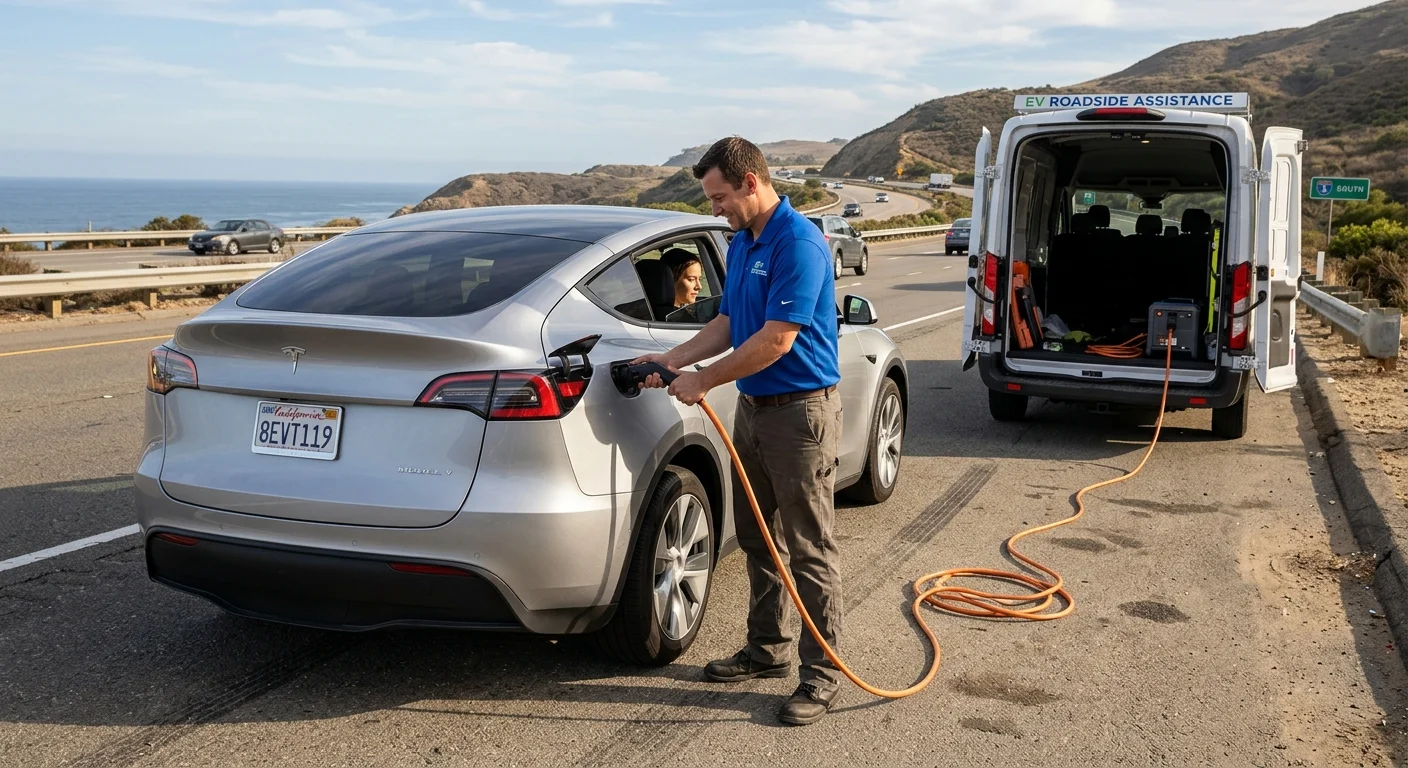
When the warning is below your range to the next charger, the next move is a mobile Level 2 visit. An operator can come to you with a portable 240-volt source and add 10 to 20 miles in 15 to 30 minutes of charging. That is enough to reach the next charger.
Charge Pro PHX matches you with an independent local operator. We do not own trucks, employ technicians, or set prices. The operator quotes before any work starts and bills you directly.
For the matching model in detail, see mobile EV charging near me in the Phoenix area.
When a tow is the right answer
A tow is the right move when the traction battery has a physical fault, when the car will not wake after a 12-volt jump, or when you are on the I-17 north of Anthem with single digits and a generator cannot run safely on the shoulder.
For the wider principle, see mobile EV charging vs a tow.
What to do if you are stuck right now
If your Tesla is at single digits on a Valley road right now, get the car as far off the travel lane as you can and keep hazards on. Have the nearest exit number or cross street ready.
Call (602) 932-0920. The operator quotes before any work starts and bills you directly.
Frequently asked questions
What should I do when my Tesla low battery warning fires in Phoenix heat?
Slow down, turn off the AC if you can, end the navigation and re-enter it, and look for shade. If the next charger is too far, call a mobile operator for a Level 2 visit.
Why does Phoenix heat make my range estimate wrong?
Heat derates the traction pack. Recurrent reports EVs can lose 20 to 30 percent of range above about 95F. Cabin cooling is one of the biggest draws.
Does Tesla roadside bring a charge to my car?
No. Tesla tows to the nearest Supercharger or service center for a fee in most cases. An independent mobile operator can bring a Level 2 charge to your car.
Does Charge Pro PHX work on all Tesla models?
Yes. The truck carries a native NACS plug that fits every Tesla sold in North America. The operator confirms whether they can reach you and at what price before any work starts.