Your Tesla is at single digits on a Valley road and the next charger is further than the battery will go. Heat and the I-17 climb turn a low Tesla into a shoulder call. Here is how to handle it and how an operator can meet you on I-10 or I-17 with a Level 2 source.
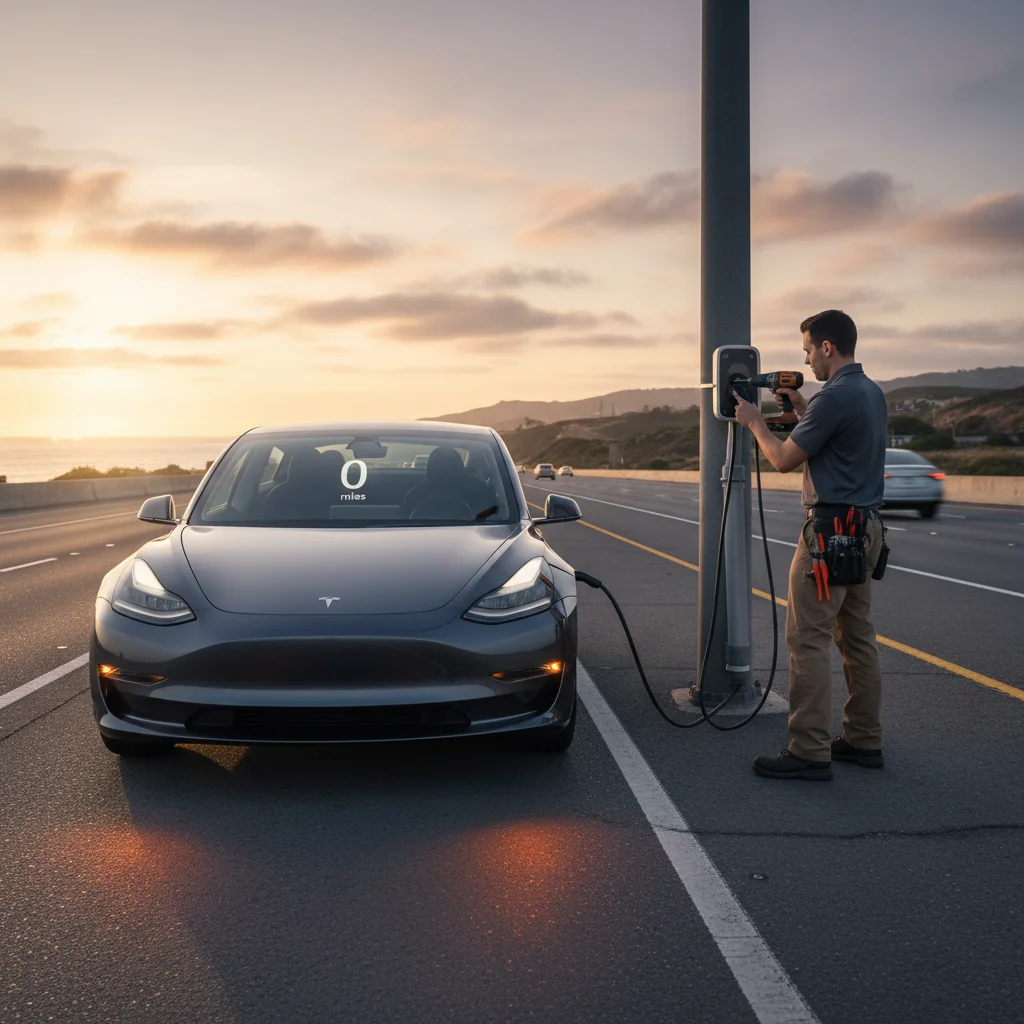
What to do the moment the warning fires
Six habits work in the moment when the low battery warning appears and you are still miles from the next charger:
- Slow down to 55 to 60 mph. Speed is the biggest range variable on a highway.
- Turn off the AC if you can tolerate the heat. Cabin cooling is one of the biggest draws on the battery. Open the windows for cross-ventilation.
- Avoid the right lane if there is a tailwind. Headwinds burn more energy.
- Pull into a shaded spot if you can. A hot pack is less efficient than a cooled one.
- End the navigation to the next charger and re-enter it. Tesla’s nav will reroute to a closer charger if one exists.
- If the warning is below 10 miles, do not take an exit that adds miles before reaching the charger.
These habits buy you time. They do not change the fundamental math: a Tesla that cannot reach the next charger needs help to make it.
Why Phoenix-area roads make it worse
Two factors make the math harder in Phoenix than in most other US cities:
- Heat derate. Phoenix averages about 111 days a year at or above 100F and about 21 days at or above 110F. Recurrent reports EVs can lose 20 to 30 percent of range above about 95F. AAA’s 2026 study found about a 10 percent efficiency drop and an 8.5 percent range loss at 95F versus 75F. A car that should make the next charger at 75F may not at 112F, especially with the AC running.
- Grade on the I-17. From Anthem, the Black Canyon Freeway climbs thousands of feet through New River and Black Canyon City toward Sunset Point (about 3,400 feet) and Cordes Junction (about 3,800 feet). Forum drivers on the I-17 climb report roughly 481 Wh/mi going up versus 293 coming down, about 40 percent more energy uphill. The nav often underestimates the climb.
The combination is what strands Phoenix-area drivers. A car starting the climb north of Anthem with single digits is not reaching Camp Verde without help.
What to do on a Valley freeway shoulder
Get the car as far off the travel lane as you can. Keep hazards on. ARS 28-871 says to leave the traveled part of a highway when you can. A vehicle that cannot be moved is exempt.
Have a location ready: mile marker, exit number, or landmark. The closer the pin, the faster an operator can find you. If you are on the I-10, the exit number is the best pin. If you are on the I-17, the mile marker is.
Stay in the car if that is safer. ARS 28-775 is the Move Over law. Approaching a stopped vehicle with flashing or warning lights, drivers must move over a lane if they safely can or slow down.
If you can safely exit and pull into a side street or shopping center, do that. Off-freeway stops are easier for the operator and safer for you.
What an operator does on the freeway shoulder
A mobile operator brings a portable 240-volt Level 2 source to where the car sits, plugs in with a native NACS plug, and adds real miles while you wait. A typical session adds about 10 to 20 miles of range in 15 to 30 minutes of charging. That is enough to reach the next charger you already meant to use.
For the broader picture on what mobile Level 2 adds at the car, see roadside Level 2 charging for stranded drivers and Tesla on-site charge or factory tow.
How the matching works on the I-10 or I-17
Charge Pro PHX is the referral line that matches you with an independent local operator. We do not own trucks, employ technicians, or set prices. The operator quotes before any work starts and bills you directly.
The I-10 runs through the heart of the Valley, so dispatch is short. The I-17 north of Anthem is a longer-haul dispatch. Ask about timing when you call.
For the matching model in detail, see mobile EV charging near me in the Phoenix area.
What DPS and ADOT will not do
Arizona DPS Roadside Motorist Assistance and ADOT’s Incident Response Unit are the two free motorist-help programs in the Valley. They change tires, bring gasoline or diesel, jump conventional batteries, and clear debris. Neither program advertises bringing an EV a charge. That gap is exactly what an independent mobile operator fills.
For the wider rundown on what DPS will and won’t do for a stranded EV, see Tesla flat tire coverage and the Arizona motorist help gap.
When a tow beats a charge on Valley roads
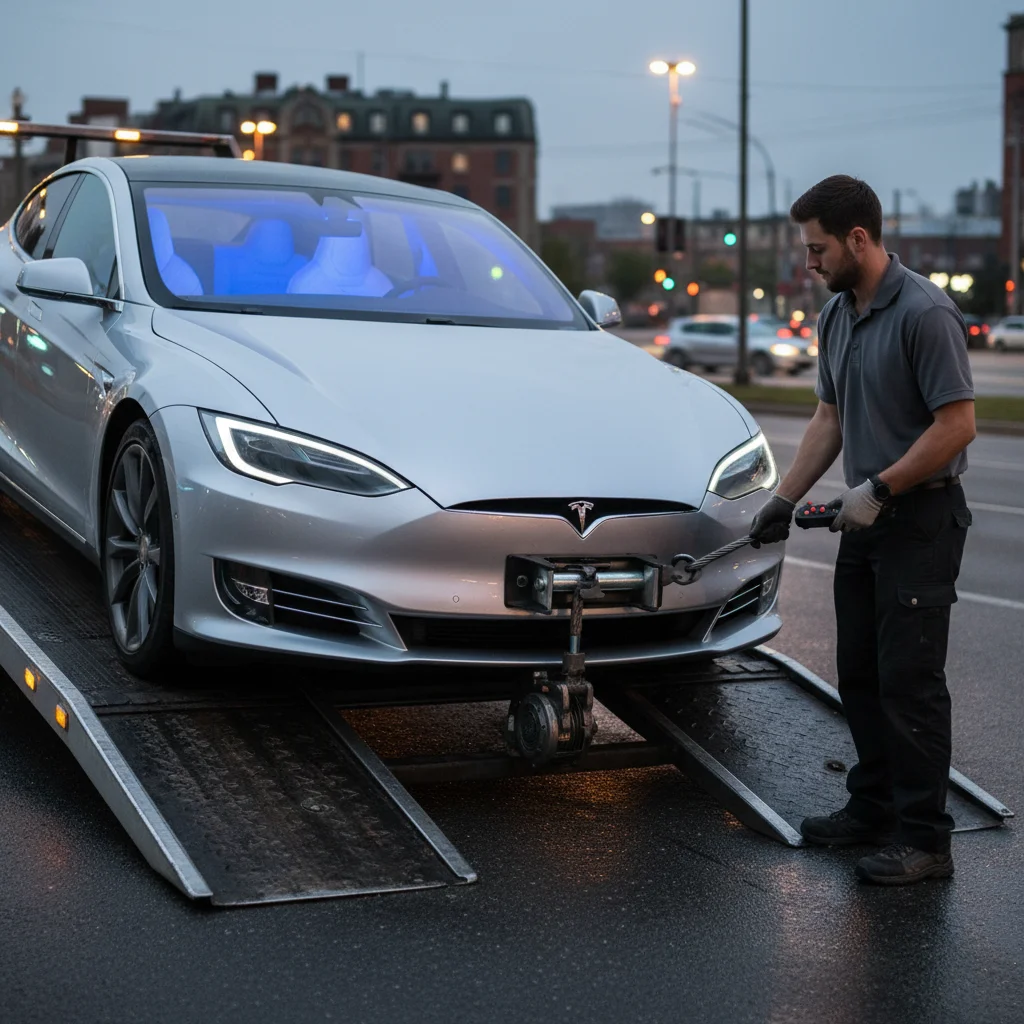
A tow is the right move when the traction battery has a physical fault, when the car will not wake after a 12-volt jump, when the charge port is damaged, or when the operator cannot safely run a generator on the freeway shoulder.
For the wider principle, see mobile EV charging vs a tow.
What to do if you are stuck on a Valley road right now
If your Tesla is at single digits on a Valley road right now, get the car as far off the travel lane as you can and keep hazards on. Have the nearest exit number, mile marker, or cross street ready.
Call (602) 932-0920. The operator quotes before any work starts and bills you directly.
Frequently asked questions
What should I do if my Tesla runs out of battery on the I-10 or I-17?
Get the car as far off the travel lane as you can. Keep hazards on. Call a mobile operator who can come to you with a Level 2 source and add enough range to reach the next charger.
Will Tesla roadside bring a charge to my car on a Valley freeway?
No. Tesla tows to the nearest Supercharger or service center for a fee in most cases. An independent mobile operator can bring a Level 2 charge to your car.
How much range does a mobile Level 2 visit add on a Valley freeway?
A typical session adds about 10 to 20 miles in 15 to 30 minutes of charging. That is charging time at the car, not travel time for the operator.
Does Charge Pro PHX cover the I-10 and I-17?
Yes. We match you with an operator who serves the corridor. The I-10 runs through the heart of the Valley, so dispatch is short. The I-17 north of Anthem is longer, so ask about timing when you call.