Phoenix drivers read the warranty for the same reason everyone else does, because something already felt off in the heat. A car sat in a Phoenix driveway for a week and would not wake. A daily driver in the East Valley watched the range estimate fall faster than the miles. The answer is the same one a driver in Maine or Florida would get. The traction-pack coverage is national. The reason anyone in the Valley bothers to read it is local.
What the warranty actually says
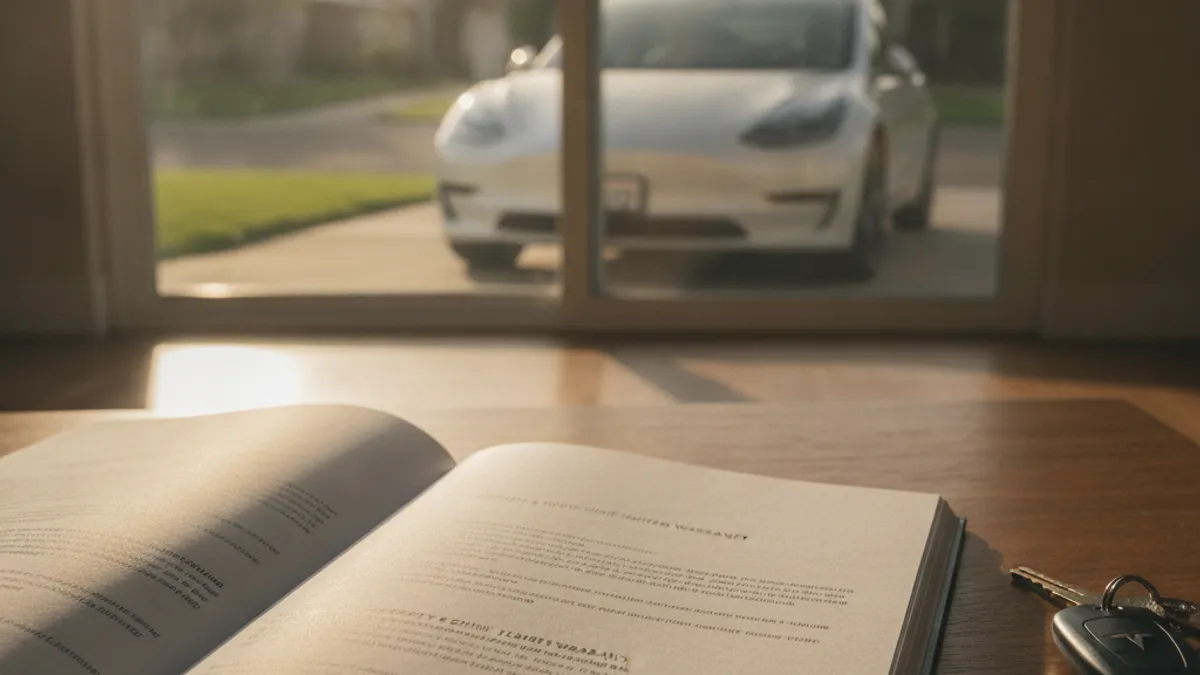
Tesla’s New Vehicle Limited Warranty was issued on June 5, 2025. It covers the high-voltage battery and drive unit on Model S, Model 3, Model X, and Model Y sold by Tesla. The terms are the same in every state, and they break down by model.
Model S and Model X carry 8 years or 150,000 miles, whichever comes first. That tier includes a minimum 70% battery capacity retention guarantee. Standard or Standard Range Plus Model 3 and Model Y get 8 years or 100,000 miles. Long Range or Performance Model 3 and Model Y carry 8 years or 120,000 miles. The VIN in the Tesla app controls. That document does not cover Cybertruck, which has its own terms. Confirm current coverage with Tesla before you plan a claim.
The key phrase across every tier is “defect.” The warranty covers defects in materials or workmanship. It does not cover ordinary wear, and it does not cover capacity loss that fits the published aging curve. That distinction matters more here than anywhere else, because heat changes what counts as ordinary.
What Phoenix heat is doing to the math
Phoenix averages about 111 days a year at or above 100F, and about 21 of those reach 110F or higher. Those figures come from NOAA 1991-2020 normals at NWS Phoenix. July highs sit near 107F, August near 105F, and overnight summer lows hang in the mid-80s. A pack on a north Phoenix driveway never really rests at night. The record high is 122F, set June 26, 1990.
Geotab studied vehicles in climates above 27C for more than 35% of days. Those packs degraded about 0.4% per year faster than packs in mild climates. Phoenix sits in that hot group. Recurrent, using 345,622 trips from 300 Phoenix-area EVs, reported 20 to 30% range loss above about 95F, with loss near 31% at 100F. AAA’s 2026 study found about a 10% efficiency drop at 95F versus 75F.
None of those numbers are defects. They are the chemistry and the air conditioning working in 110-degree conditions. A car that loses range in July is operating as designed. The warranty treats that loss as ordinary. The driver is the one who has to read the document carefully to know the difference.
What the warranty does not cover
Three Phoenix-shaped cases sit outside traction-pack coverage, and they are the ones that drive the calls.
Daily summer range loss. When Recurrent reports a Phoenix-area car losing 30% of range at 100F, that is a measurable effect, not a covered defect. The cabin cooling load is one of the biggest energy draws NREL tracks. A July commute that used to read 240 miles can read 180 miles on the dash. The pack is fine. The heat is just expensive.
Parked draw in a hot lot. Sentry Mode and Cabin Overheat Protection both pull power while parked. A week at Sky Harbor in the Terminal 3 garage, the Terminal 4 garage, or the East Economy lots is the parked extreme. Cars that sit unplugged for that long often will not wake. The traction pack can still be near full. What drained is the small 12-volt, and the traction warranty does not touch that battery. Read Why a Tesla 12-volt dies in desert heat for that pattern.
Capacity loss inside the published curve. Every battery loses some capacity with time. Tesla’s warranty triggers when the loss is unusual for the mileage and age, not when it matches the expected curve. A Model 3 in the Valley after three summers is on the expected curve. A claim based on the expected curve does not move forward. A car that drops suddenly below the curve is a different conversation.
The 12-volt is the gap most Phoenix drivers feel
The traction battery moves the car. The 12-volt wakes it up. The 12-volt runs the locks, the screens, and the contactor that connects the main pack. Kill the 12-volt and the car is bricked, even with a full traction pack and an active warranty.
Battery Council International, via Battery University, studied starter-battery life in heat. Those units lasted about 47 months in hot climates versus 59 in cool ones. A 12-volt that would last five years in a milder state can fail in two or three in the Valley. AAA calls heat the number-one cause of battery failure.
That failure sits outside the traction warranty. Tesla covers the 12-volt under a separate piece of the New Vehicle Limited Warranty for a shorter term, and a 12-volt that ages out of that window is on the owner. Read Why a Tesla 12-volt dies in desert heat for the pattern that drives it, and Replacing a Tesla 12-volt after Phoenix heat for the post-warranty visit.
Federal and state help that is no longer there
A few incentives that shaped the older purchase math are gone, and that shapes what drivers expect from a warranty today.
The federal clean-vehicle credit (the new-vehicle 30D credit and the used-vehicle 25E credit) ended for vehicles acquired after September 30, 2025. The federal exemption that let alternative-fuel plates drive solo in HOV lanes ended on that same date in 2025. Both are past tense now. A Phoenix driver buying a used Model 3 today does not get either benefit, so the warranty terms carry more weight than they used to.
Arizona does not run a state EV rebate or tax credit, and does not charge an annual EV registration surcharge. Arizona is one of about nine states with no EV fee in 2026, after a proposed 135-dollar fee did not pass. That keeps ownership flat, but it also means no state help if the warranty does not cover a heat-related failure. The state is neutral. The federal government pulled back. The warranty is what is left.
When a Phoenix stall is a charge, not a claim
A Tesla that will not move on a Valley shoulder is almost always one of two failures, and only one of them is a warranty conversation. The traction pack can be empty, with a 12-volt battery that still works. That car needs a Level 2 source at the vehicle. An independent operator brings a 240V source to the charge port. Teslas take a native NACS plug. Typical charging time adds 10 to 20 miles in 15 to 30 minutes at the car. That is charging time, never an arrival time.
The other failure is the dead 12-volt. The screens are dark, the handles will not present, and a full traction pack sits underneath doing nothing. A jump wakes it. An on-site 12-volt replacement is a different visit. Charge Pro PHX is a referral line, and the pros we send can jump or swap the 12-volt on the spot, or add a Level 2 charge to the traction pack. The operator quotes before any work starts and bills the driver directly. We do not perform licensed work, hold a warranty, or file a claim for you.
For the warranty path, Tesla service in Phoenix handles traction-pack cases that qualify. The on-site emergency path is the mobile operator. See Tesla roadside rescue in Phoenix for the matched-operator visit, and Mobile EV charging in Phoenix for an empty pack for the Level 2 visit. The 12-volt jump sits at Tesla 12-volt jump in Phoenix.
If the empty pack came from a longer run, an out-of-charge recovery is the closer match: Out-of-charge recovery in the Phoenix area. For a one-time stall on a Valley shoulder, the FAQ at /faq/ covers the most common follow-up questions.
Frequently asked questions
Does Phoenix heat void Tesla’s battery warranty?
No. Heat ages the pack a bit faster. Geotab’s extra 0.4% per year in hot climates is the measured gap. That is ordinary wear, not a voided warranty. A sudden drop below the published curve is a defect claim, regardless of climate.
Is the 12-volt battery covered separately?
Yes. The 12-volt is covered under a different part of the New Vehicle Limited Warranty for a shorter window. A 12-volt that ages out of that window in the Valley, which heat can do in two to three years, is on the owner.
Does the warranty cover range loss in summer?
No. Range loss in heat is the air conditioning and the chemistry working as designed. Recurrent’s 20 to 30% loss above 95F is the expected behavior, not a defect. The warranty triggers on unusual loss, not on summer.
If your Tesla will not wake on a Valley road, call (602) 932-0920. Charge Pro PHX will match you with a local independent operator for the on-site jump or charge. For a warranty question, Tesla service handles the claim.