Tesla doesn’t publish what a traction battery costs to replace. People searching how much is a Tesla battery want a number. Phoenix heat changes how the pack ages. It doesn’t create a public price list. Geotab studied cars in climates above 27C for more than 35% of days. Those packs degrade about 0.4% per year faster than mild-climate packs. NWS Phoenix normals put this metro in that hot group. About 111 days a year hit 100F or more. About 21 days hit 110F. A full pack swap still belongs at Tesla service or a qualified shop.
This search often means the small 12-volt
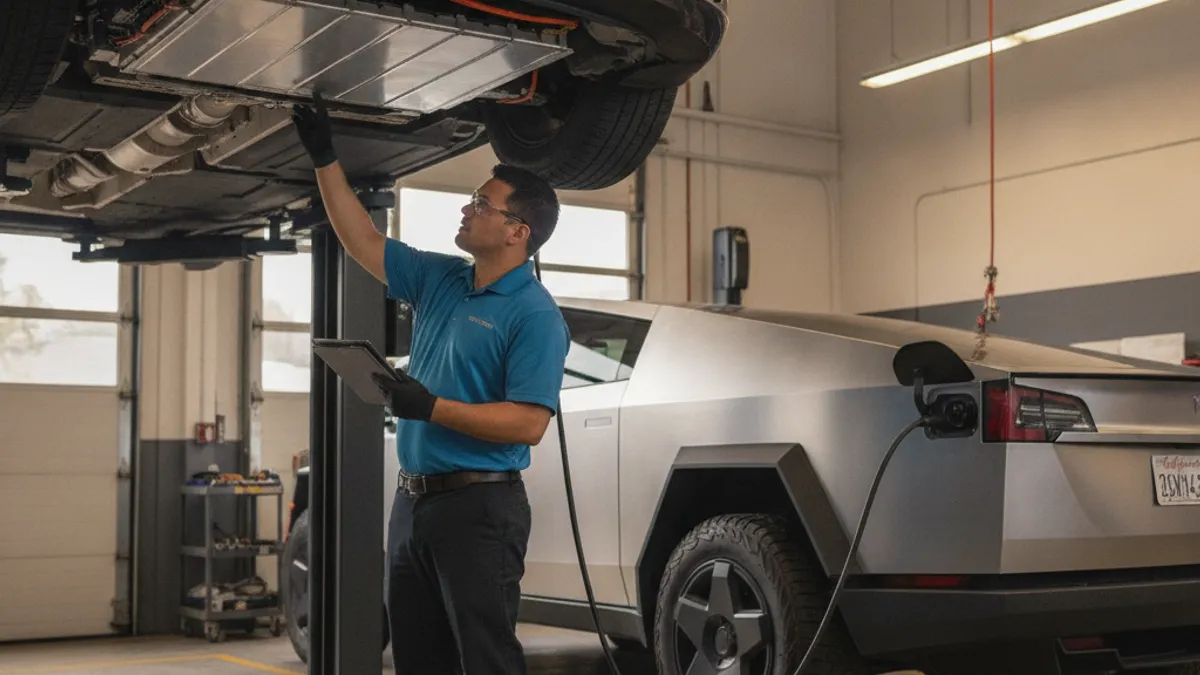
The floor pack stores the energy that moves the car. The 12-volt runs locks, the screen, and the wake contactor. Kill the 12-volt and the car looks fully dead. The traction pack can still be charged. That’s the stall after a hot parked afternoon in Phoenix or Mesa. Battery Council International, via Battery University, timed starter batteries in heat. They lasted about 47 months in hot climates versus 59 in cool ones. A battery good for five years elsewhere can fail in two or three here. AAA calls heat the number-one cause of battery failure. If the car won’t power on, read Tesla won’t wake: 12-volt failure or the high-voltage pack.
Daily range loss isn’t a dead floor pack
July highs average near 107F, and August near 105F. Overnight summer lows hang in the mid-80s, so a pack never really rests. The record high is 122F, set June 26, 1990. Recurrent used 345,622 trips from 300 Phoenix-area EVs. It reported 20 to 30% range loss above about 95F. Loss sat near 31% at 100F in that set. AAA’s 2026 study found about a 10% efficiency drop at 95F versus 75F. Don’t treat those as Tesla’s own numbers. We couldn’t confirm a Tesla range-loss figure from tesla.com. Geotab’s extra 0.4% a year is slow chemical wear. It isn’t a sudden failure on Loop 101. Read How long Tesla batteries last in Phoenix heat as of 2026 for that clock.
New Gilbert streets aren’t old Sun City blocks
Gilbert’s housing stock is young by Valley standards. About 4.1% of homes were built before 1980. Maricopa, the city in Pinal County, is about 1.9% that old. Overnight Level 2 is common on those new streets. APS markets R-EV as EV Overnight Charging, 11pm to 5am weekdays. SRP’s Electric Vehicle Price Plan closed to new enrollment after a February 2025 board decision. Existing SRP customers may stay through the November 2029 billing cycle. APS and SRP split many Valley blocks, so confirm your address. Sun City is a census-designated place, not a city. About 88.9% of its housing predates 1980. More of those cars sit on older streets and public plugs. A pack on home Level 2 still sits hot at midnight. Using DC fast charging as your only plug adds extra heat cycles.
Tesla doesn’t post the replacement number
There’s no Tesla menu price for a high-voltage pack we could verify. Nothing you can take to a cashier turned up. Owner screenshots online aren’t a quote for your VIN. Model S and Model X packs are larger than Model 3 or Y packs. Labor and the exact failure change whatever Tesla bills. Whether a section can be repaired instead of swapped is a shop diagnosis. Charge Pro PHX doesn’t set those prices. We’re a referral line for stranded drivers across the Phoenix area. Independent operators quote you before they start, then bill you directly. Ask Tesla service, or a qualified independent EV shop, after they inspect the car.
Check the warranty before you assume you’re paying
Tesla’s New Vehicle Limited Warranty is dated June 5, 2025. It covers the high-voltage battery and drive unit. That applies to Model S, 3, X, and Y sold by Tesla. Model S and Model X are covered 8 years or 150,000 miles, whichever comes first. That coverage includes a minimum 70% battery capacity retention. Standard or Standard Range Plus Model 3 and Model Y get 8 years or 100,000 miles. Long Range or Performance Model 3 and Model Y get 8 years or 120,000 miles. Your VIN in the Tesla app still controls. That PDF doesn’t cover Cybertruck. Confirm current terms with Tesla before you plan a swap. Ordinary expected degradation isn’t the same as a defect. Read What Tesla’s battery warranty covers, and what heat doesn’t for the heat limits.
A dead car on a Valley shoulder is usually the 12-volt
A week in a Sky Harbor garage is the parked extreme. Level 2 charging is confirmed in the Terminal 3 and Terminal 4 garages. It’s also at the 24th St. station. Cars that sit unplugged often won’t wake, even with a full pack. Northbound I-17 through Anthem, New River, and Black Canyon City is a grade, not pack death. Arizona DPS Roadside Motorist Assistance will jump a 12-volt. Published materials don’t mention charging an empty EV. Tesla roadside tows toward a Supercharger or service center. It doesn’t charge you on the shoulder.
If the car won’t wake, treat the 12-volt first. Replacing a Tesla 12-volt after desert heat, without surprises covers that smaller job. The operators we connect you with can jump or replace a dead 12-volt on site. They can also bring a 240V Level 2 source to the car. Typical charging adds 10 to 20 miles in 15 to 30 minutes of charging. That’s plug time, never an arrival promise. See EV rescue vs repair in the Phoenix area: which call to make for that split. For a car that won’t roll, start with Tesla roadside rescue. If you’re on the traveled lanes, ARS 28-871 says move off when you can.
Frequently asked questions
How much is a Tesla battery to replace out of warranty?
Tesla doesn’t publish a public traction-pack price. Ask Tesla service or a qualified EV shop for a VIN quote. Forum numbers aren’t your bill.
Does Phoenix heat void Tesla’s battery warranty?
Heat is why packs wear a bit faster here. Geotab’s extra 0.4% a year is the measured gap. Confirm coverage in the Tesla app for your VIN. Ordinary aging isn’t automatically a paid replacement.
Is a Tesla battery the same as the 12-volt?
No, the 12-volt and the traction pack are different repairs. The 12-volt is the small battery that wakes the car. The traction pack is the floor battery that moves it. A dead 12-volt is the common roadside stall.
If your Tesla won’t wake on a Valley road, call (602) 932-0920. You’ll be matched with a local independent operator.