Search EV service in the Phoenix area and you hit two jobs. One is a shop visit for a car that still drives. The other is getting a dead car moving on the road. Rescue is that second job. Repair is the first. Charge Pro PHX is a referral line. We match stranded drivers with independent local operators. The operator quotes you, bills you, and doesn’t repair the car.
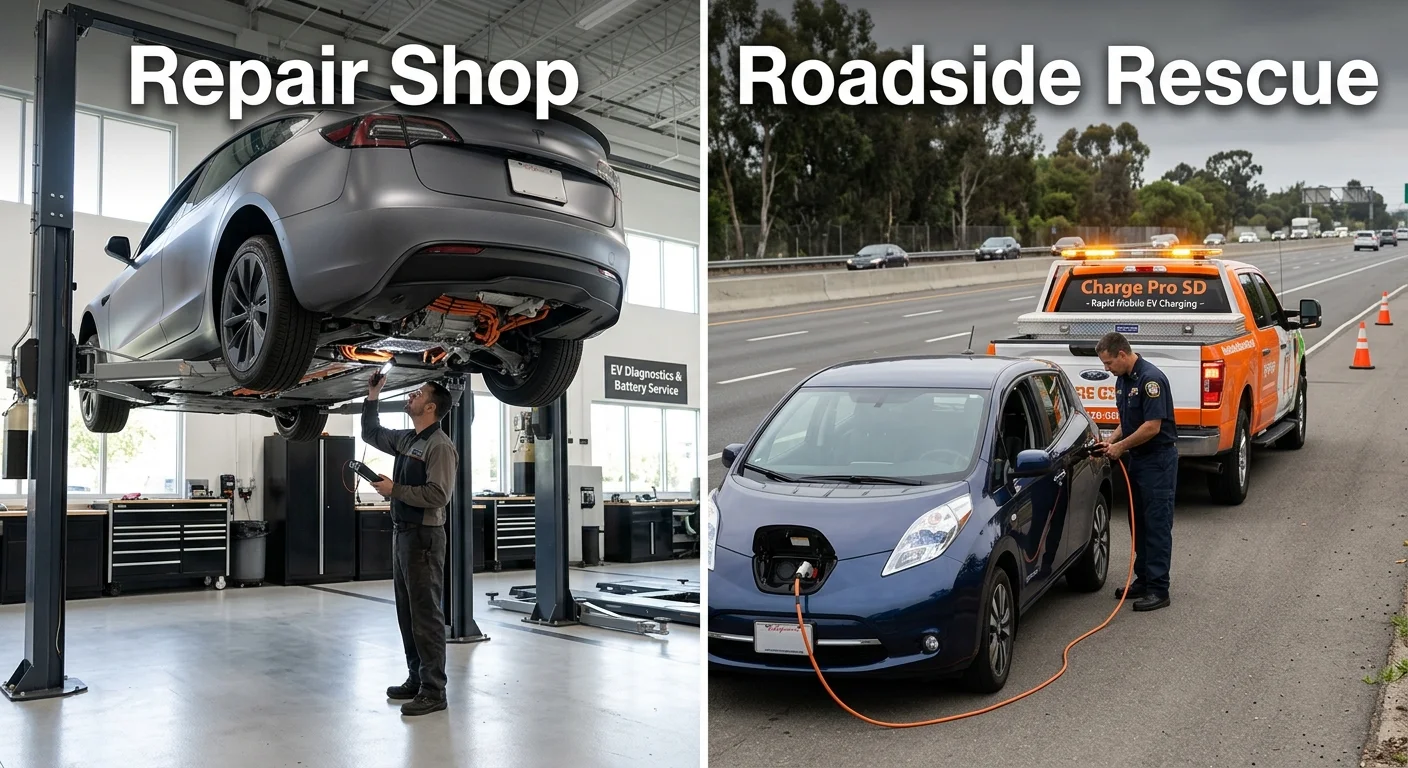
The search mixes two kinds of help
EV service is a wide phrase. Dealerships, body shops, and tire stores all show up. Roadside pages show up too. That mix wastes time when you’re already stuck. A shop needs a car that can roll in, or a tow into a bay. Rescue happens where the car sits. Different tools, different people, different bill.
Phoenix, Mesa, Tempe, and the East Valley all have shops. You still have to pick the right call. If the screens work and the car rolls, you’re in shop territory. If the doors won’t wake or the pack is empty, you’re in rescue territory.
Shop work is scheduled, not a shoulder job
An EV still needs service. Brakes, tires, cabin filters, and coolant loops live at a service center. Software updates belong there too. So do warning lights that stay on. Odd noises belong in a bay. A home charger that fails for days belongs there as well. Warranty claims need a dealer, not a truck.
If you can drive to a dealer, do that. Tempe, Scottsdale, Gilbert, and Chandler all have service centers. Book the appointment and bring the car in. That’s repair.
EVs skip oil changes. They still need inspections. Arizona has no annual safety inspection. EVs are also exempt from Maricopa County emissions tests. That doesn’t mean skip the shop. Heat still cooks 12-volt batteries, tires, and cabin filters.
Don’t call a referral line for a rattle. Don’t call for a recall. Don’t call for a main-battery diagnosis. The operator who shows up can’t open the high-voltage pack. They can’t flash software. They can’t honor a factory warranty.
Rescue is for a car that won’t move
Rescue starts when you can’t drive. The pack hit zero on I-10. The 12-volt died in a Sky Harbor garage after a trip. The car is silent in Phoenix after a Suns night at Mortgage Matchup Center. Those are roadside jobs.
EV roadside assistance here means an independent operator comes to the car. They quote before they start. They bill you directly. Charge Pro PHX doesn’t own trucks. It doesn’t employ technicians. It doesn’t set the price.
What they can do on site is narrow, and that’s the point. Mobile EV charging brings a 240-volt Level 2 source to the car. Tesla owners get a native NACS plug. Other brands use a CCS or J1772 adapter. Typical charging time is 15 to 30 minutes. That window is charging time, not a promise of when anyone arrives. You usually pick up about 10 to 20 miles of range. That’s enough to resume a trip toward a charger you already had in mind.
If the 12-volt is the problem, the main battery can still be full. The small battery runs the handles, screens, and the main pack switch. When it dies, the car is a brick. A Tesla 12-volt jump on site can wake it. Replacement on site is also in that toolkit when the cell is cooked. Phoenix heat is hard on those batteries. In hot climates they often fail in two or three years, not five.
They don’t rotate tires the way a shop would. They don’t replace a main battery. They don’t chase a climate-control bug. If you need a tow to a dealer after the jump, say so. The operator can help you think through charge, jump, or tow. They still won’t repair the car.
Valley heat changes which call you make
Phoenix averages about 111 days at or above 100F. About 21 days hit 110F or more. July highs sit near 107F. That load hits range and the 12-volt at the same time.
AAA’s 2026 study found about a 10% efficiency drop at 95F versus 75F. Range loss in that study was about 8.5%. Recurrent reported 20 to 30% range loss above about 95F in Phoenix-area trips. Loss was near 31% at 100F. Cabin cooling is a real draw. Northbound I-17 toward Anthem and Black Canyon City has posted 6% grades. The Beeline toward Payson posts 7% into Slate Creek Canyon. US-60 east of Apache Junction climbs toward Superior. The I-17 climb often takes about 40% more energy than the descent.
None of that is a shop diagnosis. It’s why an empty pack on a shoulder is common in summer. A week in a Sky Harbor garage can drain the 12-volt too. Terminal 3 and Terminal 4 garages have Level 2 charging. So does the 24th St. station. Sentry Mode and Cabin Overheat Protection draw power while a Tesla sits. The small battery only recharges while the car is on or plugged in.
Monsoon season runs June 15 to September 30. Stay out of floodwater. Rescue still isn’t a repair.
State help and factory help aren’t a mobile charge
Arizona does run free motorist programs. Neither one advertises charging an EV.
Arizona DPS Roadside Motorist Assistance can change a tire. It can bring gasoline or diesel. It can jump a dead 12-volt, add water, and call a tow. Its published materials name gasoline and diesel. They don’t mention EV charging or an empty main pack. ADOT’s Incident Response Unit works Phoenix-area freeways from 5am to 8pm on weekdays. It clears crashes and debris, changes tires, and helps stranded motorists. It also doesn’t advertise an on-site EV charge.
Factory roadside is its own path. Tesla roadside versus a local rescue is a common mix-up. Tesla tows an empty pack to a Supercharger or service center. It isn’t a charge at the car. Ford’s pattern is a tow to a charger, home, or dealer. Rivian and Hyundai/Kia owners often have to ask for a tow. Power at the bumper means a mobile operator, not a factory dispatcher.
ARS 28-871 says get off the traveled lane when you can. A car that can’t move is exempt. On the shoulder, ARS 28-775 asks other drivers to move over or slow down. Keep your flashers on. Stay out of the travel lane if you can.
How the referral call actually works
You call. We match you with an independent operator who can reach you. That person quotes the job before they start. You accept or you don’t. They bill you. Charge Pro PHX isn’t the shop, and this isn’t a repair.
How mobile EV charging is quoted is a separate question from shop labor. Shop labor is hours on a lift. Rescue is a truck, a Level 2 source, and time on the cable. Don’t mix the two when you compare options.
Operators handle Tesla and every major EV brand. Native NACS for Tesla. CCS or J1772 adapters for the rest. If you aren’t sure which port you have, say the make and model. They’ll bring the right plug.
After a charge, you drive. You leave with enough range to keep going. Or you leave with a 12-volt that can wake the car. If it dies again a block later, that’s information. It often means the 12-volt can’t hold a charge and needs replacement. Or the pack was closer to empty than the display said. It still isn’t a reason to treat the operator as a dealer.
A 30-second test before you dial
Run three checks.
The car can roll under its own power. If it can, and you aren’t in a live lane, a shop is the next step. Drive there if it’s safe. A warning light on a car that still moves belongs in a bay.
Screens are dark, handles are dead, and the pack still shows charge. That’s a 12-volt failure until proven otherwise. Rescue first. Shop later if the battery keeps dying.
The main pack is at zero, or so low the car won’t go into drive. That’s an out-of-charge recovery. A mobile Level 2 charge is the on-site option. A tow to a charger is the other. State motorist help won’t bring you a charge. Factory help may only tow.
On I-17, Loop 101, Loop 202, or US-60, get onto the shoulder. Then make the call that matches the test.
For a car that still drives, call the dealer or an EV shop. For a car that won’t move, call Charge Pro PHX at (602) 932-0920. We connect you with an independent operator. They quote. They bill. They don’t repair the car.