A Chevy Blazer EV that won’t start after a parked 100F day is the 12-volt. It’s almost always that small battery, not the Ultium pack. The traction battery can still show miles in the myChevrolet app. Door handles, the center screen, and the high-voltage contactors all run on the 12-volt. When it dies, the car won’t boot. Phoenix averages about 111 days a year at or above 100F. About 21 of those reach 110F or more. July highs sit near 107F. August averages near 105F. Overnight summer lows still hang in the mid-80s. Leave the crossover in that heat, and the accessory battery is what quits.
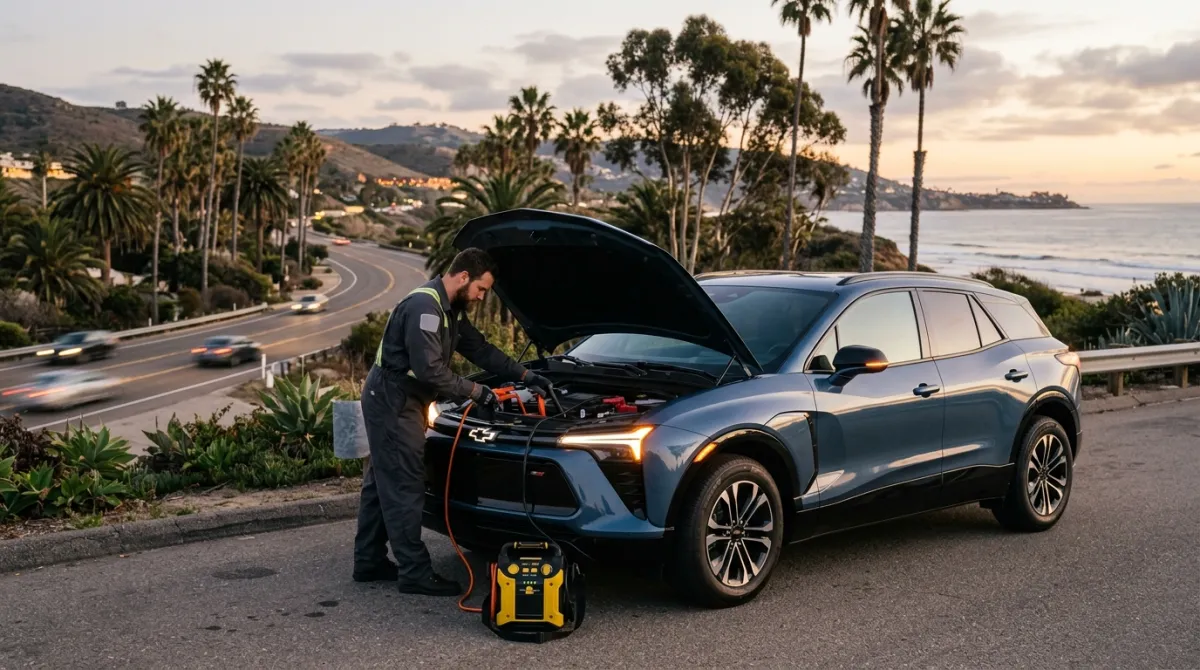
Heat is why the small battery dies first
Every production EV runs two electrical systems. The Ultium traction pack turns the motors. A conventional 12-volt battery runs everything else. Locks, screens, and body modules pull from that small battery. So do the computers that connect the high-voltage pack. A dead 12-volt strands you even with a full main pack.
Desert heat shortens that accessory battery. Battery Council International work, via Battery University, found a clear climate split. Starter batteries last about 47 months in hot climates. They last about 59 months in cool ones. A five-year battery in a mild city can fail in two or three here. AAA calls heat the number-one cause of battery failure. AAA also recommends AGM batteries for hot areas. The DC-DC converter recharges the 12-volt only while the car is on or charging. Parked through a 100F afternoon, that little battery just sits in a hot front trunk.
The Chevy Equinox EV and the Cadillac Lyriq share the Ultium platform. They fail the same way after a hot park. If your household has another GM EV, start with the Equinox EV no-start notes. The Lyriq 12-volt guide covers the same family.
Read the cabin before you assume the pack is empty
A dark interior after a workday looks like an empty pack. Check the app first, if it still pairs. A normal state of charge with a dead cabin is the 12-volt.
No screen, no dome light, fob silent: the 12-volt is fully down.
Doors unlock, screen stays black: the 12-volt is low, not gone. A jump pack is the next try.
Screen flashes on, then off, then on again: modules are looping. Try the 12-volt power cycle below.
Screen loads, a service warning stays, Ready never holds: that’s an Ultium fault. A jump may wake the screen. It may not clear the fault.
Charge-port lock icon and no Ready: the latch is holding you out of drive. Work the port before you blame the battery.
Don’t start with a tow. A tow fits a car you can’t move. It also fits a high-voltage fault a dealer has to scan. After a 100F park, a dark Blazer EV is usually a 12-volt job.
The 12-volt lives in the frunk
There’s no engine bay. The auxiliary battery sits in the front trunk under a plastic panel. Gas-car habits send people to the wrong end of the vehicle.
If the 12-volt still has a little charge, the frunk should open. Use the interior release or the key fob. If it’s fully dead, the latch is electric. You’ll need the manual emergency release in the owner’s manual. Read that procedure in your book before you force anything. Latch steps can vary by year. This article isn’t a substitute for the manual.
Jump points are a dedicated bus bar in that front compartment. They’re separate from the battery posts. The positive post has a red cap. The negative is a chassis bolt nearby. Clip the jump pack to the bus bar, not onto the battery itself. Wait 60 to 90 seconds before you press start. Modules need that pause to sequence. You’ll hear relays click. Then try Ready.
Heat-day jumping steps live in how to jump start an electric car in desert heat.
If it starts, don’t call it fixed. Heat-killed 12-volts often die again after the next parked day. Have the battery tested. If it fails a load test, replacement is the repair. Another jump is only a delay. Catch signs the 12-volt is on its way out before the next lockout.
Software hangs that mimic a dead battery
Early Blazer EV builds had a messy launch. In late 2023 and into 2024, GM issued a stop-sale on new inventory. Software could cause no-starts, unexpected power losses, and failed charge sessions. GM pushed over-the-air updates. Ask a Chevrolet dealer whether your VIN has the remediation. A blog post can’t check that for you.
A battery-management hang looks different from a silent 12-volt. The center display may power, then cut. Ready may appear, then drop before you can move. You might get “Service EV System” or a high-voltage charging warning. The myChevrolet app still shows a normal charge. The car still refuses to drive.
The field reset owners use is a full 12-volt power cycle. Open the front compartment. Disconnect the negative terminal. Leave it off for two full minutes. Reconnect. Wait for the relay clicks. Try a normal start. That clears volatile memory in the body modules. It lets the battery-management system initialize from scratch. It clears a lot of software hangs without tools.
If high-voltage warnings stay after that cycle, stop. That’s a dealer diagnostic. Don’t force a charge session on a Blazer EV that’s showing active Ultium faults.
A stuck charge-port latch can also block Ready. If the port icon says locked, use the manual release in the owner’s manual. Then retry.
Where Valley drivers actually meet this no-start
Airport week is the textbook case. Phoenix Sky Harbor parks cars in the Terminal 3 and Terminal 4 garages. Terminal 3 has Level 2 charging on Level 1 west, Level 3, and Level 7. Terminal 4 has it on Level 4 east, zone B. The 24th St. station has it too. EVPassport installed charging at Sky Harbor in 2022. None of that wakes a 12-volt that sat a week in a hot garage. You land. The cabin is dark. The pack may still show range. That’s the accessory battery. The same pattern shows up in our Sky Harbor dead-EV notes.
Long event sits do the same thing. Chase Field downtown holds Diamondbacks nights. Mortgage Matchup Center, renamed in October 2025, holds Suns and Mercury games. Arrive with a tired 12-volt and sit through extra innings. The car can refuse to wake when the lot empties.
Commute geography matters for where you wait. Loop 101 is Agua Fria on the west. It’s Pima on the northeast and Price on the southeast. US-60 is Grand Avenue going northwest and the Superstition Freeway going east. Those are different segments of one numbered route. If the Blazer EV dies in gear, get off the traveled lanes if you can.
A driveway no-start after a parked afternoon is still the 12-volt. Older West Valley housing sees a lot of that parked-day pattern. Newer East Valley and Pinal suburbs charge at home more often. The call there is often at work. Maricopa the city sits in Pinal County, not Maricopa County.
Northbound I-17 is a different failure. ADOT posts a 6% maximum grade on the northern climb. That’s a range problem for a low pack. It isn’t why a Blazer EV won’t start in a Phoenix stall after lunch. Don’t mix an empty traction pack with a cooked 12-volt.
What Arizona motorist help will do, and what it won’t
Arizona runs free motorist help.
Arizona DPS Roadside Motorist Assistance changes tires, brings gasoline or diesel, and jump-starts dead batteries. In 2018 it assisted 75,235 motorists statewide. Its published materials name gasoline and diesel. They say nothing about charging an EV. Hours and specific corridors aren’t published. Ask DPS what they can do on your stretch if you reach them.
ADOT’s Incident Response Unit covers Phoenix-area freeways from 5am to 8pm weekdays. It’s a 14-member unit, sponsored by State Farm since 2020. It clears crashes and debris, changes tires, and helps stranded motorists. No EV-specific mention.
The state may jump a 12-volt. Neither program advertises bringing a Blazer EV a charge. Independent mobile operators fill that. Charge Pro PHX is a referral line. It matches stranded drivers with those operators. It holds no license, owns no trucks, and employs no technicians. It doesn’t set prices or publish hours. The operator quotes you before starting and bills you directly. The pros we connect you with are licensed and insured.
If you’re outside a business or residence district, ARS 28-871 still applies. Don’t sit on the traveled part of a highway when you can get off it. A vehicle disabled so badly it can’t be moved is exempt. When you’re stopped, leave room for other traffic. Stay visible 200 feet in each direction. Hazards on. As far right as you can get.
ARS 28-775 is Arizona’s Move Over law. Approaching a stopped vehicle with warning lights, move over a lane if you can. Otherwise slow down. That’s for the person working your car on the shoulder, and for you.
Empty pack versus dead 12-volt
Jumping the 12-volt adds no miles. If the app shows zero, you need energy in the Ultium pack. Same if you drove until the car limited power.
Carmaker roadside is mostly a tow. Tesla won’t charge on site. It tows to a Supercharger or service center. Ford tows to the nearest charger, home, or dealer within 50 miles. Independent operators who take non-Tesla EVs can bring a 240-volt Level 2 source. They use CCS, or a J1772 adapter if that’s what the car wants. They typically add 10 to 20 miles in 15 to 30 minutes of charging. That’s charging time. It isn’t an arrival time. Charge Pro PHX doesn’t promise when someone shows up.
If that’s the call, non-Tesla EV rescue is the matching path for GM CCS cars. A 12-volt jump is a different job from a pack fill. Tell the operator which one you’re looking at. They quote before they start.
Charge Pro PHX matches you with an independent operator. Call (602) 932-0920. The operator can jump a 12-volt and bring Level 2 to a CCS Blazer EV. You get a quote before work starts.
Frequently asked questions
How do you jump a Chevy Blazer EV
Open the front trunk with the interior release or the fob if it still works. Under the plastic panel, find the jump bus bar. Clip positive to the red-capped post. Clip negative to the nearby chassis ground. Don’t clamp the battery posts themselves. Wait 60 to 90 seconds, then press start. If the frunk won’t open, use the manual release in the owner’s manual. Confirm those steps in your book.
Does a dark screen mean the Ultium pack is dead
Usually no. The center display runs on the 12-volt, not the traction pack. A black screen with no dome light means the accessory battery is down. The Ultium pack can still hold a normal charge. Check the myChevrolet app if it connects. A jump on the front bus bar is the usual fix after a hot park.
Can a Blazer EV refuse to start with a full charge
Yes. A body-module fault can block Ready even when the app shows a full pack. Early Blazer EV builds had documented no-starts like that. Disconnect the 12-volt negative for two minutes, reconnect, and retry. If the fault stays, it’s a Chevrolet dealer scan. Ask whether the 2024 software remediation is on your VIN. This page can’t verify that.