When a Chevy Equinox EV won’t start here, the small 12-volt is usually why. That battery runs the door handles, the screens, and the pack’s contactor. The drive battery can still hold plenty of range. The car stays dark until the 12-volt wakes those systems. Phoenix-area heat is hard on that little battery.
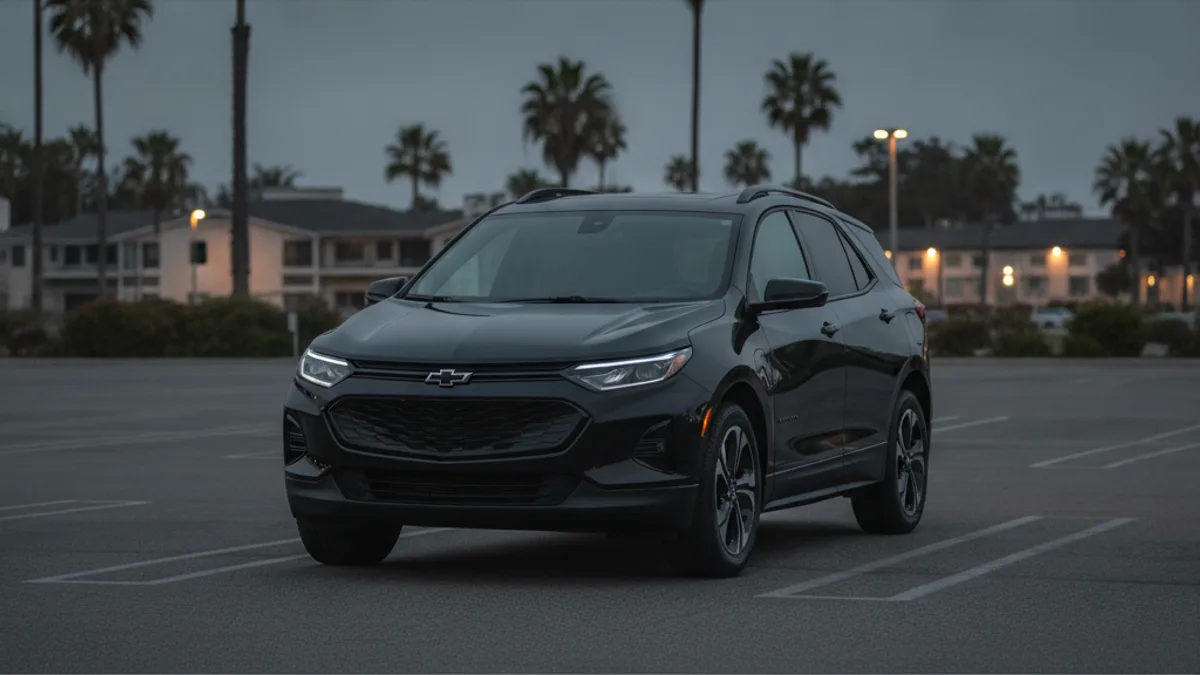
The 12-volt is what wakes an Equinox EV
The Equinox EV runs two electrical systems. A high-voltage Ultium pack turns the wheels. A separate 12-volt AGM battery boots every computer the pack needs. If that 12-volt is dead, the fob stays silent. The dash stays black, and drive won’t engage. Yesterday’s range number won’t save you.
Door handles need the 12-volt, and so do the screens. So does the contactor that closes the high-voltage circuit. A full Ultium pack behind a dead 12-volt can’t connect. The DC-DC converter recharges that battery only while the car is on or charging. Parked in the sun with everything off, the 12-volt sits alone.
This isn’t a charging-session fault. If the car powers on but won’t take a charge, use that guide instead.
Valley heat is rough on this battery
Phoenix averages about 111 days a year at or above 100F. About 21 days reach 110F or more. Those figures come from NOAA’s 1991-2020 normals. July highs average near 107F, and August sits near 105F. Overnight summer lows often stay in the mid-80s. The battery rarely gets a cool rest.
Battery Council International work, via Battery University, put hot-climate starter batteries at about 47 months. Cool-climate batteries lasted about 59 months. A five-year battery in a mild city can fail in two or three here. AAA names heat as the top cause of battery failure. It recommends AGM batteries for hot regions. The Equinox EV already uses an AGM 12-volt. The climate still shortens it.
Heat also trims traction range, which confuses the diagnosis. AAA’s 2026 study found about a 10% efficiency drop at 95F versus 75F. Range fell about 8.5% in that test. Recurrent used 345,622 trips from 300 Phoenix-area EVs. It saw 20 to 30% range loss above about 95F. Loss was near 31% at 100F. A low pack still usually wakes the screens. A dead 12-volt doesn’t. Don’t mix those two failures.
Short trips make the 12-volt weaker. Errands in Tempe around ASU may never give the DC-DC a long run. Mesa and Chandler trips can be just as short. Gilbert, Queen Creek, and San Tan Valley have a lot of home charging. The 12-volt still dies after a workday in a hot lot. Overnight charging on APS’s R-EV plan runs 11pm to 5am weekdays. That keeps the car plugged in so the small battery can recover. SRP’s Electric Vehicle Price Plan is closed to new enrollment as of February 2025. Existing SRP customers may stay through the November 2029 billing cycle. Confirm your utility at your own address. APS and SRP split some cities block by block.
The Equinox EV shares Ultium hardware with the Blazer EV. That model fails the same way. For that checklist, read Chevy Blazer EV won’t start: the 12-volt checklist.
What a true no-start looks like
An Equinox EV that’s only low on range still usually wakes. You’ll see a low-battery warning, and the screens still come up. You can often select drive. You just won’t get far. A dead 12-volt feels like the car was switched off at the source. You get no chime, no cluster, and no fob. You might not even get neutral.
Some Equinox EVs show a warning first. Drive to a Chevy dealer while you still can. Others go from a normal commute to a silent brick. Either way, treat the small battery as the first suspect. A dark car isn’t proof the Ultium pack failed.
A dead 12-volt also locks the car when handles have no power. That’s why the liftgate blade matters.
Where this shows up around the Valley
Airport parking is the version that ruins a trip home. Leave an Equinox EV in a Sky Harbor garage for a week. The 12-volt may not wake when you return. Terminal 3 and Terminal 4 garages get very hot. Level 2 charging is confirmed in the Terminal 3 garage. You’ll find it on Level 1 west, Level 3, and Level 7. It’s also in the Terminal 4 garage on Level 4 east, zone B. Plug in if a stall is open. That keeps the DC-DC alive so the small battery can recharge. An unplugged week in that heat is a classic no-start.
Event lots cook the same battery. It happens after a long Diamondbacks night at Chase Field. A Suns or Mercury game at Mortgage Matchup Center does the same. So does surface parking at Phoenix Raceway in Avondale on a race weekend. The car sits, modules nap, and the 12-volt ages in the heat.
West Valley streets in Sun City and Youngtown see long parked days. About 88.9% of Sun City housing was built before 1980. Cars rest in driveways through 110F afternoons. Glendale, Arizona and Peoria, Arizona add Loop 101 Agua Fria commutes. Scottsdale lots off Loop 101 Pima bake the same way. After hours in a sun-baked work lot, the fob may do nothing. Surprise, Goodyear, and Buckeye sit on APS service and the same desert heat.
On the shoulder it hits at a bad time. It shows up on I-10 through central Phoenix. It shows up on Loop 202, and on US-60 through Mesa. That’s the Superstition Freeway segment of US-60. Northbound I-17 toward Anthem and New River is another. Farther up that climb, ADOT posts a 6% maximum grade. You may still have range shown from the last drive. You still aren’t moving if the 12-volt is down.
Arizona does run free motorist help. DPS Roadside Motorist Assistance can change a tire and bring gasoline or diesel. It can also jump a conventional battery. Its published materials don’t mention charging an EV. ADOT’s Incident Response Unit covers Phoenix-area freeways from 5am to 8pm on weekdays. It clears crashes and debris and helps stranded drivers. It doesn’t advertise an on-site EV charge. A mobile operator jumps an Equinox EV 12-volt on site. The same operator can bring Level 2 energy to the CCS port.
Get in through the liftgate, not the front door
When the 12-volt is dead, the fob can’t talk to the car. The Equinox EV still hides a mechanical key blade in the fob. That blade isn’t for the driver’s door. It’s for the liftgate.
Press the fob release and pull the blade free. Walk to the rear of the car. Use the blade in the liftgate lock. Once the hatch opens, reach the cabin and pull the interior hood release. The 12-volt lives under the front hood. You have to pop that hood before any jump.
Do this on a driveway or in a garage aisle when you can. ARS 28-871 says leave the traveled lanes when it’s practical. That applies on a highway outside a business or residence district. A vehicle disabled so badly it can’t move is exempt. Leave room for other traffic, and stay visible in both directions. ARS 28-775 is Arizona’s Move Over law. Other drivers must change lanes for a stopped vehicle with warning lights. If they can’t change lanes, they have to slow down. Keep your body out of the live lane while you work a lock.
Arizona has no toll roads. Loop 202 South Mountain is free. A text claiming an unpaid Arizona toll is a scam. Get the car off the traveled way, then wake it.
Jump the marked terminals, not the battery’s negative post
The 12-volt AGM sits under the front hood. You’ll see dedicated jump points. A metal cage or bracket often covers the battery. It’s commonly secured with four 10mm nuts. You don’t need to remove that cage for a standard jump. The cage can block a clean clamp on the negative post. Skip the battery’s own negative post.
Connect the positive jumper clamp to the positive terminal. Connect the negative clamp to bare, unpainted chassis metal. Never clamp negative to the battery’s own negative post. When the car wakes, leave it on. The DC-DC converter then feeds the 12-volt from the Ultium pack while you drive.
A compact jump pack is enough if the clamps are right. If a weak pack still struggles, keep the car’s own positive lead out at first. Complete the hookup after modules begin to stir. If you can’t identify a safe ground, stop. A wrong clamp can damage electronics. For the cross-brand method, read how to jump start an electric car safely in desert heat.
A 10-minute reboot for a glitchy car
If the Equinox EV feels crashed rather than empty, try a power-down first. Disconnect the 12-volt negative terminal. Wait about 10 minutes so every module actually shuts off. Reconnect, then try to start. That reboot can clear a no-power stall after a software update that didn’t finish.
An interrupted update can leave the car unresponsive. A dealer may need to replace the 12-volt and reprogram the vehicle together. Don’t treat that as another parking-lot jump. Get it to Chevy once it will roll.
When a jump only lasts a day
A jump that dies again by morning isn’t a battery to keep kicking. The 12-volt may be finished. The DC-DC converter may not be charging it. A software drain may still pull it down while the car sits. That’s a dealer diagnosis, not another parking-lot jump. When an EV dies again after a jump, stop repeating the same fix.
A fresh 12-volt that still goes flat is the same story. Look at charging and software, not another battery from the parts aisle.
Charge the pack only after the car can wake
If the Equinox EV still powers on, you may only be out of range. Then you need energy in the traction pack. Operators we connect you with bring a 240V Level 2 source to the car. Chevy uses CCS on the Equinox EV. They carry CCS or J1772 adapters for non-Tesla EVs. Typical on-site charging adds about 10 to 20 miles of range. That takes 15 to 30 minutes of charging. That’s charging time, never an arrival time. See mobile EV charging for that path. The operator quotes you before they start.
If the car is fully dark, start with the 12-volt. A Level 2 cable on a car that can’t close its contactors does nothing useful. Jump first, then charge the pack after the computers are awake.
Charge Pro PHX is a referral line. We match stranded EV drivers with independent local mobile rescue operators. We don’t perform the work. We don’t own trucks, and we don’t employ technicians. The operator bills you directly.
Stop DIY when the lock, hood, or jump fights you
Stop if the liftgate blade won’t turn. Stop if you can’t get the hood open from inside. Stop if a correct jump still leaves the car dark. A wrong ground in a dim garage can damage modules. A live shoulder on I-10 isn’t a workshop.
Non-Tesla EV rescue is the path for an Equinox EV. The operator can enter through the liftgate and jump the right terminals. They can tell you if the 12-volt is done. They confirm the plan when they take the job. This site doesn’t promise when they arrive.
Frequently asked questions
Why won’t my Chevy Equinox EV start?
The usual cause is a dead or weak 12-volt, not the Ultium pack. That small battery has to wake the computers before the high-voltage system can connect. You can show plenty of range and still get a dark car. Phoenix-area heat shortens 12-volt life. A dash warning helps if you can still roll to a dealer. No warning is still usually the same battery.
How do I get into a locked Equinox EV with a dead 12-volt?
Use the mechanical blade inside the fob on the liftgate lock, not the front door. Open the liftgate, climb in, and pull the interior hood release. The 12-volt is under the front hood. If the blade won’t turn, don’t force the lock. Get a mobile operator to the car.
Can someone jump a Chevy Equinox EV on site?
Independent operators we connect you with jump the 12-volt on site. They use the positive terminal and a chassis ground. Once awake, they can add Level 2 range if the pack is low. They quote the job before they start and bill you directly.
If the Equinox EV is dark, call Charge Pro PHX at (602) 932-0920. That covers a driveway, a Sky Harbor garage, or a Valley shoulder. We’ll match you with a local operator for a 12-volt jump. They can charge the pack once the car is awake.