If your EV dies again after a jump, the 12-volt is cooked. Valley heat does that faster than a mild climate. The first jump only borrowed voltage. It didn’t rebuild a battery that already failed in the heat.
A wake-up isn’t a repair
Your traction pack can sit at a healthy percent and the car still won’t start. The small 12-volt runs the screens, door handles, and the contactor that connects the main pack. When that 12-volt collapses, the car is a brick. A jump can lift voltage for one wake-up. It can’t restore plates that heat has already ruined.
A battery dying after jump start in this desert is usually that small battery. It isn’t a ruined traction pack. The DC-DC converter only recharges the 12-volt while the car is on or charging. Jump it, drive a few blocks, then park. Power fades again.
Valley heat cooks the small battery first
Phoenix averages about 111 days a year at or above 100F. About 21 of those days hit 110F or more. July highs sit near 107F. August sits near 105F. Overnight summer lows often stay in the mid-80s. The battery never gets a cool reset.
Battery Council International work, cited through Battery University, timed starter batteries in heat. They last about 47 months in hot climates. In cool climates they last about 59 months. A battery that might last five years elsewhere can fail in two or three here. AAA names heat as the number-one cause of battery failure.
Recurrent looked at 345,622 trips from 300 Phoenix-area EVs. They reported 20 to 30 percent range loss above about 95F. That’s the traction pack under load. The 12-volt still has to keep the computers alive while A/C runs.
Tesla features such as Sentry Mode and Cabin Overheat Protection keep drawing while the car sits. A week in a Sky Harbor garage is a classic setup. Level 2 charging is confirmed in the Terminal 3 and Terminal 4 garages. It’s also at the 24th St. station. The high-voltage pack may still be fine. The 12-volt often isn’t. You come back from a trip. The app won’t connect. A jump gets you one start. Then the screens go dark in the Terminal 3 garage or the East Economy lot.
What the second death usually looks like
The first jump may have come from a gas-car kit or a neighbor. It may have come from Arizona DPS Roadside Motorist Assistance. That program jump-starts dead batteries and brings gasoline or diesel. Its published materials don’t mention EV charging. ADOT’s Incident Response Unit works Phoenix-area freeways from 5am to 8pm on weekdays. It helps stranded motorists. It also doesn’t advertise an EV charge. A conventional jump can wake an EV’s 12-volt once. It can’t replace a cooked cell.
After that first wake, watch for a short life. Doors unlock, then lock you out. The center display lights, then dies at a signal. The car shifts, then drops into a no-power state. The app shows the car, then drops offline.
Copy the warning text exactly. Look for 12V, low voltage, or a replace-battery prompt. Don’t rewrite it into a diagnosis. Photos of the full screen help when you can take them. Note what still works: charge port, key fob, app ping. Those details tell an operator which system is dark.
Read your model’s official procedure before anyone clips on again. Connection points differ by brand and year. A Tesla jump from the bumper tow hook isn’t the same as a Hyundai or Rivian post. Our notes on how to jump start an electric car in desert heat cover heat and safety. They don’t replace your owner’s manual.
Don’t keep jumping it
A second jump isn’t a repair plan. Each attempt stresses a failing 12-volt. You can end up locked out in traffic. If the official procedure says stop, stop. If nobody on scene has your model’s documented connection points, don’t improvise.
Smoke, a burning smell, or swollen plastic means you leave the car. Call emergency services. Don’t have a bystander keep trying.
If the car moved after the first jump, get it off the travel lane when you can. Arizona’s ARS 28-871 says get off the traveled highway when that’s practical. A vehicle that truly can’t move is exempt. Leave room for traffic and stay visible. ARS 28-775 is the Move Over law. Other drivers should change lanes or slow for a stopped vehicle with warning lights. Put your hazards on.
On I-10, Loop 101, or US-60, give the route, direction, and nearest exit. US-60 is Grand Avenue on the northwest side and the Superstition Freeway on the east. Those are different segments. Loop 101 is Agua Fria in the West Valley and Price in the East Valley. A Mesa shoulder isn’t the same access problem as a gated Gilbert garage.
Don’t clear codes just to make the screen look clean. The next tech needs that history.
Tell the operator it already died twice
Charge Pro PHX matches stranded EV drivers with independent local mobile rescue operators. We don’t own trucks. We don’t do the work. The operator quotes you before starting and bills you directly.
When you call, lead with the repeat failure. Say the 12-volt came back after a jump, then died again. Give make, model, and year. Give the exact warning text. Say whether the car is in a lot, a garage, or on a freeway shoulder. Say who did the first jump, if you know. If you don’t know, say it could not be confirmed.
Tesla, Ford, Rivian, Hyundai, Kia, and Chevy all still use a small 12-volt. That’s true even when the traction pack is full. A Tesla 12-volt jump is a common Valley call in summer. Drivers in other brands can start with non-Tesla EV rescue.
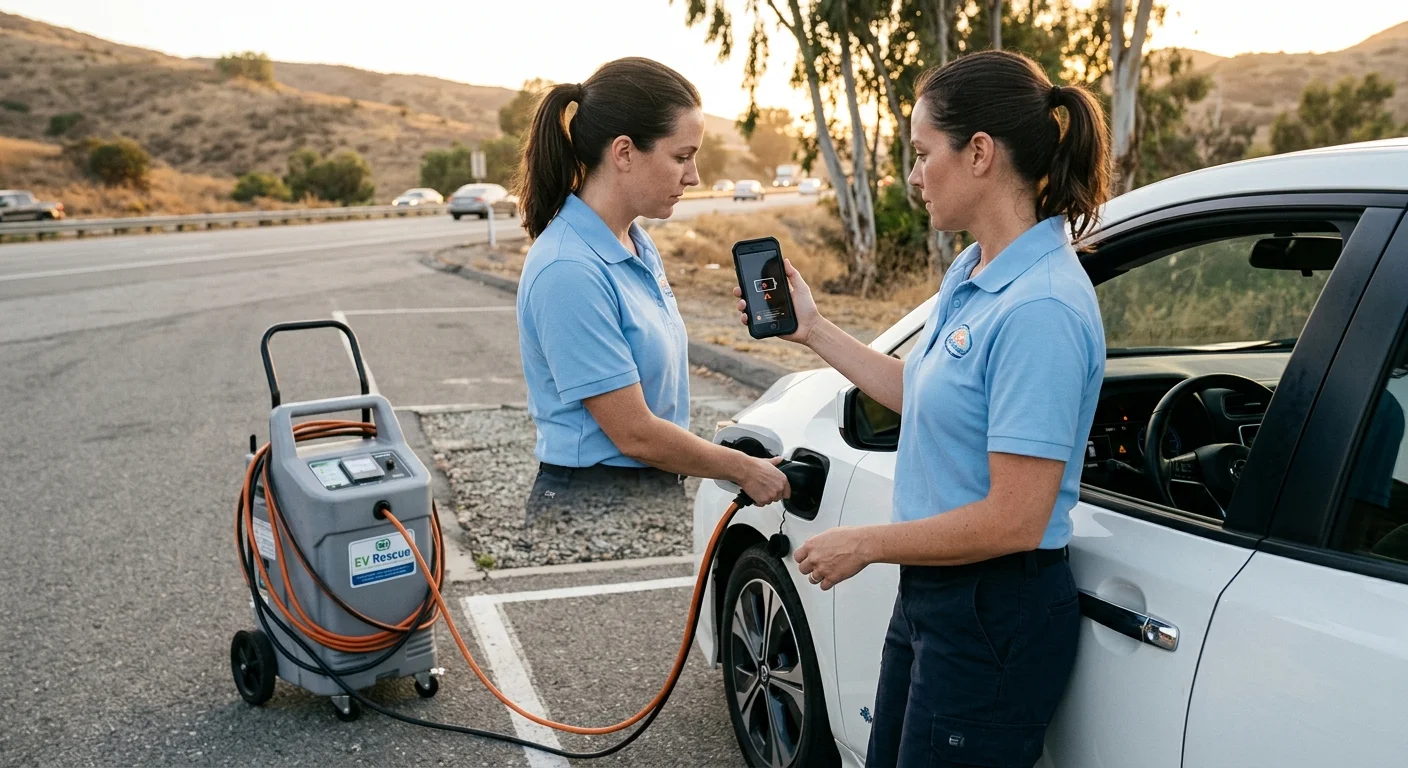
The pros we send can jump or replace a dead 12-volt on site. They can also bring a 240V Level 2 source if the traction pack is empty. That typically adds 10 to 20 miles of range in 15 to 30 minutes of charging. That’s charge time, not a promise of when someone arrives. If the 12-volt failed, a pack charge won’t wake the car until the small battery holds voltage.
Tesla factory roadside, as published, doesn’t charge you on site. It tows to a Supercharger or service center. Ford tows to the nearest charger, home, or dealer within 50 miles. If you need the car to wake where it sits, say that.
A shop still has a job after the car wakes
On-site work gets you moving. It doesn’t always finish the diagnosis. A cooked 12-volt can be the whole story. It can also hide a DC-DC converter that isn’t topping the battery off. Your service center is the place for that test.
Bring the same timeline. When the first blackout happened. What the jump changed. How long power lasted. Note where it sat in the sun. Sky Harbor and a Tempe lot both bake a 12-volt. So does a garage by State Farm Stadium in Glendale, Arizona. Heat soak after a Cardinals game, or a Suns night at Mortgage Matchup Center, is a real pattern.
Ask the advisor to check the 12-volt first. Owners sometimes assume the traction pack failed because the car is an EV. The big pack usually isn’t why a jumped car dies again. See our notes on 12-volt replacement signs before it strands you.
APS and SRP split much of the Valley, sometimes block by block. Home charging on APS’s R-EV overnight plan doesn’t prevent a 12-volt failure on the road. Confirm your own address with the utility. Arizona doesn’t run an annual safety inspection. EVs are exempt from Maricopa County emissions testing.
Get somewhere safe, then replace the 12-volt
If the operator can wake the car, don’t treat that as a long-term fix. Drive to a shop, or have the 12-volt replaced, before the next parked day in July heat. Older West Valley streets in Sun City and Youngtown have housing that has baked for decades. Newer Pinal County suburbs, including the city of Maricopa on the SR-347 commute, have more home charging. The 12-volt still sits in the same desert.
If the car won’t wake at all, stay with the timeline. Don’t keep cycling a failing jump. EV roadside assistance can connect you with a local operator after a 12-volt fails twice. For the lockout pattern, see what happens when an EV’s 12-volt dies in desert heat.
The U.S. Department of Energy’s electric vehicle overview is general background. It can’t diagnose your second blackout.
If the 12-volt has already died twice after a jump, call Charge Pro PHX at (602) 932-0920. We’ll connect you with an independent local operator. That operator quotes the work before starting and bills you directly.