The best roadside assistance for Tesla in 2026 matches the stall. Tesla’s factory program tows you to a Supercharger or a service center. A local operator can put 240-volt power into the car where it sits.
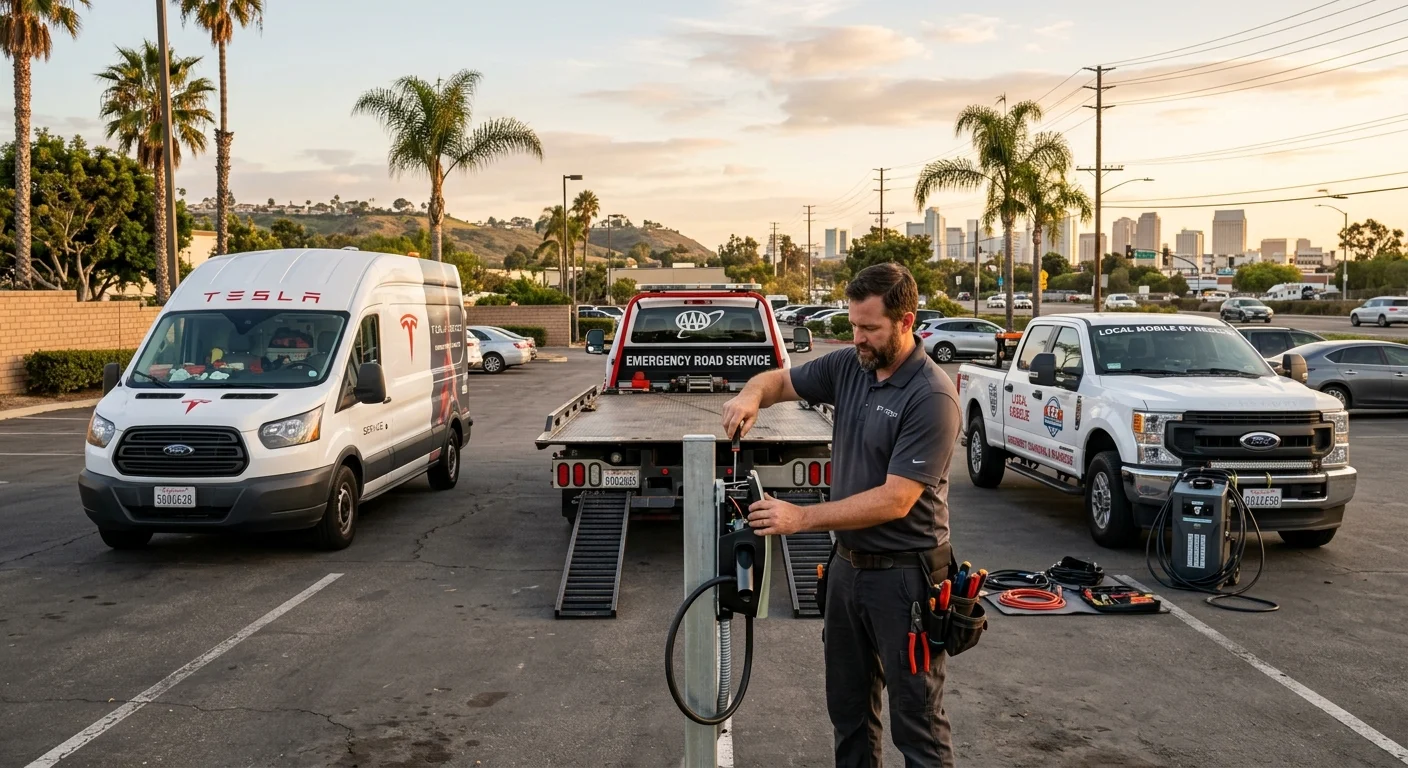
That split decides most Valley Tesla calls. An empty pack on I-17 north of Anthem is a charge problem. A car that won’t wake at Sky Harbor is often a 12-volt failure. A long tow still has a place, but it’s not the only tool.
Charge at the car, or tow to a Supercharger
Factory help and a local operator solve different jobs. Tesla doesn’t charge you on site. The factory path is a tow to the nearest Supercharger or Tesla service center. You wait for a flatbed, then you wait at a Supercharger with a dead car.
A local operator brings a Level 2 source to the bumper. Teslas take a native NACS plug. Charging time is typically 15 to 30 minutes. That window is time on the plug, never an arrival promise. Operators we connect you with often add about 10 to 20 miles. That’s enough to roll to a Supercharger or home on your own power.
AAA sits in the middle, so confirm the details with them. Some memberships include a long tow. Some advertise EV help. This page couldn’t verify a Phoenix-area AAA dispatch that charges a Tesla at the curb. Call AAA before you need it. Ask whether they send a mobile charge or only a tow.
For more on that factory split, read Need a charge on the spot, or a Tesla tow to a Supercharger.
Heat and grades change the stall
Phoenix averages about 111 days at or above 100F, and about 21 days hit 110F or more. July highs average near 107F. August sits near 105F, with overnight summer lows in the mid-80s. That’s NOAA’s 1991-2020 normal, via NWS Phoenix. Monsoon season runs June 15 to September 30.
Heat cuts range. AAA’s 2026 study found about a 10% efficiency drop at 95F versus 75F, and about an 8.5% range loss. Recurrent looked at 300 Phoenix-area EVs across 345,622 trips. It reported 20 to 30% range loss above about 95F, near 31% at 100F. Don’t treat those numbers as Tesla factory range. tesla.com wasn’t available to verify Tesla’s own figures.
The small 12-volt battery is the quieter trap. Battery Council International work, via Battery University, found starter batteries last about 47 months in hot climates versus about 59 in cool ones. AAA calls heat the top cause of battery failure. In a Tesla, a dead 12-volt can freeze the car even with a full pack. The 12-volt runs door handles, screens, and the contactor. Sentry Mode and Cabin Overheat Protection keep drawing while you’re parked. A week in a Sky Harbor garage is a classic version of that stall. Level 2 charging is confirmed in the Terminal 3 garage, the Terminal 4 garage, and at the 24th St. station.
Phoenix sits about 1,135 feet at Sky Harbor. Northbound I-17 is a different drive. Anthem is about 1,860 feet, New River about 2,140, and Black Canyon City about 2,000. ADOT posts a 6% maximum grade on that northern climb. Forum drivers have reported about 40% more energy going up than coming down, and the nav often underestimates it. Out of charge on I-17: Anthem toward Black Canyon City walks that corridor. The Beeline posts a 7% grade into Slate Creek Canyon toward Payson. Arizona has no toll roads. You can still empty a pack on a long, hot grade.
Home charging is common in newer East Valley housing such as Gilbert. Sun City is the opposite, with about 88.9% of housing built before 1980.
Tesla factory roadside: a Supercharger, not a curb plug
Tesla knows the car. That’s the honest strength of factory roadside. You start from the Tesla app or Tesla’s roadside number. Dispatch knows the model and can see some diagnostics.
For an empty traction pack, the documented move isn’t a plug at the bumper. Tesla tows to the nearest Supercharger or service center. That can be the right call if the car can’t accept a charge. It’s the slow call if you only need miles.
This page doesn’t publish Tesla’s included-versus-billed list. Terms change with vehicle age and account. Confirm what your car still has in the app. Don’t assume an on-site charge. A longer look at that limit is in When Tesla roadside assistance won’t charge you on site.
Factory help also won’t quote a local operator’s on-site job. Tesla isn’t a mobile charging fleet. Charge Pro PHX isn’t Tesla, and it isn’t a tow company. We match stranded drivers with independent operators. They quote you before they start. They bill you directly.
AAA: ask if they’ll charge you, or only tow
If you already carry AAA, treat it as a tow network first. A long membership tow can matter when the car has to cross the metro. A trip from Buckeye to a shop in Tempe is a different job than a Level 2 charge at the bumper.
Don’t treat AAA as a proven mobile EV truck. Membership rules vary. This page couldn’t confirm that AAA dispatches on-site Tesla charging across Phoenix, Mesa, Scottsdale, or the West Valley. Ask AAA whether they will charge this Tesla where it sits, or only tow it.
If they only tow, you’re back to the factory pattern. You still need a Supercharger or a shop. For club towing versus a mobile charge, see When AAA can’t charge you, a mobile EV operator can. Phoenix-specific notes live in Tesla rescue in Phoenix: AAA or a mobile charge.
State trucks will change a tire. They won’t charge a Tesla
Arizona does run free motorist help.
Arizona DPS Roadside Motorist Assistance works statewide. It changes tires, brings gasoline or diesel, jump-starts dead batteries, adds water, and calls tows. Published materials name gasoline and diesel. They say nothing about EV charging or an empty traction pack.
ADOT’s Incident Response Unit works Phoenix-area freeways from 5am to 8pm on weekdays. It’s a 14-member unit, sponsored by State Farm since 2020. It clears crashes and debris, changes tires, and helps stranded drivers. It doesn’t advertise charging an EV.
A DPS or ADOT stop can still keep you safer on the shoulder. It isn’t a Level 2 charge. That gap is what an independent mobile operator fills.
What the operators we send actually do
Charge Pro PHX is a referral line. We don’t own rescue trucks. We don’t employ technicians. We don’t set prices or arrival clocks. We connect stranded Tesla drivers with independent local operators.
Those operators bring a 240-volt Level 2 source to the car. Teslas take a native NACS plug. Non-Tesla EVs use a CCS or J1772 adapter. Operators can also jump or replace a dead 12-volt on site. They handle Tesla and every major EV brand. Typical charging time is 15 to 30 minutes. Typical added range is about 10 to 20 miles. That’s time on the plug, not a dispatch promise.
If you want the hardware picture, read How a mobile EV charging truck actually helps you. Tesla-specific matching is on our Tesla roadside rescue page. A quote happens before work starts. The operator bills you, and you can decline.
When you should still take the tow
A mobile charge is the wrong tool sometimes. If the car won’t accept power, stop guessing. If a tire is shredded on I-10, you need a flatbed, not a plug. If the high-voltage pack has a fault, Tesla service is the destination.
Long rural miles also change the math. Wickenburg, Gila Bend on I-8, and Black Canyon City sit farther out. A local operator may still reach you. A factory tow may still be what Tesla offers. Confirm both before you pick. This page won’t guess the distance to the next charger.
Event nights add drain. Mortgage Matchup Center downtown and Chase Field empty packs in parking structures. State Farm Stadium is in Glendale, Arizona. Phoenix Raceway is in Avondale, not Phoenix, despite the name. That’s often a 12-volt jump at the stall.
US-60 is two different roads in one number. Grand Avenue runs northwest. The Superstition Freeway runs east. Loop 101 is Agua Fria on the west and Price on the southeast. Maricopa the city is in Pinal County, not Maricopa County. Salt River, Gila River, Fort McDowell, and Ak-Chin are sovereign nations with their own police. Stay put and call for help.
If you stall, get off the travel lane
ARS 28-871 says you can’t sit on the traveled highway when you can get off it. A vehicle disabled so badly it can’t move is exempt. Leave room for traffic to pass. Stay visible 200 feet each way.
ARS 28-775 is the Move Over law. Drivers who approach a stopped car with lights should change lanes when they can. If they can’t, they must slow down. That’s why an operator on the shoulder needs other drivers to give space.
Police can order a disabled car removed under ARS 28-872. Owners pay reasonable tow and storage before release. Arizona sets no statewide private-tow rate cap. Cities and counties may set local maximums. Confirm any tow bill with the yard before you pay. This page won’t invent a Phoenix tow rate.
Monsoon storms bring flash floods. Don’t drive around a barricade into water. ARS 28-910 can bill you for the emergency response if you do. A stalled Tesla in a wash is a tow, not a charging stop.
Pick by the symptom, not the logo on the card
If the screens are dead and the doors won’t open, start with the 12-volt. A local operator can jump or replace that battery at the car. Confirm what Tesla will do for a 12-volt call on your account.
If the car is awake and the pack reads empty, decide between a curb charge and a Supercharger tow. Tesla’s default is the tow. A local Level 2 truck is the curb charge. AAA might be either, so ask them.
If you only keep one option, keep the one that matches your usual stall. Commuters on Loop 101 and Loop 202 run empty more than they need a long tow. People who want factory diagnostics still want Tesla’s own channel. Don’t buy every membership just to feel covered.
Call for a local quote, not a promise
If you want an on-site charge or a 12-volt jump, call (602) 932-0920. Charge Pro PHX will match you with an independent operator. That operator quotes you before starting. Nobody here promises an arrival clock. Tesla tows to a Supercharger. A local operator can charge the car where it sits.