Your Tesla is dark on the I-10 shoulder past the Broadway Curve. The club card in the console says AAA. Arizona DPS will change a tire or bring gasoline. It won’t charge an EV. That’s why Phoenix Tesla drivers call an independent operator. They need miles at the car, or a 12-volt jump.
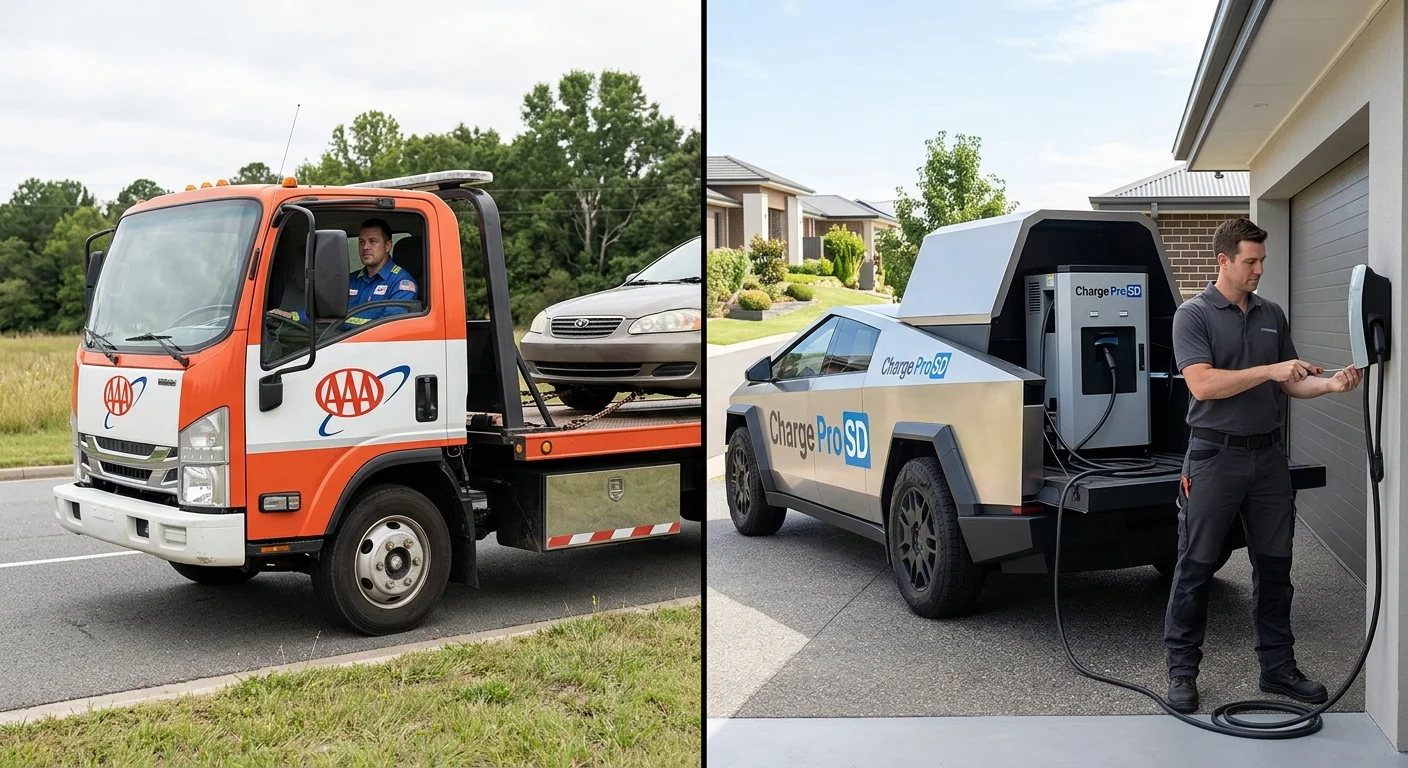
What Arizona sends, and what it doesn’t
Arizona runs two free motorist programs in this metro. Neither program advertises an EV charge. Arizona DPS Roadside Motorist Assistance, called RMA, is statewide. It changes tires, provides gasoline or diesel, and jump-starts dead batteries. It also adds water and calls for tows. Its published pages name gasoline and diesel. They don’t mention charging an EV.
ADOT’s Incident Response Unit covers Phoenix-area freeways. Hours are 5am to 8pm on weekdays. It’s a 14-member unit, sponsored by State Farm since 2020. It clears crashes and debris, changes tires, and helps stranded drivers.
On I-17, Loop 202, or SR-51, the state can help with a flat. It isn’t the call for a Level 2 charge at the bumper. Read the tire-versus-charge split in Tesla flat tire coverage, and the Arizona motorist help gap.
AAA is a membership club for mixed vehicles
AAA sells yearly coverage, and you pay whether you use it or not. The club sends general roadside help for mixed vehicles. That mix includes gas cars, lockouts, flats, and battery jumps. A Tesla on the Papago Freeway sits in the same queue.
Public Arizona materials don’t confirm that AAA will charge a Tesla on site. Ask AAA what your plan actually covers. If they can’t add miles at the car, you’re usually looking at a tow. It moves the car to a Supercharger or a shop. Confirm current AAA terms before you count on them. A card in the glove box is not a mobile charger.
The same fork is in When AAA can’t charge you, a mobile EV operator can.
Tesla’s own roadside tows the car
Tesla’s app is the other first tap for many owners. For an empty pack, Tesla doesn’t charge you on site. It arranges a tow to the nearest Supercharger or service center. That policy is Tesla’s, not a local operator rule.
A Model Y in Ahwatukee still needs miles at the car. Factory help is still right for some tire and lockout calls. For a dead traction battery, Tesla’s path is a tow. The 2026 comparison is in Tesla roadside in 2026: factory, AAA, or a local operator.
What a mobile operator brings to the car
We match stranded EV drivers with independent local operators. We don’t own trucks, and we don’t employ technicians. We don’t set prices, and we don’t promise an arrival time. The operator quotes you before they start, then bills you directly.
The operators we connect you with bring a 240-volt Level 2 source. Teslas use a native NACS plug. CCS and J1772 adapters cover other EVs. Typical charging adds about 10 to 20 miles. That takes 15 to 30 minutes of charging at the car. That’s charging time, not a clock on when someone shows up. It’s often enough to reach a Supercharger, a home plug, or work.
If the 12-volt is dead, they can jump it on site. The Tesla jump point sits behind the front bumper tow-hook cover. A dead 12-volt can lock the doors and blank the screen. For Tesla dispatch, use Tesla roadside rescue. For the rig itself, see How a mobile EV charging truck actually helps you.
Heat, Sky Harbor, and the 12-volt that dies first
Phoenix sees about 111 days a year at or above 100F. About 21 days reach 110F or more. July highs average near 107F, and overnight lows stay in the mid-80s. At 115F, an EV can lose 20 to 30 percent of range. Heat is the number-one cause of 12-volt failure. A five-year battery elsewhere can fail in two or three here. That’s why a Tesla can stall here with a full pack.
Sky Harbor is the airport version of that stall. You leave a Tesla in a Terminal 3 or Terminal 4 garage. Or you park in the East Economy lots for a week. Heat plus Sentry Mode drains the small battery. You come back to a car that won’t wake. Level 2 charging is on site at the airport, after EVPassport’s 2022 install. Stalls sit in the Terminal 3 and Terminal 4 garages. There’s also charging at the 24th St. station. None of that helps if the 12-volt already dropped. The car won’t take a plug until someone wakes it.
Downtown and midtown apartment towers drive the other cluster. Many stalls have no home charger. The I-10 or I-17 commute then ends at single digits. Deer Valley, Maryvale, Laveen, and South Mountain sit on those corridors. About 41.6% of Phoenix housing was built before 1980. Older streets weren’t wired for a wall unit. The car sat in heat without a cord. See When Tesla 12-volt batteries fail in desert heat for the small-battery path.
The I-17 climb, and the rest of the map
Northbound I-17 is the main range scare. Phoenix sits near 1,135 feet. Anthem is about 1,860, and New River is about 2,140. Black Canyon City is about 2,000, and Sunset Point is about 3,410. Cordes Junction is about 3,800 before the drop into Camp Verde. ADOT posts a 6% maximum grade on northern I-17.
Uphill uses more energy than the nav often predicts. Slow down, and ease off the climb. An operator can meet the car on I-17 with a Level 2 source. They can add enough miles to reach Camp Verde. Ask about the quote and the drive before they roll.
The Beeline, SR-87 toward Payson, also gains thousands of feet. Charge in the Valley first when you can. Fountain Hills is the last dense stop before that grade. Event nights at Chase Field and Mortgage Matchup Center drain range in downtown garages. Don’t treat a haboob as a charging problem. Monsoon season runs June 15 to September 30. ADOT’s rule is “Pull Aside, Stay Alive.” Get off the traveled lanes if you can. Cut extra draw, and call before the phone dies.
Shoulder rules while you wait
ARS 28-871 limits stopping on the traveled part of a highway. That’s outside a business or residence district, if you can get off it. A vehicle disabled so badly it can’t move is exempt. Leave room for other traffic to pass. Stay visible 200 feet in each direction.
ARS 28-775 is the Move Over law. Move over a lane for a stopped vehicle with warning lights. If you can’t move over, slow down. Arizona has no toll roads and no toll express lanes. Texts about unpaid Arizona tolls are scams.
Phoenix is the densest EV market in Arizona. Arizona had about 141,800 battery EVs as of 2025. Nearby Mesa, Tempe, Chandler, and Gilbert feed the same freeways. The local map starts at EV charging and rescue in Phoenix.
Which number to use
Keep the AAA card for mixed household cars. Use it for a Tesla tire if that’s what failed. Call an independent operator when the pack is empty or the 12-volt is dead. We don’t publish business hours, and we don’t quote a wait. The operator who takes the job quotes the work. Then they come from where they are.
Call Charge Pro PHX at (602) 932-0920 when you want that match. Say if you’re on I-10 or I-17. Name a Sky Harbor garage or a midtown lot. Say whether the screen is dead or the range hit zero. The operator quotes before they start, then bills you. We only make the match.