A home battery in the garage and a mobile EV operator at the car are two different answers to two different questions. The Phoenix monsoon season and 100-degree parked cars sharpen both questions, and many drivers end up needing both.
What each one is for
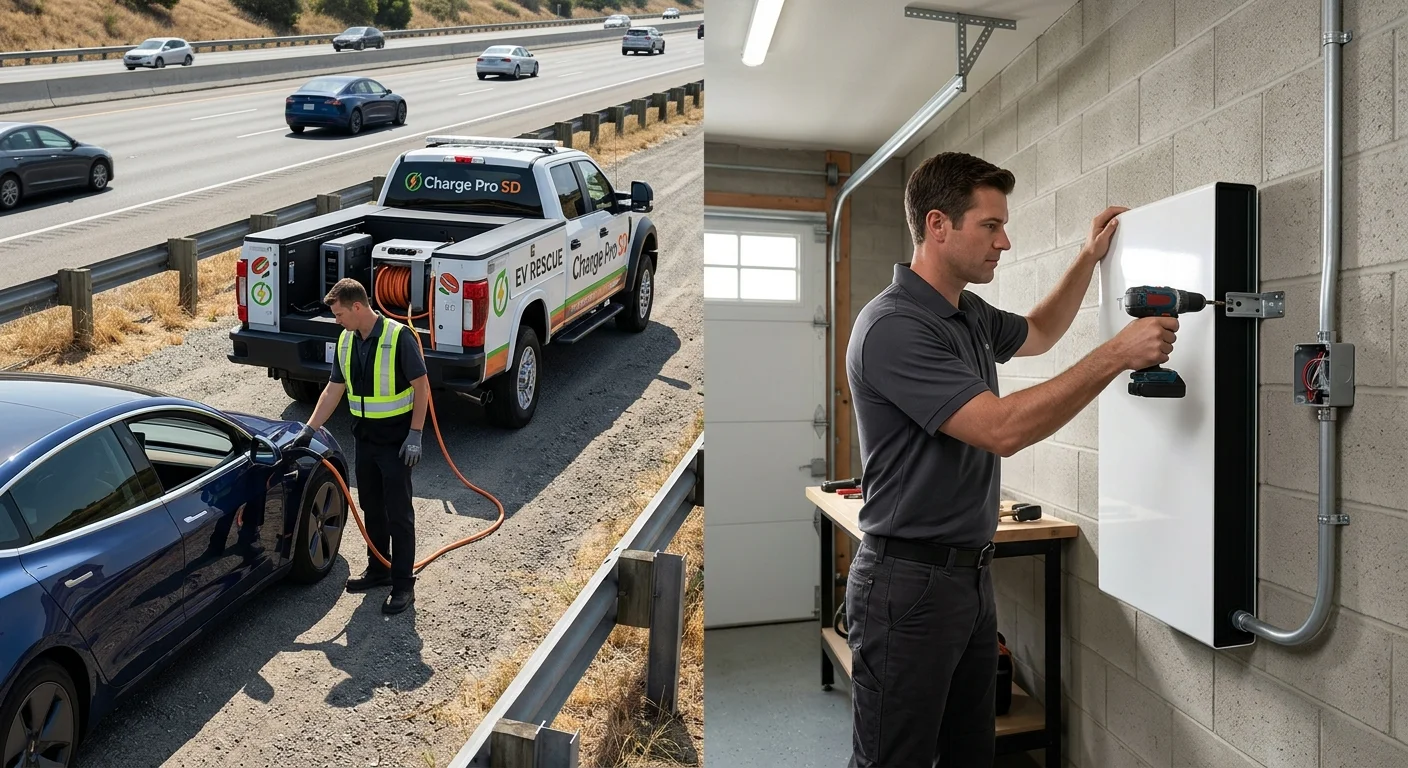
A home battery, also called a stationary storage battery or a backup battery, sits in the garage and powers the house during an outage. It does not move. It is paired with solar or with grid charging and is sized in kilowatt-hours of capacity. Its job is to keep the fridge, the AC, and a few circuits running when APS or SRP is down.
A mobile EV operator brings a portable 240-volt Level 2 source to where the car sits, plugs in with the right connector, and adds real miles to the traction pack while you wait. The truck carries a native NACS plug for Teslas and CCS or J1772 adapters for other major brands. A typical session adds about 10 to 20 miles of range in 15 to 30 minutes of charging. The job is to give your car enough energy to reach a charger you already meant to use, or enough to make it home on a slow top-up.
For the deeper picture on what mobile Level 2 adds at the car, see roadside Level 2 charging for stranded drivers.
Why monsoon season sharpens the question
Phoenix monsoon season runs June 15 to September 30 and brings haboobs and flash floods. ADOT’s guidance for haboobs is “Pull Aside, Stay Alive”: pull off the road, turn off the lights, set the parking brake, and take your foot off the brake pedal so your lights are not the only thing visible.
Monsoon-driven power outages are real and frequent in parts of the Valley. A home battery keeps the fridge and the AC running when the grid is down. It does not charge an EV. A car plugged into a Level 2 wall charger that has lost grid power will not charge, because the charger needs grid power or a home battery that is wired to it.
A mobile EV operator is the answer when the car is the problem, not the house. If your car is dead at the office and the office has power, a mobile operator can come to you. If your car is dead at home and the house is out, the home battery does not help the car, and you still need a mobile operator or a tow to a charger.
Why 100-degree parked days change the home-charging math
A home Level 2 charger in a closed garage in Phoenix does not always deliver what the nameplate says. Charger handles and batteries derate above about 100F. An overnight charge that normally takes four hours can stretch past seven in July in a closed garage.
That is not a charger problem. It is a thermal protection problem. The car is protecting the traction pack. The fix is to keep the garage ventilated. A side door open, a fan running, or a garage that is detached and shaded all help.
A home battery does not fix the derating problem. The traction pack is still hot, and the car is still going to slow the charge to protect itself.
For the broader picture on what a hot parked day does to an EV, see EV battery care in Phoenix heat.
When the two work together
A driver in a newer suburb with solar and a home battery has a strong home setup. The home battery covers outages. The Level 2 charger covers daily driving, with derating in summer. The car still needs a mobile operator when it dies on the road, because home equipment does not roll.
A driver in an older central Phoenix or Glendale home without solar and without a home battery has a weaker home setup. Outages hit the fridge and the AC. The car still needs a mobile operator when it dies on the road, and the home setup does not help the car at all.
For the broader picture on home charging versus a mobile rescue, see Home 240-volt charging versus a mobile rescue.
When mobile charging is not the right answer
A mobile Level 2 visit is the right move when the traction pack is empty but the car will wake and roll, and the next charger is further than your current range will go. It is not the right move when the traction battery has a physical fault, when the car will not wake after a 12-volt jump, when the charge port is damaged, or when the car is in a tight indoor space where a generator cannot run. In those cases, a tow is the right answer.
For the broader principle of when a tow beats a charge, see mobile EV charging vs a tow.
What to do if your EV is stranded right now
If your EV is dead on a Valley road right now, get the car as far off the travel lane as you can and keep hazards on. Have a location ready: nearest cross street, exit number, or landmark.
Call (602) 932-0920. The operator quotes before any work starts and bills you directly.
Frequently asked questions
Does a home battery charge an EV during a power outage?
No. A home battery powers house circuits. The Level 2 charger needs grid power or a home battery that is wired to it. Most home battery installs are not wired to the EV charger.
Does mobile EV charging work during a monsoon outage?
Yes, if the operator can reach you. The truck runs its own generator. The power grid being out at your house does not stop the operator from rolling.
Why does my home charger slow down in summer?
The traction pack and the charger handle derate above about 100F to protect the battery. The car is doing its job. The fix is garage ventilation, not a different charger.
Does Charge Pro PHX install home batteries?
No. We match you with independent local EV charging operators. For a home battery install, talk to a licensed solar and storage installer in your area.