A Tesla left a week at Sky Harbor can wake with a dead 12-volt. The traction pack can still read full. Phoenix heat rewrites the EV maintenance schedule by brand. Sentry Mode and Cabin Overheat Protection keep drawing power while you park. Summer overnight lows in the mid-80s never let that small battery cool.
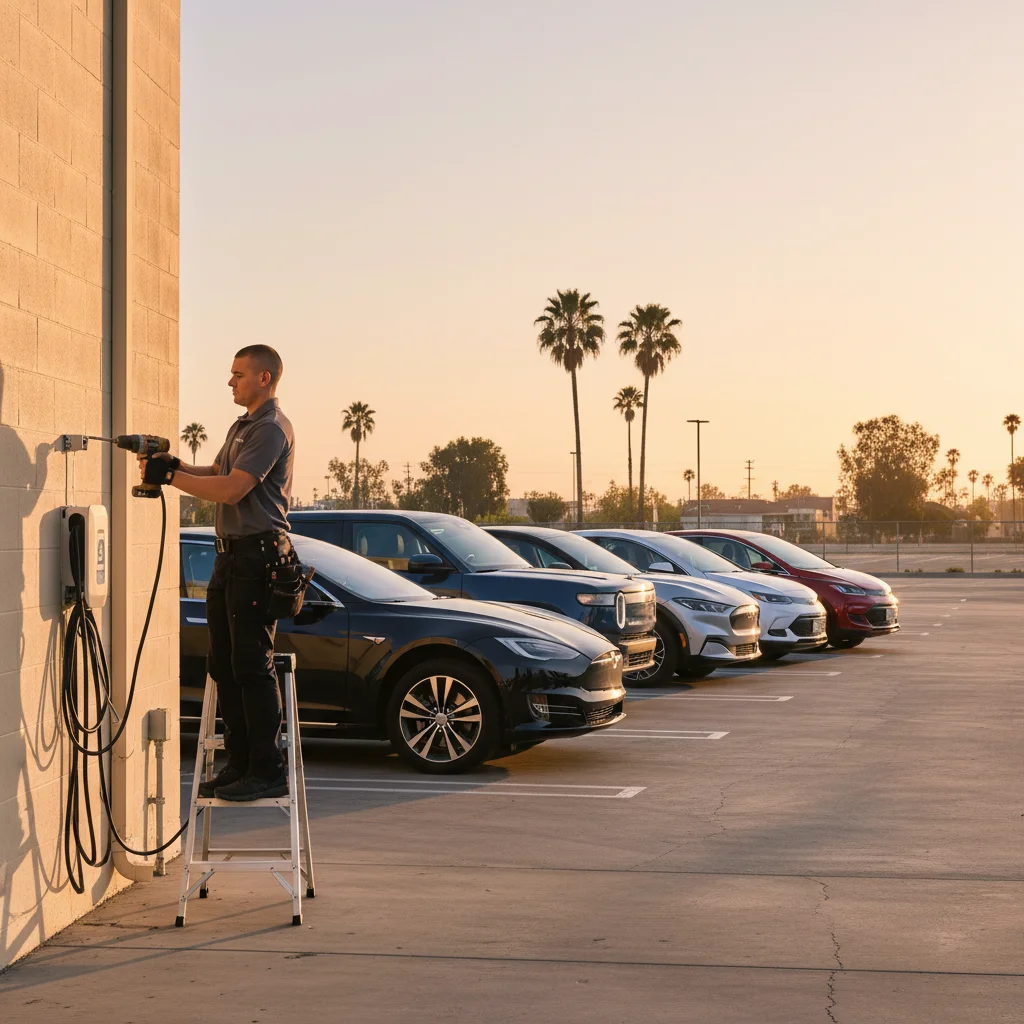
NOAA’s Phoenix normals put about 111 days at or above 100F. About 21 days reach 110F or more. July highs average near 107F. August sits near 105F. Recurrent used 345,622 trips from 300 Phoenix-area EVs. It found range can fall 20 to 30 percent above about 95F. Loss was near 31 percent at 100F. AAA’s 2026 study found about a 10 percent efficiency drop at 95F versus 75F. Range fell about 8.5 percent in that test. Those aren’t Tesla numbers. NREL still flags cabin cooling as a heavy draw. Geotab found faster pack wear above 27C. Extra loss is about 0.4 percent a year when those days exceed 35 percent.
Your owner’s manual still sets the interval. Confirm it for your model year, because brands edit these lists. The sections below are the published patterns owners still plan around. Desert use then changes which item fails first.
Heat puts the 12-volt first
Every EV still carries a small 12-volt battery. It wakes the screens, the handles, and the main-pack contactor. A DC-DC converter only tops it up while the car is on. Charging also replenishes it. When that little battery dies, a full traction pack won’t help. The car won’t unlock, boot, or roll.
Battery Council International work, via Battery University, puts hot-climate starter batteries near 47 months. Cool climates see about 59 months. A battery that lasts five years elsewhere can fail in two or three here. AAA calls heat the number-one cause of battery failure. It recommends AGM batteries for hot areas. Tesla’s parked features add drain on top of that heat.
Treat a no-start after a Sky Harbor trip as a 12-volt job first. Level 2 charging is confirmed in the Terminal 3 garage. It’s also in the Terminal 4 garage and at the 24th Street station. A week in a hot structure plus parked electronics is a classic Valley stall. When Tesla 12-volt batteries fail in desert heat walks through the pattern.
Tires, dust, and brake fluid stay on every brand’s list
EVs are heavy, and torque hits the patch at once. Check tire pressure every month. Rotate on the interval your brand publishes. Alignment matters on the I-17 climb. Anthem sits near 1,860 feet. New River is near 2,140. Black Canyon City is near 2,000. ADOT posts a 6 percent maximum grade on northern I-17. Drivers on that climb have reported about 481 Wh/mi up and 293 down. That’s roughly 40 percent more energy uphill. Soft or uneven tires make the nav’s guess worse. The Beeline toward Payson posts a 7 percent grade into Slate Creek Canyon. US-60 east rises through Apache Junction toward Superior.
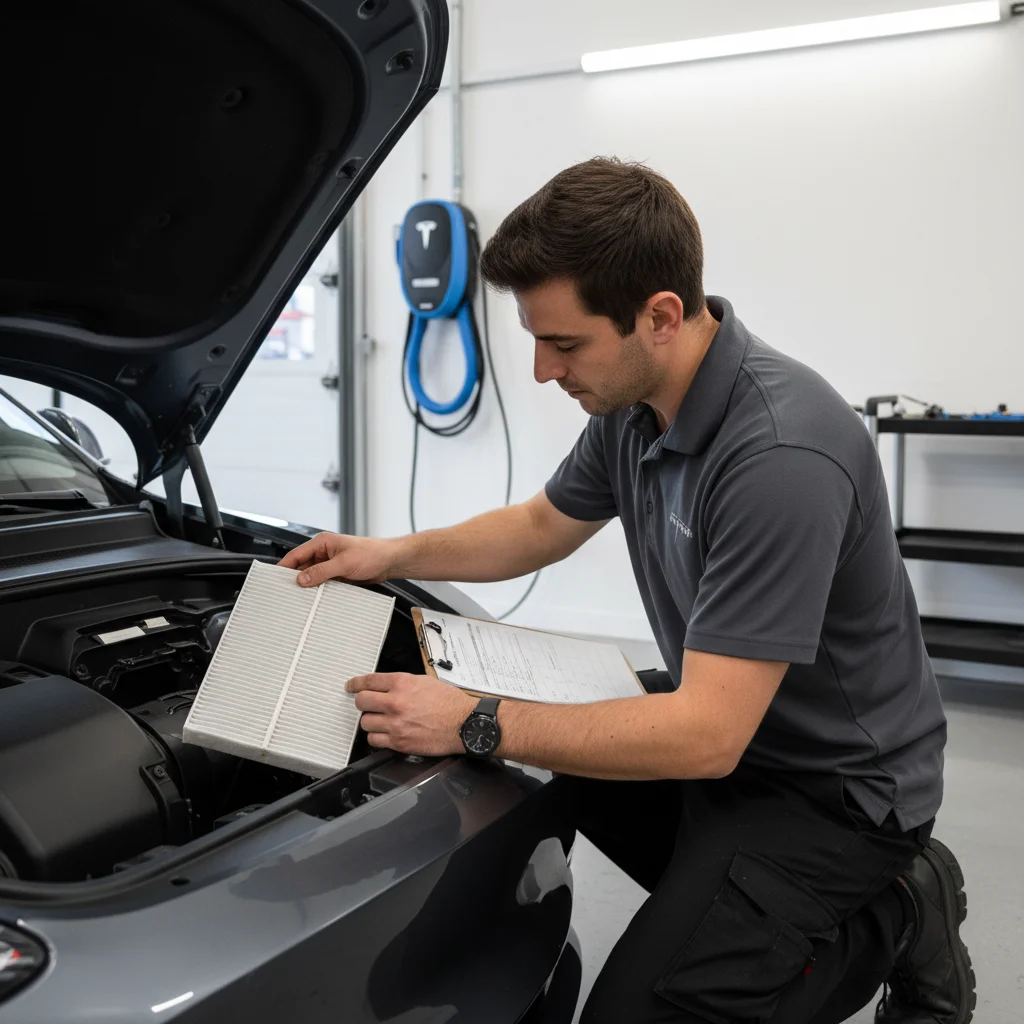
Cabin filters are a dust item here. Monsoon season is June 15 to September 30. Haboobs can drop visibility to near zero. That load hits HVAC filters faster than a mild-climate calendar assumes. If vents smell like dirt after a dust wall, replace the cabin filter. Don’t wait for the mileage box.
Regen saves pads. Brake fluid still takes on moisture. Rotors can rust when you almost never use the friction brakes. Inspect fluid on the brand’s interval. Thick pads don’t mean old fluid is fine.
Wiper blades and washer fluid sound minor until a haboob hits Loop 101. Replace blades when they streak.
Arizona won’t send a reminder sticker. EVs are exempt from Maricopa County emissions tests, and hybrids aren’t. The state has no annual safety inspection. You keep this calendar. For heat-specific pack care, read how Phoenix heat changes EV battery care. For the shared checklist, see the EV maintenance schedule owners actually need.
In newer East Valley and Pinal housing, home plugs are common. Gilbert, Surprise, Sun City West, and Maricopa skew new. The missed rotation or 12-volt still shows up on the road. Sun City’s housing is far older. Heat still cooks a 12-volt on those streets.
Tesla: rotations, fluid, filters, and the desiccant bag
Tesla dropped a mandatory yearly visit. It still publishes item-by-item service. Check the in-car service screen and the current manual before you book.
Published tire rotation is every 6,250 miles. Rotate sooner if any two tires differ by 2/32 inch of tread or more. That interval is tighter than several others. Weight and power are the reason.
Brake fluid gets a health check every two years. Replace it if the test shows contamination.
Cabin filters are typically due every two years. Newer Model S and X with HEPA list a three-year filter interval.
The A/C desiccant bag pulls moisture out of the system. Tesla’s published window is three to six years, by model. Model 3 and Model Y often list four years. 2012-2020 Model S often lists three.
The screen will flag some of this. It won’t always flag a 12-volt that sat on Sentry through a 107F afternoon. Cabin Overheat Protection is meant to spare people and interiors. It still draws the small battery while the car sits.
Rivian R1T and R1S: drive-unit fluid and air springs
Rivian’s trucks carry hardware a crossover never had. Confirm the current R1T or R1S book. Owners still plan around a few published marks.
Tire rotation is commonly listed every 7,000 miles. Alignment checks show up around 14,000 miles, or sooner if wear looks odd. That matters on the Superstition Freeway grades and on the I-17 climb.
Drive-unit fluid is the long-interval item many EVs omit. Rivian has published a 140,000-mile replace for the fluid in those motor gearsets. The interval is long, and skipping it is still a skip.
Air suspension needs a look. Published guidance has been to inspect for leaks or damage every 28,000 miles. The compressor filter has been listed at 56,000 miles.
Cabin filters run more often than Tesla’s. Annual, or every 14,000 miles, is the usual published pair. After monsoon dust, change on smell, not only on miles.
Brake fluid is typically a three-year replace on Rivian’s list.
Ford Mach-E and F-150 Lightning intervals
Ford still writes EV service as a simplified checklist. The backbone is a multi-point inspection every 10,000 miles, or at least yearly. Confirm your book’s wording. That visit usually covers tire rotation and a brake look. It also covers cooling hoses, half-shaft boots, and steering and suspension joints.
Cabin filters on Ford’s EV list are often 20,000 miles. After a dusty monsoon week, inspect sooner.
The F-150 Lightning’s AWD rear eAxle fluid has been published at 150,000 miles. That line isn’t a Mach-E line. Use the right manual.
High-voltage battery coolant is the long job. Ford has published a first replace at 100,000 miles, then every 50,000 miles after that. Heat makes the thermal loop work harder. It doesn’t create a new official number. If your glovebox differs, follow the glovebox.
Home charging is part of pack care here. APS markets the R-EV plan as EV Overnight Charging from 11pm to 5am on weekdays. It also names a Level 2 smart-charger rebate, APS Smart Charge, and Take Charge AZ. SRP’s Electric Vehicle Price Plan closed to new enrollment after a February 2025 board vote. Existing customers may stay through the November 2029 billing cycle. SRP also publishes an Electric Vehicle Export Price Plan for solar homes. It names a Marketplace Level 2 rebate, EV Smart Charge, and BizEV. Confirm the utility on your address. Phoenix, Chandler, Gilbert, and Tempe can split APS and SRP block by block. Glendale, Arizona, and Peoria, Arizona can split too. So can Scottsdale, Avondale, and Paradise Valley.
Hyundai Ioniq 5 and Chevy Bolt: short loops, long coolant
Hyundai and Chevy still use short inspection steps. They’re not the same steps.
The Ioniq 5 pattern is built on 8,000-mile marks. Rotate tires at 8,000. Inspect brakes, steering, and suspension at 16,000. Replace the cabin filter at 24,000. Inspect battery coolant at 40,000. Hyundai has published a first coolant replace at 120,000 miles. Later changes are every 40,000 miles after that. Brake fluid is commonly a two-year flush.
Bolt EV and Bolt EUV use 7,500-mile marks. Rotate tires and run a multi-point inspection at 7,500. Replace the cabin filter at 22,500. Brake fluid is commonly a five-year flush. At five years or 150,000 miles, Chevy’s major service drains and fills separate coolant loops. Those loops serve the battery, the power electronics, and the cabin heater.
Miles on SR-347 toward Maricopa, in Pinal County, accrue in heat. So do miles on I-10 toward Casa Grande. ED3 serves Maricopa with an EV TOU 2-10 rate and smart-charger on-bill financing. ED2 serves Casa Grande, Coolidge, and Florence. No EV-specific program was found on ED2’s site. Mesa Municipal Electric runs an E1EV time-of-use rate around downtown Mesa. A rate plan doesn’t rotate tires. It doesn’t test a 12-volt.
What a skipped item looks like on the shoulder
Charge Pro PHX is a referral line. It doesn’t perform shop maintenance. Independent operators meet you at the car. After a skipped 12-volt test, the stall is total. Doors, screens, and contactors all need that small battery. Signs your EV 12-volt needs replacement before it strands you is the home checklist. If it already won’t wake, the match is a Tesla 12-volt jump on site.
Arizona DPS Roadside Motorist Assistance will change a tire. It will jump a conventional battery. It will bring gasoline or diesel. Its published materials don’t advertise charging an EV. ADOT’s Incident Response Unit covers Phoenix-area freeways from 5am to 8pm on weekdays. It clears crashes and debris. It helps stranded motorists. It also doesn’t advertise an on-site EV charge. Empty pack is a mobile EV charging call. Use EV roadside assistance if you’re not sure which failure you have.
If you’re already on a traveled highway, follow ARS 28-871. Leave the travel lanes when you can. A vehicle that can’t move is exempt. Leave room to pass. Stay visible 200 feet each way. ARS 28-775 is the Move Over law. Other drivers must change lanes or slow for warning lights. That protects the person working your car.
Operators in the network bring a 240V Level 2 source to the car. Tesla owners get a native NACS plug. CCS or J1772 adapters cover other brands. Typical charging time adds 10 to 20 miles of range in 15 to 30 minutes. That’s plug time. It’s not an arrival estimate. They can also jump or replace a dead 12-volt on site. They handle Tesla and every major EV brand.
The operator quotes before starting. The operator bills you directly. Charge Pro PHX owns no trucks and employs no technicians. If you need a match in the Phoenix area, call (602) 932-0920.